
Chapter 1
Introduction to Parachute Rigging
Regulations and Human Factors
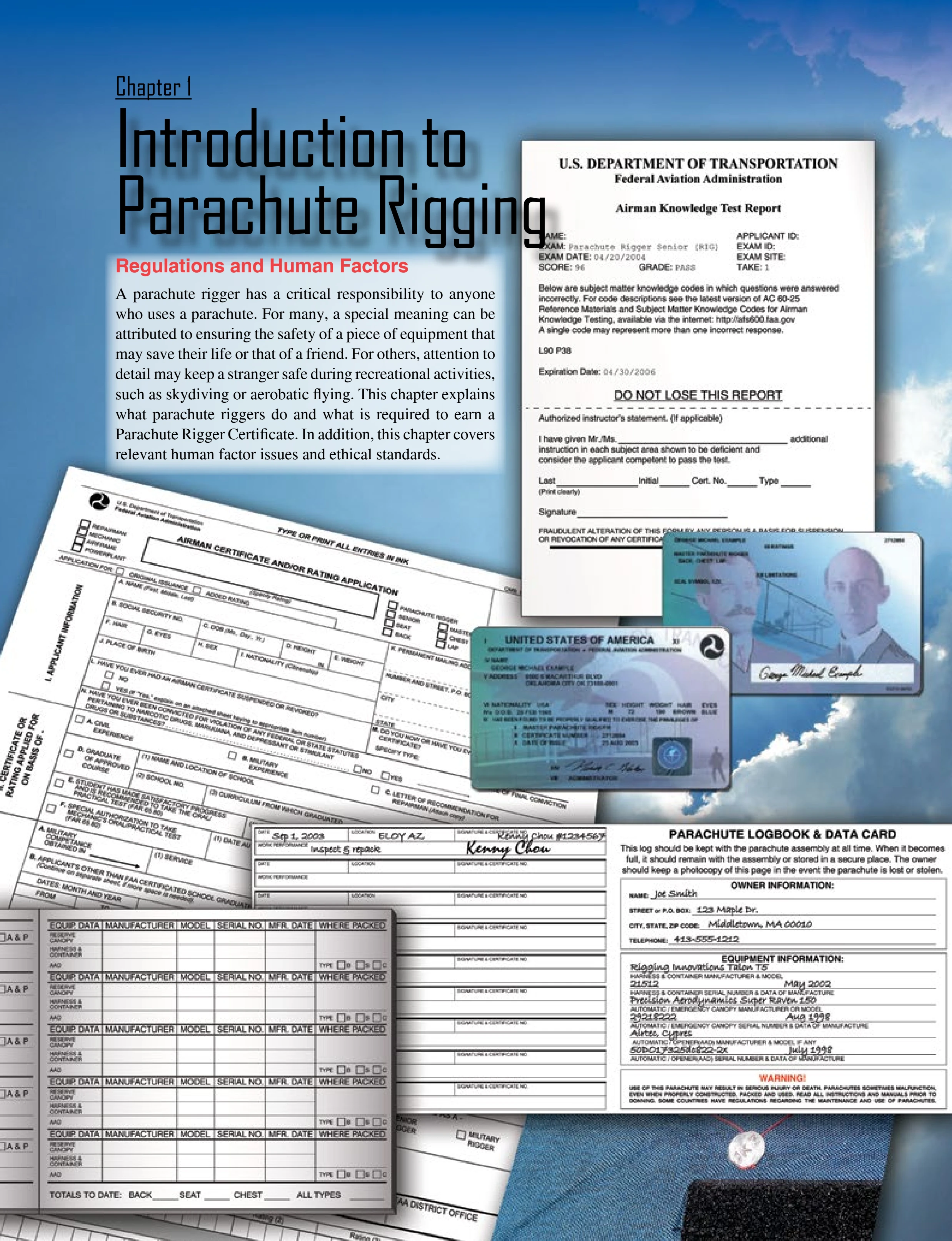
A parachute rigger has a critical responsibility to anyone who uses a parachute. For many, a special meaning can be attributed to ensuring the safety of a piece of equipment that may save their life or that of a friend. For others, attention to detail may keep a stranger safe during recreational activities, such as skydiving or aerobatic flying. This chapter explains what parachute riggers do and what is required to earn a Parachute Rigger Certificate. In addition, this chapter covers relevant human factor issues and ethical standards.
The term “rigger” originated in the 16th Century and referred to a person who organized, repaired, and maintained sails and lines aboard sailing ships. The rigger was not a high-ranking individual aboard the ship, but he was an essential technician that could not be done without. Likewise, parachute riggers, as indispensible as they are, must operate within strict boundaries set forth by the Federal Aviation Administration (FAA). When parachutes were developed in the early 20th Century, those who sewed the canopies and lines became known as “riggers.” In those first decades, anyone with some knowledge of sewing and materials could make or repair parachutes. As the aviation industry grew and matured, the need for trained individuals to pack and maintain the parachutes grew as well. In order to protect the pilots and public who flew in airplanes and relied on parachutes, the government began to license these individuals. Rigging, in reference to parachutes, came to mean: the final adjustment and alignment of the various component sections to provide the proper aerodynamic reaction.
Parachute Rigger Certificates
Parachutes intended for emergency use in civil aircraft in the United States, including the reserve parachute of a dual parachute system to be used for intentional jumping, must be packed, maintained, or altered by a person who holds an appropriate and current Parachute Rigger Certificate. The certificate is issued under Title 14 of the Code of Federal Regulations (14 CFR), part 65, subpart F. These regulations do not apply to an individual who packs the main parachute of a dual parachute pack to be used for intentional jumping.
These regulations also do not apply to parachutes packed, maintained, or altered for use by the Armed Forces.
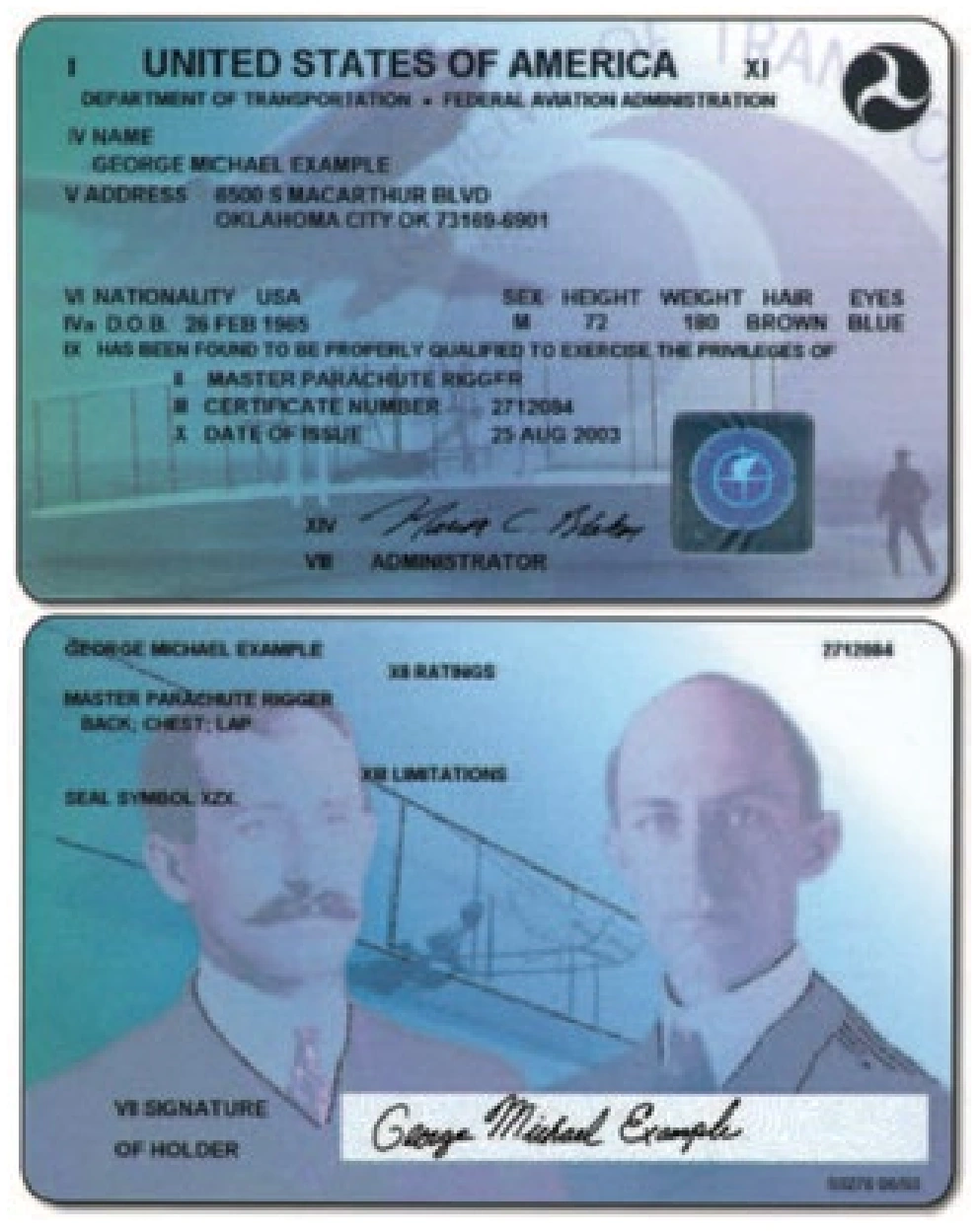
Any person who holds a Parachute Rigger Certificate must present it for inspection if requested by the Administrator or an authorized representative of the National Transportation Safety Board (NTSB) or any federal, state, or local law enforcement officer. A sample certificate is shown in Figure 1-1.
Eligibility and Requirements
To be eligible for a Parachute Rigger Certificate issued by the FAA, individuals must be at least 18 years of age; be able to read, write, speak, and understand the English language; and comply with other requirements of 14 CFR, part 65, subpart F, which governs the certification of parachute riggers.
There are two levels of Parachute Rigger Certificate available in the United States: senior and master. The Senior Parachute Rigger candidate must pack a minimum of 20 parachutes of one type and be able to demonstrate the ability to maintain and make minor repairs. The Master Parachute Rigger candidate must have 3 years of experience as a parachute rigger and have packed at least 100 parachutes of two types in common use (for a total of 200 pack jobs). There are four type ratings that may be placed on a Parachute Rigger Certificate: back, chest, seat, and lap. Of these, the first three are used today. The lap rating applies to parachutes that are basically obsolete. A Senior Parachute Rigger is considered a journeyman technician, and the Master Parachute Rigger is considered an expert.
The two types of certificates differ in the level of experience and responsibility. A Senior Parachute Rigger may pack, as well as maintain, a parachute by making minor repairs. A Master Parachute Rigger has all the privileges of the lesser certificate plus the ability to make major repairs and alter parachutes according to approved data. A major repair is one that, if improperly done, can appreciably affect the airworthiness of the parachute. An example of a major repair might be replacing a damaged canopy panel or altering a harness by changing the size of a main lift web. A minor repair is anything other than a major repair, such as a small patch on a canopy or the replacement of a defective or worn connector link.
Earning a Parachute Rigger Certificate
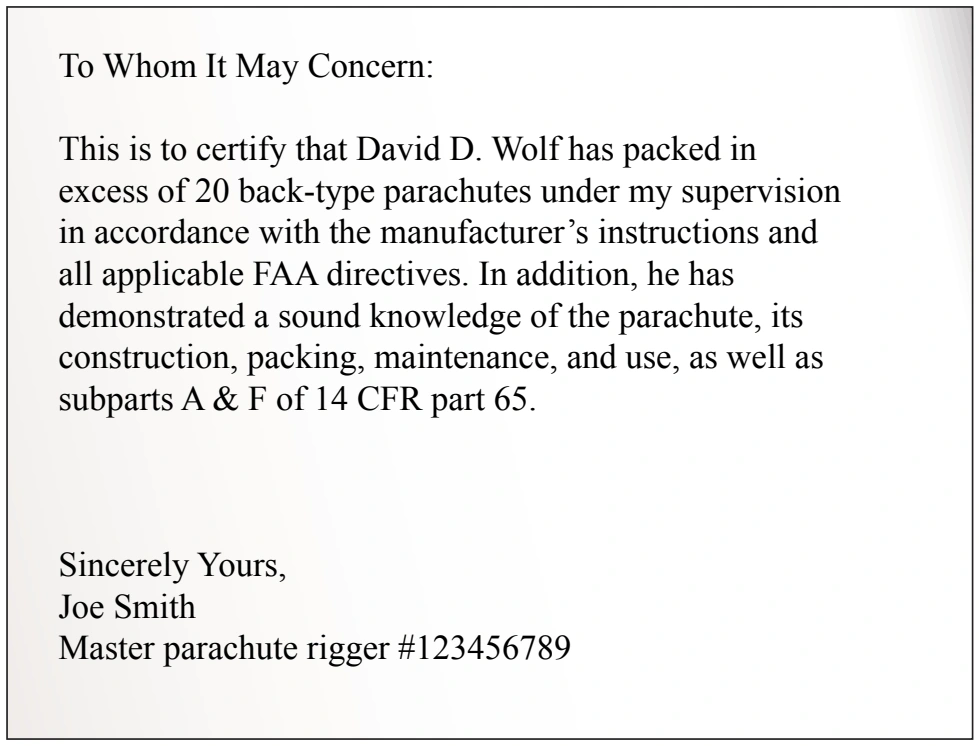
When an applicant meets the requirements and demonstrates sufficient knowledge and skills as outlined in 14 CFR part 65, subpart F, the supervising parachute rigger (either a senior or Master Parachute Rigger) “signs off” on the trainee’s logbook and provides a letter to the FAA that allows the applicant to take the necessary tests. [Figure 1-2]
Once the rigging candidate has successfully achieved a rigger's certificate, they can now begin to learn through experience. Rigging is best learned through apprenticeship; however, it takes a lot of time to become intimately familiar with materials, learn how to identify stains, and experience packing the myriad of sport parachute systems.
Testing
The applicant should take a letter similar to the one depicted in Figure 1-2, the applicant’s logbook, and any other necessary identification to the nearest FAA Flight Standards District Office (FSDO) or International Field Office (IFO). An FAA Aviation Safety Inspector (ASI) (airworthiness) examines these documents for completeness and eligibility. The applicant is asked to fill out FAA Form 8610-2, Airman Certificate and/or Rating Application. When the inspector has determined that the applicant is eligible to take the test, he or she signs the FAA Form 8610-2. [Figure 1-3] Once this is done, the applicant may then go to any of the designated FAA airman knowledge testing centers to take the airman knowledge written test.
The knowledge test consists of 50 multiple-choice questions that are not designed to be tricky or misleading. They cover all basic rigging and packing subject areas in addition to 14 CFR part 65 regulations. A minimum score of 70 percent is required to pass the test. The test is scored immediately on conclusion of the test and a Certified Airman Knowledge Test report is issued to the applicant. [Figure 1-4] After passing the test, the candidate may then make an appointment for taking the oral and practical portion of the test with a Designated Parachute Rigger Examiner (DPRE).