
Chapter 2
Design and Construction
For the aspiring rigger, the primary purpose of knowing the TSO system is determining the compatibility of components when assembling the parachute system. This is necessary in order to ensure that, besides fitting together properly, the performance standards are compatible. Under Advisory Circular (AC) 105-2, Sport Parachute Jumping, “the assembly or mating of separately approved components may be made by a certificated and appropriately rated parachute rigger or parachute loft in accordance with the manufacturer’s instructions and without further authorization by the manufacturer or the FAA.” Under these guidelines, there are certain parameters that must be met. One of them is to ensure that “the strength of the harness must always be equal to or greater than the maximum force generated by the canopy during the certification tests.” Full knowledge of the TSO documents ensures that the above requirements are met.
Canopy Design
Accomplished design skills are not necessary for the rigger to properly service parachutes. The skills involved to become a designer can take several years of training and practice. It is necessary, however, that the rigger understands some of the basic concepts to relate the performance characteristics to the design theory of the components involved. For the average rigger, these concepts are accepted as those proven and tested in the finished product. The following are specific areas that the rigger should understand to determine the identity, function, and assembly of parachute components and their interaction.
Understanding the sequence and method of deployment is necessary when assembling components to assure proper function. Most ram air parachutes are trimmed nose down, and as such the canopy tries to fly over its nose during deployment. This flight angle causes the top skin nose of the canopy to roll over the bottom skin leading edge closing off the cell preventing inflation. To counter this, the trailing edge of the canopy is deflected downward to apply brakes during inflation; this holds the nose up and open allowing air intake. These are called “deployment brakes” and are implemented by providing a “brake eye” in the steering line of the canopy located so as to apply the proper amount of brakes. The steering line is pulled down through the steering guide ring on the risers and locked with the nose of the steering toggle during the packing process. Loss of one or both brakes during opening will most likely cause a malfunction. Loss of one causes the canopy to turn into that side as the cells remain collapsed and the inflated side over-flies the collapsed side. In flight corrective action is to grab both toggles and apply both brakes evenly and quickly.
Nomenclature
All riggers should become familiar with Parachute Industry Association (PIA) Technical Standard 100 (TS-100), Standardized Nomenclature for Ram-Air Inflated Gliding Parachutes (See Appendix I). This document is the official language and terminology used for ram-air parachutes. It specifies the parts of the parachute, the various construction methods, and the seam configurations used. This is necessary for the rigger to understand the manuals and repair procedures provided by the manufacturers for their products.
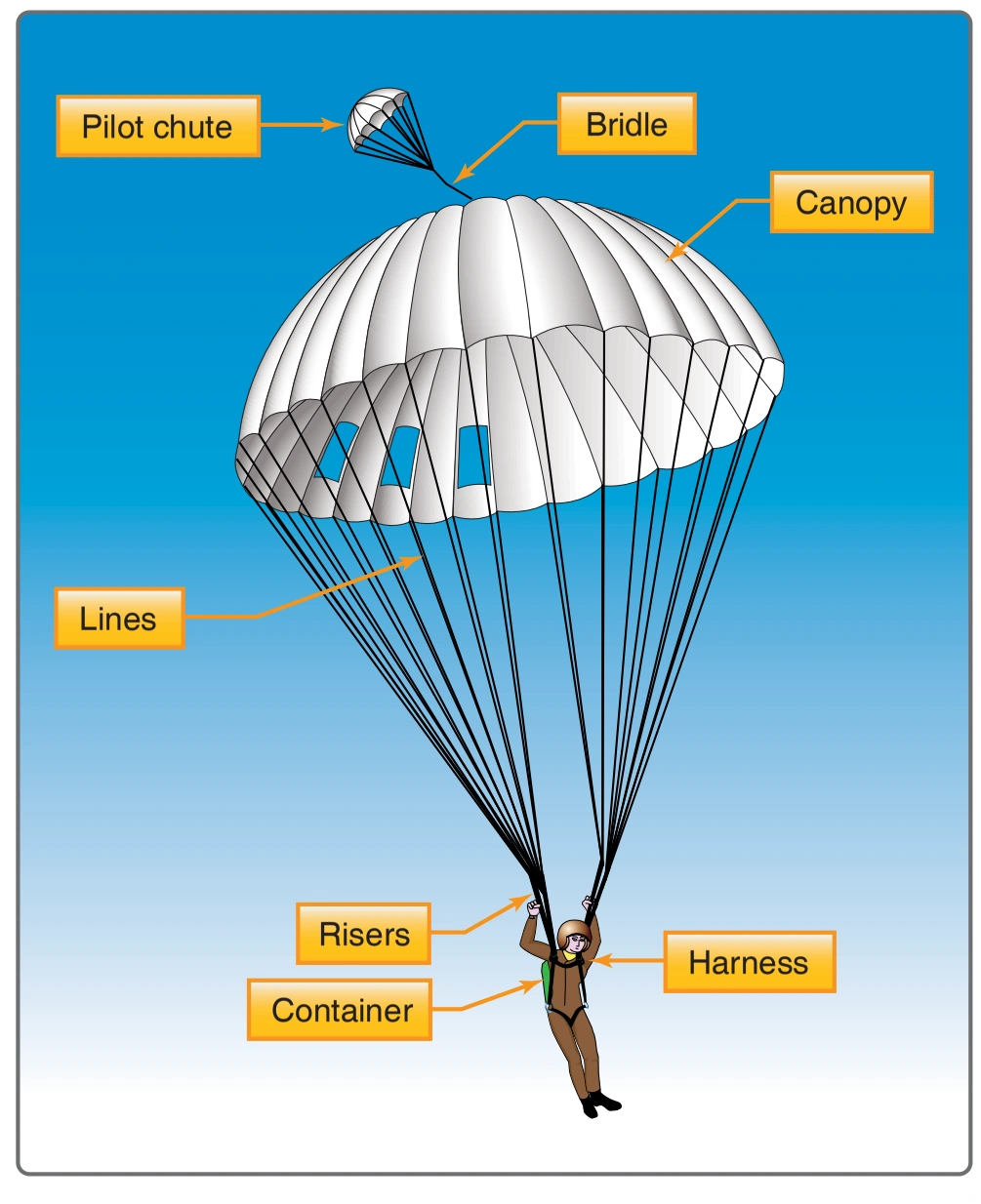
Figure 2-6 identifies the components of a typical round emergency parachute. The nomenclature of this design has remained constant for several decades with a few exceptions. While some riggers who skydive think that the square parachute has replaced it, the round parachute still has many uses, and in certain instances, fulfills some mission requirements better than the square parachute. Poynter’s Parachute Manual, Volume 1, Chapter 8, provides an excellent discussion of the design parameters and characteristics of round parachutes for those needing more technical background.
Construction Concepts and Techniques
TS-100 describes the various ram-air construction methods such as half-cell chord wise, full-cell “I” beam chord wise, full-cell interlocking “T” chord wise, and span wise configurations. When learning the various construction methods, the beginning rigger can become confused as to how the seams are folded together. Seeing the schematic diagrams of the various configurations can help in the repair sequence. Additionally, there are two basic methods of construction for the main seam used on modern ram airs. One method is to roll the adjacent bottom skins with the attendant rib together and double needle 301 stitch to hold the joint. Line attachment tabs are then appliquéd over the rolled seam for subsequent line attachment. The other method is the foil method where the rib has the line attachment tab attached directly to it and is flat stitched to the bottom skins allowing the bottom edge of the rib to be exposed.
Round parachute construction is divided into two primary techniques: bias and block construction. Bias construction is most prevalent in the early parachutes and military designs.
It is generally the stronger of the two techniques due to its ability to stretch more during opening. In bias construction, the fabric is cut and sewn so that the warp and filler threads are at 45° to the centerline of the gore. A typical example is the 28' C-9 canopy.
Block construction is where the warp threads of the panels are parallel to the hem of the canopy. Block construction gained in popularity in the lightweight sport reserves of the 1970s and 1980s. They were easier to build and packed smaller. An example of this design is the Phantom/Aerostar canopies, manufactured by National Parachute Industries, Inc. Additionally lines may run from link to link through the canopy or from skirt to link using reinforcement tape for the canopy portion of the radial seam.
Operational Theory
The rigger must have knowledge of how the parachute functions. Without this, the rigger may not be able to assemble the correct components so that they function as a complete assembly. While the manufacturer may specify what components are to be used with their particular design, with the vast numbers of products on the market today, there are an infinite number of combinations being used by the skydiving community. While seeming to be compatible with each other, many designs have subtle differences that affect their performance and operation. Such differences include pilot chute drag capability and bag extraction force requirements. Pilot chutes should not be interchanged unless the drag capability and container extraction force is known.
Materials
The materials used in construction have changed over the last several years. This has resulted in better performance and durability. The use of incorrect materials can have a detrimental effect on the opening, flying, and landing characteristics of the parachute. The growth in popularity of the ram-air canopies in the 1970s required new fabrics for the designs to function. Very low permeability fabric was necessary for the canopy to remain inflated and maintain the aerodynamic airfoil shape. To reduce the drag created by the suspension lines, newer lightweight and high-strength materials were used. First Dacron®, followed by Kevlar®, and now Spectra® and Vectran®. While reducing the line bulk and drag, these materials have introduced newer problems into the designs.
The ultra-low permeability fabrics inflate faster and have almost zero stretch. As a result, the opening forces increase considerably. These effects have contributed to newer packing and deployment methods to reduce the loads on the parachutist and harness. These, in turn, affect the design of the container systems. Using this as an example, the rigger can see the chain of cause and effect in the design process. Complete coverage of materials is presented in Chapter 3 of this handbook.
Damage
Damage patterns identified during the inspection of canopies can highlight problems caused from packing or incorrect use. By being able to identify these patterns, the rigger can provide the user with correct technique and, thereby, prevent possible injury or death. In addition, the rigger can provide valuable feedback to the manufacturer of potentially serious problems with new designs once they have been subjected to real world conditions. While manufacturers conduct extensive testing programs before releasing new products to the market, very often, subtle problems do not arise until the parachute has been in the field for an extended period of time.