
Chapter 3
Materials
Introduction
The correct identification and use of the various materials in parachute manufacturing and repair are of vital importance to all riggers. Just as important as acquiring knowledge of tools and machines, knowing and using the correct terminology for materials is essential to the rigger’s job comprehension. In doing repairs or alterations, the rigger must be able to identify the types of materials used in order to duplicate the original manufacture and to ensure the correct level of safety necessary. Some materials may look similar, but there can be subtle differences between them that make a major difference in their strength or durability.
It is not the intent of this chapter to present information on every type of material or hardware ever used in parachutes.
For very detailed specifications on a broader range of materials used in current production parachutes, as well as obsolete and military surplus parachutes, there are additional reference sources, such as “The Parachute Manual” by Dan Poynter. The purpose of this chapter is to present as much information on the essentials of modern materials seen in today’s parachute systems.
Many riggers operate quite successfully with a basic level of material knowledge in their proverbial tool kit. There are certain materials that are commonly used on most parachute systems, and in dealing with these on a regular basis, the rigger becomes very familiar with their characteristics and proper application. It is fundamental that the rigger know their correct type, nomenclature, strength, and common use.
In dealing with other riggers, manufacturers, and suppliers, the rigger is then able to identify the referenced material in order to obtain the appropriate repair part or describe the use of the material to others. All of this is part of the parachute rigger’s lexicon, required to communicate their needs and accomplish the required tasks.
Specifications
All certificated parachute systems built under government approval programs require most, if not all, materials used in their construction to have some form of specification approval. The most common of these systems is the military specification (MIL-SPEC) system. In addition, there are other government specifications, such as Federal Standards, and commercial specifications in use. The MIL-SPEC system is the one with which most riggers are familiar. Contrary to popular perception, not all materials for use in parachute manufacturing must be MIL-SPEC. Any specification may be used, provided that the manufacturer can prove compliance with this specification, and that the specification is acceptable to the Federal Aviation Administration (FAA) for use in the parachute system. As a rule, the MIL-SPEC system has proven the most readily available and accepted method.
In recent years, the government has been accepting more commercial specifications in lieu of MIL-SPEC items. In 2002, the Parachute Industry Association (PIA) adopted approximately 270 parachute-related specifications, drawings, standards, and test methods. The PIA takes responsibility for the continued maintenance and revision of these specifications.
As the specifications are revised, they keep their original identification number, but the PIA prefix precedes them.
For instance, MIL-W-4088 webbing becomes PIA-W-4088.
Through the involvement of the PIA Specifications Committee, the revised specifications, including new digital drawings, are made available to the industry.
The MIL-SPEC or PIA-SPEC system of identification consists of the initial letters MIL or PIA with a middle letter such as W for webbing or wire, then the identification or serial number of the specification. In addition, there may be a revision letter, such as A, B, C, D, etc. In the case of PIA-W-4088D, this is the fourth revision.
The materials and hardware listed herein are only a small part of those available, but the most commonly used in the majority of today’s rigging profession. By learning the specifications and uses of these materials, the rigger establishes a sound basis for the repair and maintenance of modern parachutes.
To promote the latest specifications, the PIA nomenclature is called out unless otherwise noted. In the past, the common method to denote the various types of webbings, cords, etc., was to use the Roman numeral for the type (e.g., Type VIII for Ty-8, Type XVII for Ty-17). For this handbook, the standard is the Arabic numeral (e.g., Ty-7).
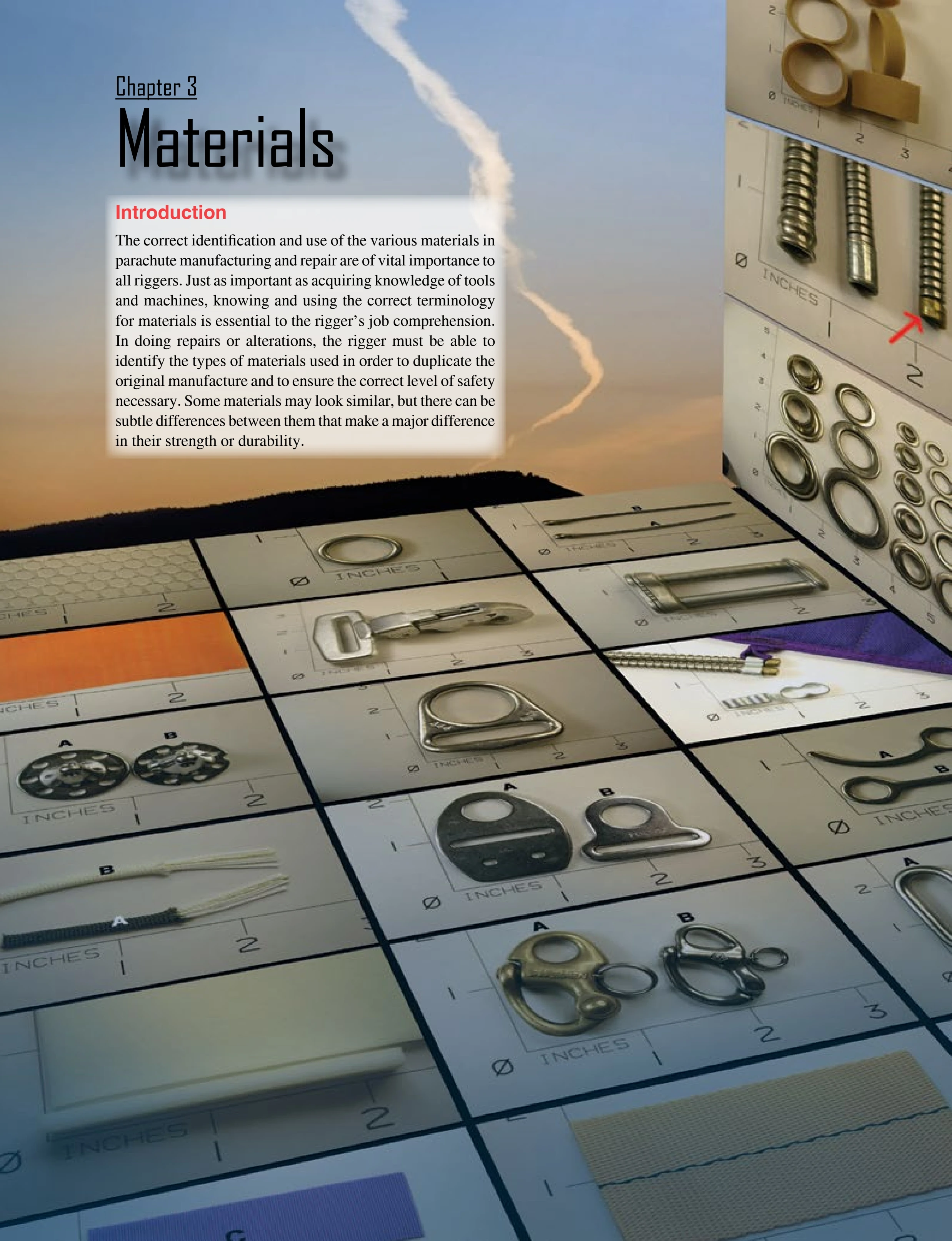
Many of the figures in this chapter use a neutral background with an XY grid for reference. The numbers are in one-inch increments for a proportional reference.
Fabrics
Nylon is the predominate fabric used in the manufacture of parachutes. Chemically speaking, nylon is made of repeating units linked by amide bonds and is frequently referred to as a polyamide (PA). It was invented in the late 1930s by Wallace Carothers while conducting research at DuPont. There are many different kinds of nylon and some of the major differences include the weave, weight, and finish. The various types of materials include canopy fabric, pack cloth, tapes, webbings, mesh, elastic fabrics, stiffener materials, and foams.
Canopy fabrics are primarily ripstop nylon. Ripstop weave is a plain weave with heavier threads woven into the material at right angles resulting in a boxlike pattern. The heavier thread and the unique weave results in ability of the threads to slide over one another inhibiting the tearing process and results in stronger fabrics. [Figures 3-1 through 3-6]