
Chapter 7
Repairs, Alterations, and Manufacture
Now we know who is responsible to make the determination on whether a repair or alteration is major or minor, but how will they decide?
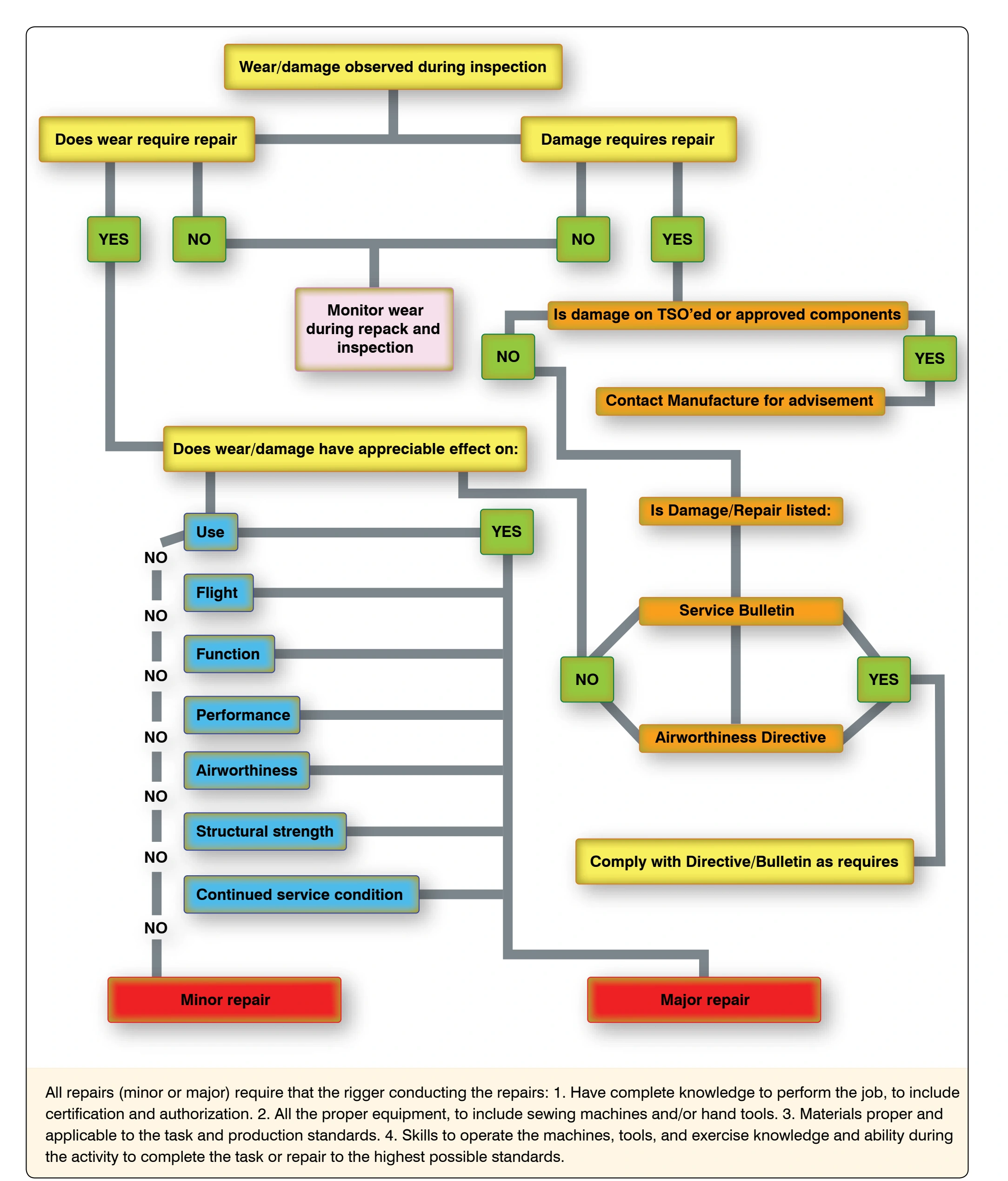
For some time, the FAA has published in Advisory Circular (AC) 120-77, Maintenance and Alteration Data, a chart to assist the technician in determining what type of repair qualifies and in which category as it applies to aircraft repair. Shown in Figure 7-13 is an example repair decision chart that riggers can use (both senior and master) to determine the processes that need to be followed when excessive wear or damage is identified during the inspection process.
It allows for consideration of repair for both TSO equipment and non TSO. It also brings into effect the need for verification of the possibility of existing Safety Bulletin’s (SBs) or Airworthiness Directives (ADs) that may apply to the items found to be damaged during the inspection process.
Contamination Conditions
During the inspection process, in many cases the focus is to locate and identify material damage, tears, rips, broken stitches, pulled tread, and burns, which generally are very apparent should they exist. Damage can exist in forms that are less apparent to the material properties/assembly. Much less obvious, but just as important, is contamination.
Contamination conditions can be critical to the repair process and have a direct effect as to the decision of the repair type (major/minor) status. Listed below are common types of contamination conditions, their visual verification properties, and the manufacturer recommended processes to repair. Identification of these conditions and rigger-applied repairs determine their effect on the airworthiness of the parachute assembly.
Acid Contamination
Nylon that has been contaminated by acid may have irregular shaped spots of gray or dead white color. The acid-contaminated fabric may also become powdery when scraped lightly. Parachute components suspected of acid contamination may be tested with blue litmus paper. Dampen the suspect area with distilled water. Then lay the litmus paper on the area in question. If the paper turns pink, acid is present. Be careful not to touch the litmus paper, as touching the paper can cause an erroneous response.
Action
If an area tests positive for acid and the effected area is known to be localized, that area should be neutralized with a solution of distilled water and ammonia. Household ammonia works. Ammonia does not damage nylon or hardware. The damaged area should be removed and the resulting hole should be patched. If the extent of contamination cannot be determined or if it effects large portions of the parachute, the parachute should be first destroyed, then disposed of.
Salt Water Contamination
Crystals of dry salt and the presence of pale brown circular stains are often evidence of salt-water exposure. If the parachute is allowed to dry after salt-water immersion without being rinsed in fresh water, salt crystals form causing damage to the fabric and suspension lines.
Action
Parachutes exposed to salt water should be rinsed out several times in warm fresh water in a smooth tub. Use of a water softener is recommended. Hang assembly in drying tower in accordance with the section within this chapter titled, Drying a Parachute. The maximum complete salt-water immersion limits for the parachute are listed below. The parachute assembly should be cleaned within 8 hours of immersion. Remove from service any parachute assembly or sub-assembly for any of the following conditions:
- Immersion in salt water for more than 6 hours if the parachute contains cadmium plated parts.
- Immersion in salt water for more than 24 hours if the parachute contains stainless steel parts (i.e., slider stops).
- Immersion in salt water and cannot be cleaned for 36 hours.
Removal of Perspiration
Perspiration causes damage to the parachute much like salt water does. Small amounts are not significant and may be ignored. For larger areas heavily contaminated, clean the parachute in accordance with the Removal of Salt Water Contamination section above.
Removal of Fresh Water
Dry parachute assembly in accordance with the section titled, Drying a Parachute.