Chapter 1
Introduction to the Powered Parachute
History of the Powered Parachute
As early as the 12th century, the Chinese used an umbrella-shape parachute design for recreation. About 300 years later, Leonardo da Vinci blueprinted a pyramid-shaped parachute. In the late 18th century, man jumped from towers and balloons with a parachute. The first parachute jump from an airplane occurred in 1912.
After World War II, sport jumping became a recreational activity. The sport started with round parachutes, ranging in size from 20 to 30 feet in diameter. Parachutes evolved into a steerable, gliding wing smaller than today’s rectangular ram-air powered parachute (PPC) wing which is approximately 38 feet wide.
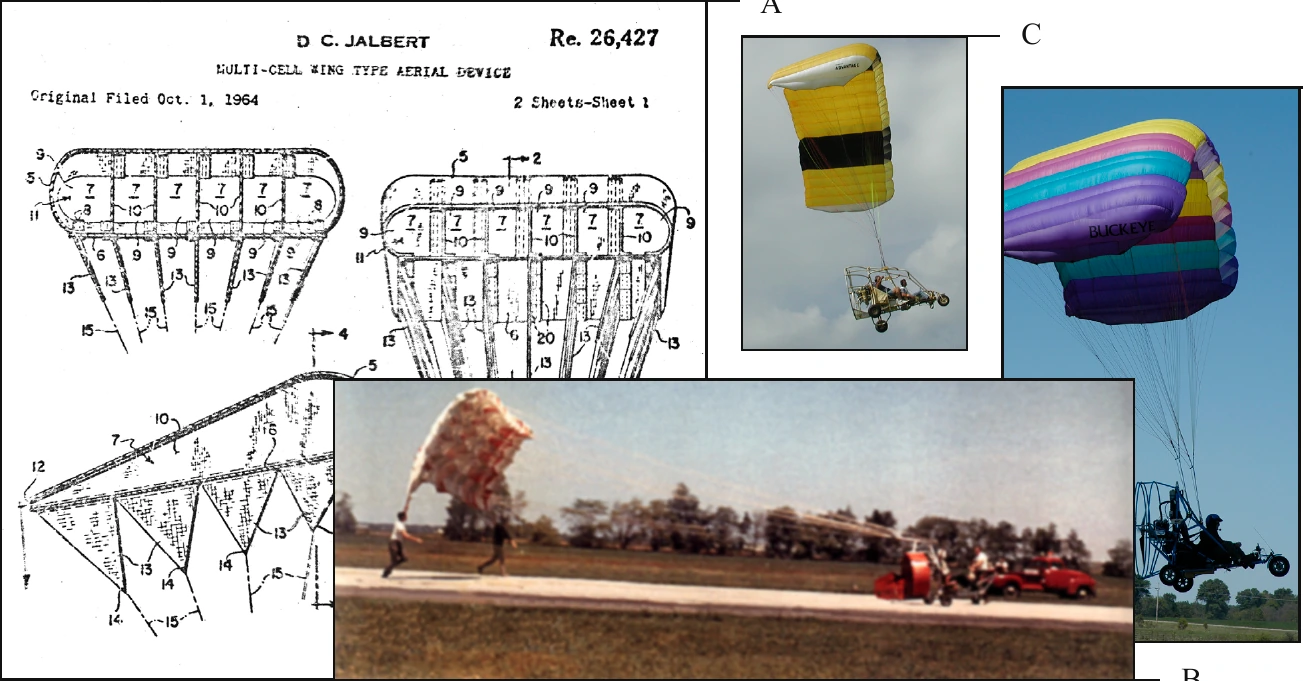
On October 1, 1964, Domina C. Jalbert applied for a patent for his “Multi-Cell Wing” named “Parafoil” (also known as a “ram-air” wing), which was a new parachute design. His ideas were registered as a U.S. patent on November 15,1966. [Figure 1-1 A] However, in 1964 Lowell Farrand had already flown a motorized version called “The Irish Flyer” by Nicolaides. [Figure 1-1 B] Farrand was the first person to put an engine on a ram-air inflated parachute wing, starting the evolution of the powered parachute with the Irish Flyer. This wing evolved into today’s modern powered parachute canopies, which include rectangular, elliptical, semi-elliptical, and hybrid wings.
The United States (U.S.) government had a number of test programs that used the square parachute as a means to glide spacecraft back to earth or glide payloads dropped out of airplanes to a specific location.
Two-place powered parachutes have years of testing, development, and evolution. Training exemptions to Title 14 of the Code of Federal Regulations (14 CFR) part 103, Ultralight Vehicles, permitted individuals to give instruction in two-place ultralight vehicles, instead of being restricted to vehicles intended for single occupants. [Figure 1-1 C] The Federal Aviation Administration (FAA) allowed ultralight vehicle pilots to train in two-place ultralights until January 31, 2008. After this date, the ultralight vehicle training exemption expires and only N-numbered aircraft may be used in two-place PPC instruction and flight. [Figure 1-1 D]
Powered Parachute Terms
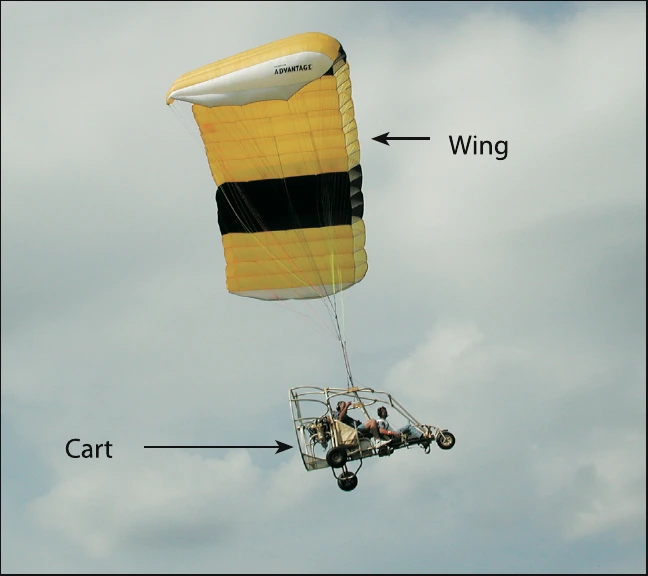
Different terms have been used throughout the powered parachute community. [Figure 1-2] The terms standardized throughout this book are as follows:
- Powered Parachute – The complete aircraft.
- Cart – The engine and seats, attached by a structure to wheels; may also be referred to as the fuselage, cockpit, chaise, or airframe.
- Wing – Typically a ram-air inflated and pressurized wing including lines that attach to the cart. The wing is not in position to fly until the aircraft is in motion; when not inflated, referred to as a parachute or chute.
Introduction to the Powered Parachute
The powered parachute is a category of aircraft that flies in a manner unique among light-sport aircraft. Three significant differences separate the PPC from other types of light sport aircraft (LSA): [Figure 1-3]
- The wing must be inflated and pressurized by ram air prior to each takeoff.
- The aircraft uses a pendulum configuration, where the cart hangs about 20 feet below the wing, connected via flexible suspension lines.
- The wing is at a relatively fixed angle with the suspension lines and flies at a relatively constant speed. Other aircraft categories allow pilots to change the speed of the aircraft, but the powered parachute airspeed remains within a very small range.
A powered parachute can be a single place ultralight flying vehicle, a single place light-sport aircraft, or a multi-place light-sport aircraft. The common acronyms for this vehicle/aircraft are PPC (powered parachute), PPCL (powered parachute land) or PPCS (powered parachute sea).
A light-sport aircraft PPC used for sport and private flying must be registered with an FAA N-number, have an airworthiness certificate, a pilot’s operating handbook (POH), and/or limitations with a weight and balance document aboard. The aircraft must be maintained properly by the aircraft owner or other qualified personnel and have the aircraft logbooks available for inspection. Dual controls are required in the aircraft for training.
Powered Parachute Pilot Certificate Eligibility Requirements
You may not act as pilot in command (PIC) of a light-sport aircraft powered parachute unless you hold a pilot certificate with a powered parachute rating issued by the FAA. At this time the only pilot certificates with powered parachute ratings are Student, Sport and Private. The FAA is empowered by the U.S. Congress to promote aviation safety by prescribing safety standards for pilots and the other civil aviation programs. The Code of Federal Regulations (CFRs), formerly referred to as Federal Aviation Regulations (FARs), are one of the primary means of conveying these safety standards.