
Chapter 11
Approaches and Landings
Speed blurs objects at close range. For example, consider the view from an automobile moving at high speed. Nearby objects seem to merge together in a blur, while objects farther away stand out clearly. The driver subconsciously focuses the eyes sufficiently far ahead of the automobile to see objects distinctly. In the same way, the distance at which the powered parachute pilot’s vision is focused is normally adjusted automatically.
If you attempt to focus on a reference that is too close or look directly down, the reference will become blurred, and the reaction will be either too abrupt or too late. In this case, your tendency will be to overcontrol, round out high, and make drop-in landings. When you focus too far ahead, accuracy in judging the closeness of the ground is lost and the consequent reaction will be too slow since there will not appear to be a necessity for action. This will result in flying into the ground without flaring.
Roundout
The powered roundout is a slow, smooth transition from a normal approach descent rate to a landing descent rate, gradually rounding out the flightpath to one that is parallel with, and within a very few inches above the runway. When the powered parachute is in a normal descent, within what appears to be 10 to 20 feet above the ground, the powered roundout should be started. Once started, it should be a continuous process until the powered parachute touches down on the ground.
As the powered parachute reaches a height above the ground where a timely change can be made into the proper landing descent, power should be gradually applied to slowly decrease the rate of descent. [Figure 11-3]
The rate at which the roundout is executed depends on the powered parachute’s height above the ground and the rate of descent. A roundout started excessively high must be executed more slowly than one from a lower height to allow the powered parachute to descend to the ground. The rate of rounding out must also be proportionate to the rate of closure with the ground. When the powered parachute appears to be descending very slowly, no increase in power settings is called for.
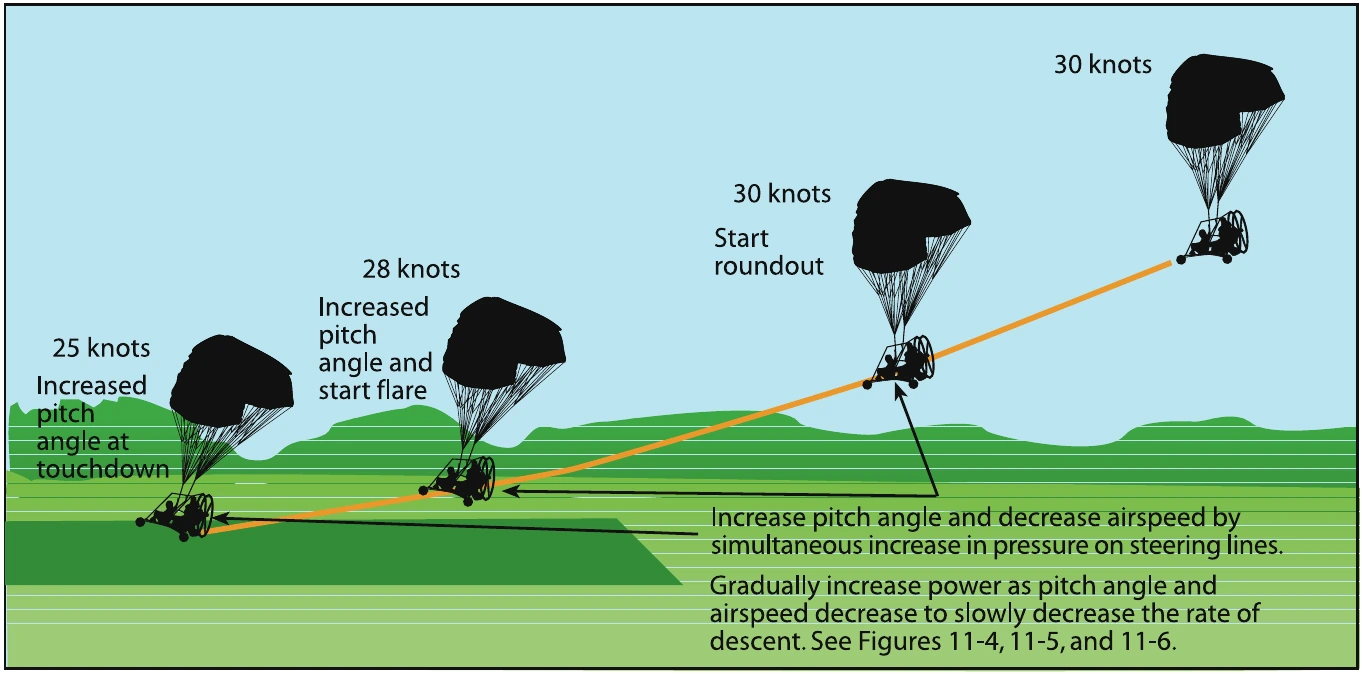
Visual cues are important in rounding out at the proper altitude and maintaining the wheels a few inches above the surface until eventual touchdown. Visual cues are primarily dependent on the angle at which your central vision intersects the ground (or runway) ahead and slightly to the side. Proper depth perception is a factor in a successful flare, but the visual cues used most are those related to changes in runway or terrain perspective and to changes in the size of familiar objects near the landing area such as fences, bushes, trees, hangars, and even sod or runway texture. You should direct central vision at a shallow downward angle of from 10° to 15° toward the runway as the roundout is initiated.
Maintaining the same viewing angle causes the point of visual interception with the runway to move progressively rearward toward you as the powered parachute loses altitude. This is an important visual cue in assessing the rate of altitude loss. Conversely, forward movement of the visual interception point will indicate an increase in altitude, and would mean that power was increased too rapidly, resulting in floating. In most powered parachutes, the front wheel can easily be seen and can be used as an indicator of how far the main wheels are above the runway.
In some cases, it may be necessary to advance the throttle slightly to prevent an excessive rate of sink which would result in a hard, drop-in type landing. You should keep one hand on the throttle throughout the approach and landing, in case a sudden and unexpected hazardous situation requires an immediate application of power.
Wing Control
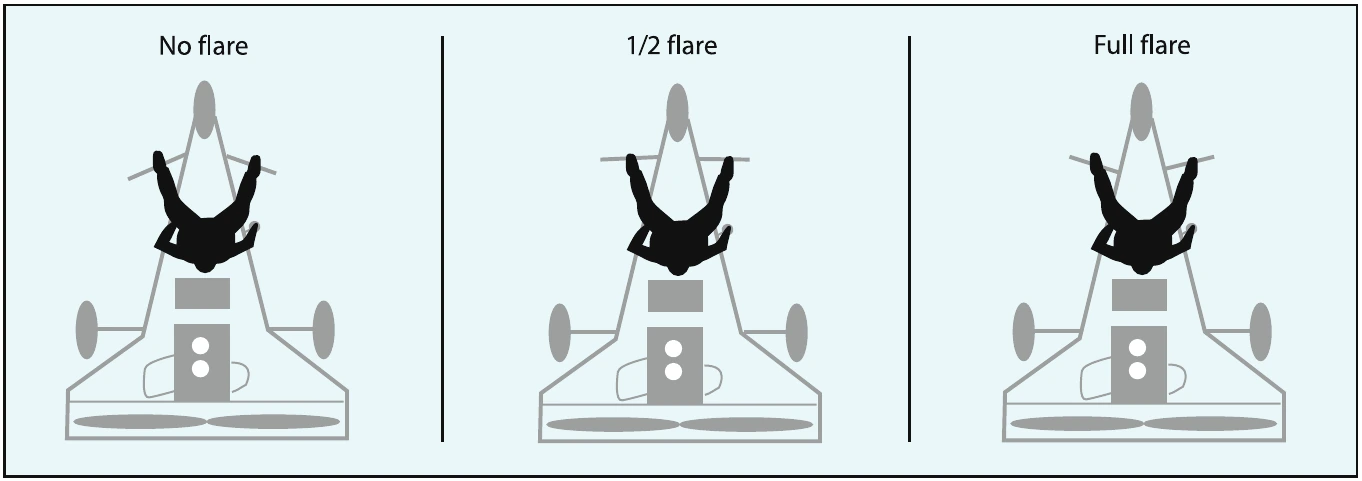
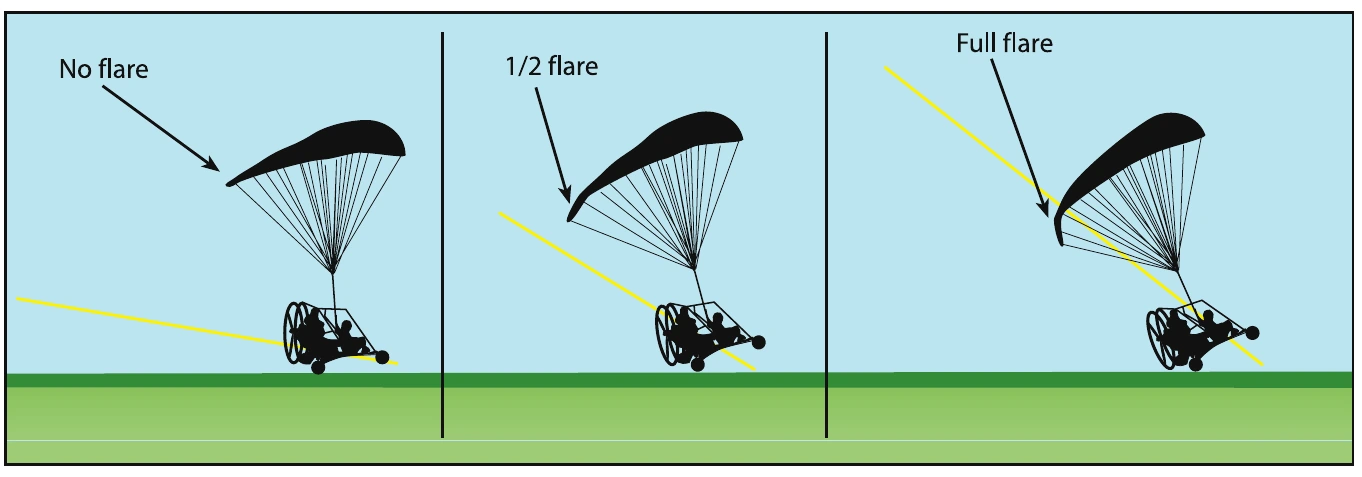
The measured input of the flare is directly related to the leg extension of the pilot. For one-third flare, simultaneously push the steering controls out approximately one-third of your leg length. During a full-flare, you would be fully extending your legs to apply input to the steering controls; one-half flare, you would be pushing the controls out half of your full leg extension, and so on. [Figure 11-4]
For landings, the amount of flare needed is directly related to the descent rate. The steeper and faster the descent, the more flare input is required for a smooth landing. [Figure 11-5] Keep in mind the flare is converting forward momentum into lift. So, if the pilot is landing with a very slow descent rate, then the pilot would only need to apply one-third flare during the landing. Use full-flare during an engine-out descent, which is the steepest descent of a PPC, for landing.
A flare should be applied in a single 1-2-3 motion. Apply the flare smoothly, in a rhythmic, even, “1-2- 3” motion.
Touchdown
The touchdown is the gentle settling of the powered parachute onto the landing surface. The roundout and touchdown should be made with the engine slightly below level flight power levels. As the powered parachute settles, the parachute is flared to smooth out the landing.
Some pilots may try to force or fly the powered parachute onto the ground without flaring. It is paradoxical that the way to make an ideal landing is to try to hold the powered parachute’s wheels a few inches off the ground as long as possible. In most cases, when the wheels are within a foot or less off the ground, the powered parachute will still be settling too fast for a gentle touchdown; therefore, this rate of descent must be retarded by the use of flare. [Figure 11-6]
Flare is accomplished by pushing both steering bar tubes simultaneously. That pulls the entire trailing edge of the parachute down. That increases drag, lowers the forward speed, and most importantly (for landing) increases the lift of the parachute. The amount of flare needed depends on the rate of descent right before landing. If the rate of descent is very gradual, very little flare is needed. Conversely, in an engine-out situation a lot of flare is required. Accurately determining how much flare is needed for a given situation is developed with practice. A general rule is to begin the flare one second before you would otherwise touch the ground.