Chapter 2
Aerodynamics of Flight
Powered Parachute Wing Pressurization and Flexibility
The powered parachute has two distinctive modes: (1) inflated, it is a ram-air wing with a curved arc—a recognizable airfoil shape; and (2) deflated, it is a canopy that is either lying flat on the ground or packed into a bag.
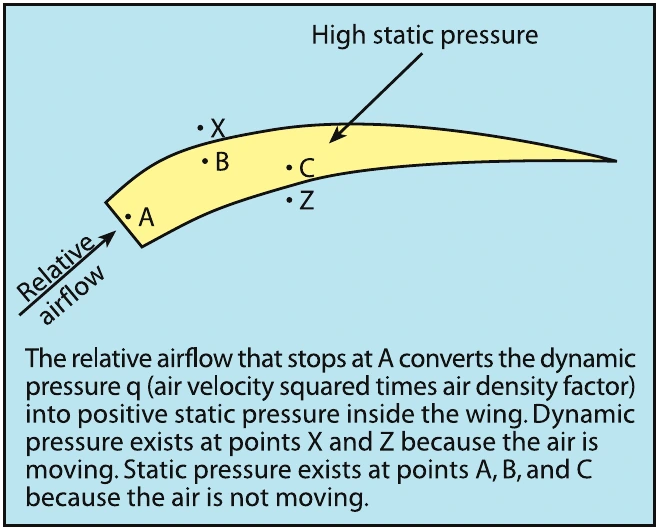
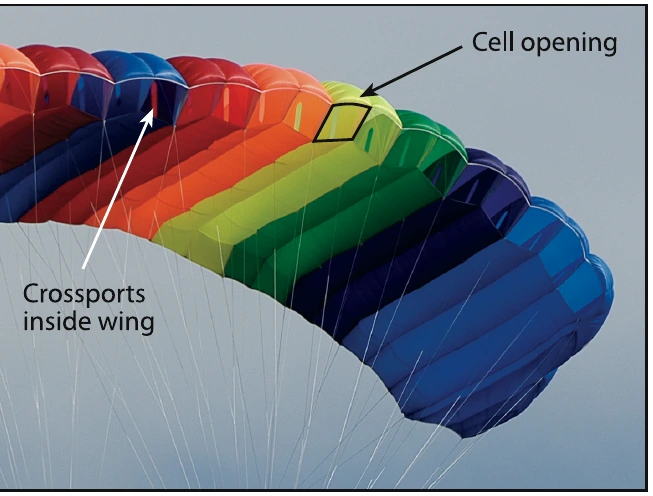
The powered parachute ram-air wing retains its airfoil shape due to the air pressurizing the inside cells via the relative wind airflow being rammed into the front openings of the canopy—thus the term “ram-air wing.” The pressure inside the wing is much higher than the outside top and bottom because the dynamic pressure from the relative wind is converted to static pressure to pressurize the wing. The greater the speed, the greater the pressure inside the wing and the more rigid the wing. The cell openings are designed to be perpendicular to the relative wind to achieve maximum pressure from the relative wind. This static internal pressure harnessed from the relative wind is called dynamic pressure (q), and is determined by the velocity squared times the air density factor. [Figure 2-7] Note the dynamic air pressure converted to static pressure at point A is constant throughout the wing points B and C. This static pressure is always greater than the pressure outside the wing at points X and Z.
Cross-port openings are placed in the ribs of each cell, connecting the adjoining cells. These cross-ports are dispersed throughout the wing (with exception to the outboard side of the end cells) to maintain positive pressure throughout. The pressure is constant inside the wing because the dynamic pressure hitting the opening is the same for each cell and the speed is the same. The cross-ports aid the complete wing in becoming pressurized during inflation and maintaining the pressure throughout the wing in turbulence. [Figure 2-8]
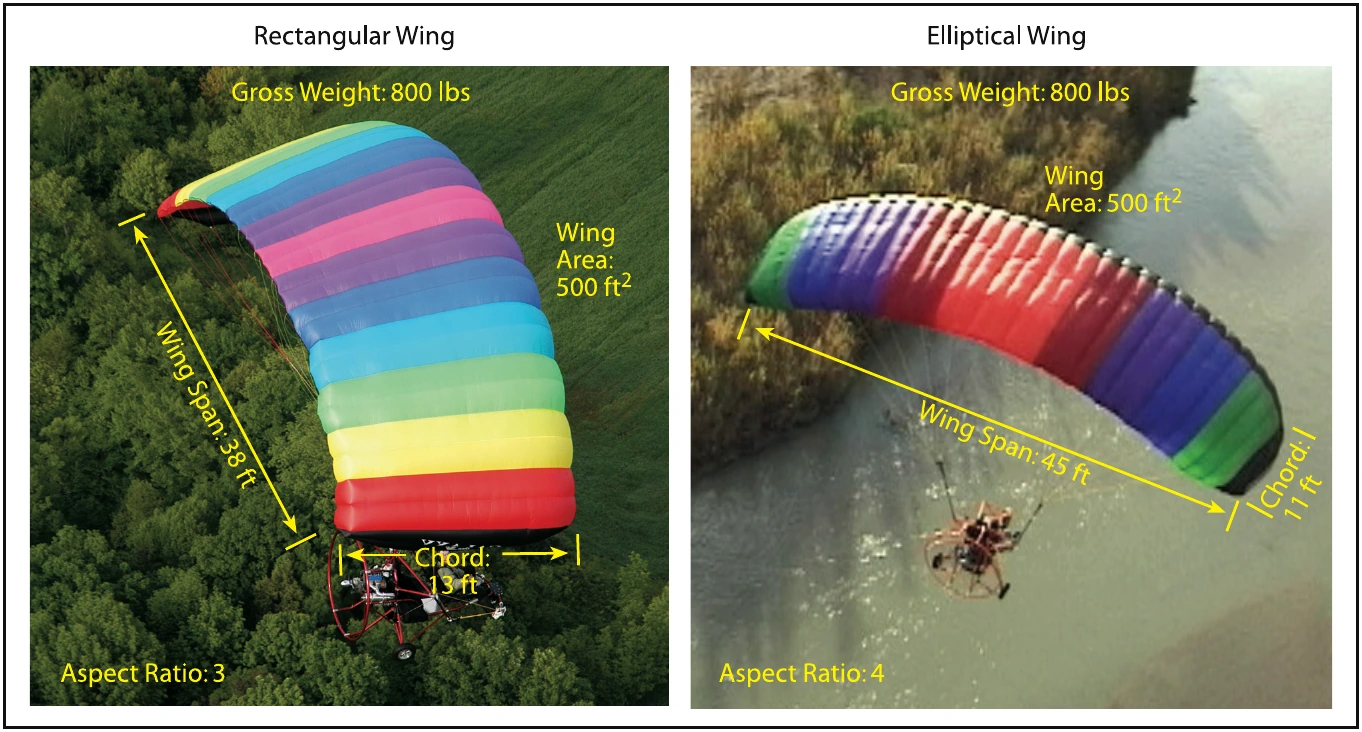
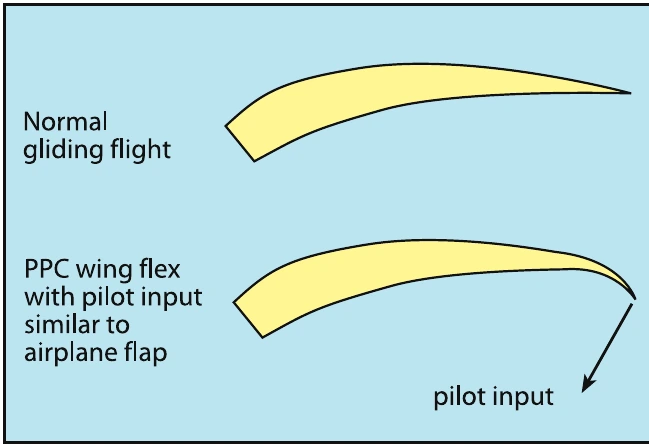
The inflatable wing airfoil generally remains a consistent shape as designed by the manufacturer. However, pilot control of the wing to make a turn significantly changes the relative aerodynamic qualities of the PPC wing by pulling down the trailing edge similar to a flap on an airplane. [Figure 2-9] Faster speeds from smaller wings or more weight create a higher pressure in the wing resulting in higher control forces because of the higher internal pressure.
Forces in Flight
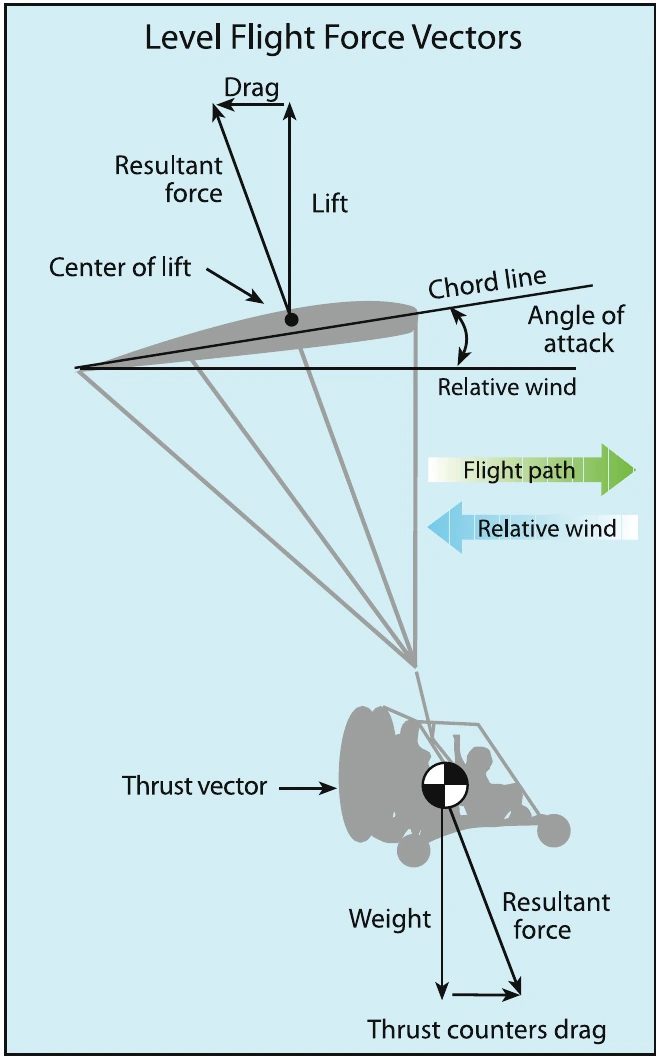
Like all aircraft, the four forces that affect PPC flight are thrust, drag, lift, and weight. [Figure 2-10] In steady PPC flight:
- The sum of all upward forces equals the sum of all downward forces.
- The sum of all forward forces equals the sum of all backward forces.
- The sum of all moments equals zero.
THRUST – the forward force produced by a powerplant/propeller as it forces a mass of air to the rear (usually said to act parallel to the longitudinal axis). vs. DRAG – the aerodynamic force acting on the airfoil lines and cart in the same plane and in the same direction as the relative wind.
LIFT – the aerodynamic force caused by air flowing over the wing that is perpendicular to the relative wind. vs. WEIGHT – the force of gravity acting upon a body.
Lift
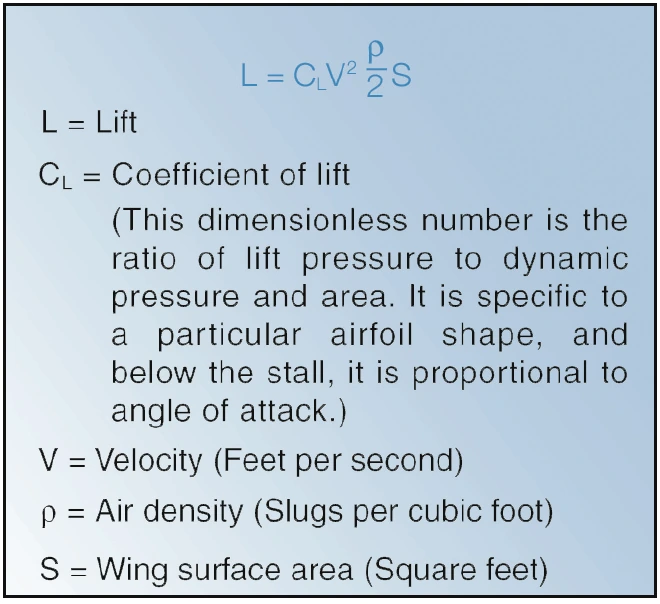
Lift opposes the downward force of weight and is produced by the dynamic effects of the surrounding airstream acting on the wing. Lift acts perpendicular to the flight path through the wing’s center of lift. There is a mathematical relationship between lift, angle of attack, airspeed, altitude, and the size of the wing. In the lift equation, these factors correspond to the terms coefficient of lift, velocity, air density, and wing surface area. The relationship is expressed in Figure 2-11.
This shows that for lift to increase, one or more of the factors on the other side of the equation must increase. Lift is proportional to the square of the velocity, or airspeed, therefore, doubling airspeed quadruples the amount of lift if everything else remains the same. Small changes in airspeed create larger changes in lift. Likewise, if other factors remain the same while the coefficient of lift increases, lift also will increase. The coefficient of lift goes up as the angle of attack is increased. As air density increases, lift increases. However, you will usually be more concerned with how lift is diminished by reductions in air density on a hot day, or if you are operating at higher altitudes.