
Chapter 2
Aerodynamics of Flight
Compared to an airplane, as discussed in Chapter 3 of the Pilot’s Handbook of Aeronautical Knowledge, thrust serves different purposes in the PPC: (1) it is used to accelerate the PPC to flying speed while inflating the wing (2) it is used to climb when at high thrust, cruise level at medium thrust, and descend at lower thrust. Variations in thrust have negligible effect on PPC airspeed which remains relatively constant whether climbing, descending, or in level flight.
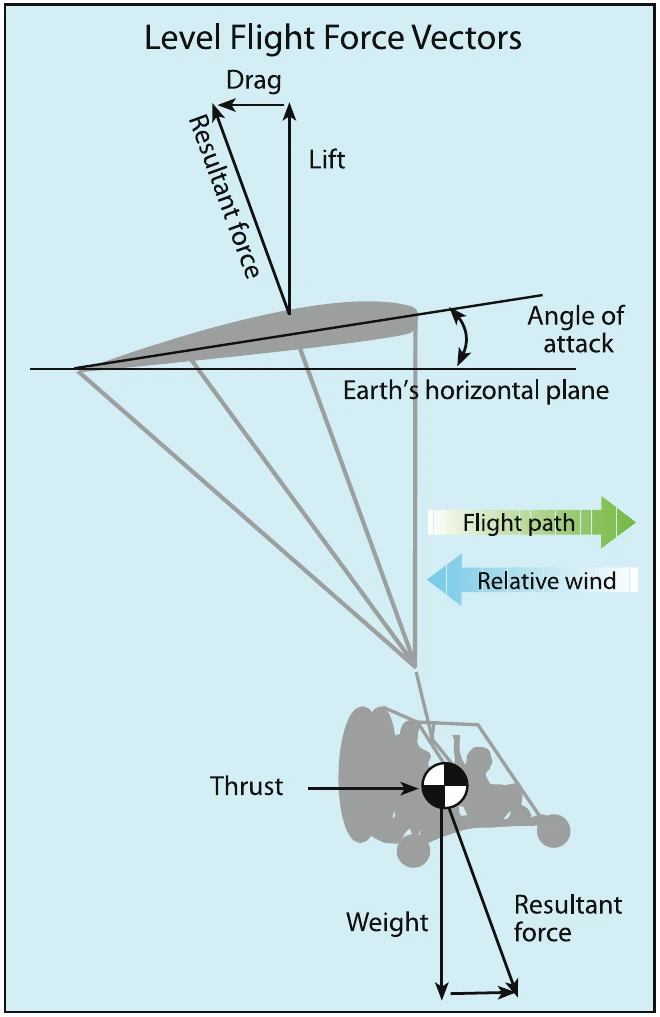
When enough thrust is added to produce level flight, the relative wind stream becomes horizontal with the earth; the angle of attack and speed remain about the same. Just as described in the Pilot’s Handbook of Aeronautical Knowledge for the airplane, thrust equals total drag for level flight. [Figure 2-16]
When in straight-and-level unaccelerated flight: LIFT (L) = WEIGHT (W) and THRUST = TOTAL DRAG (DT)
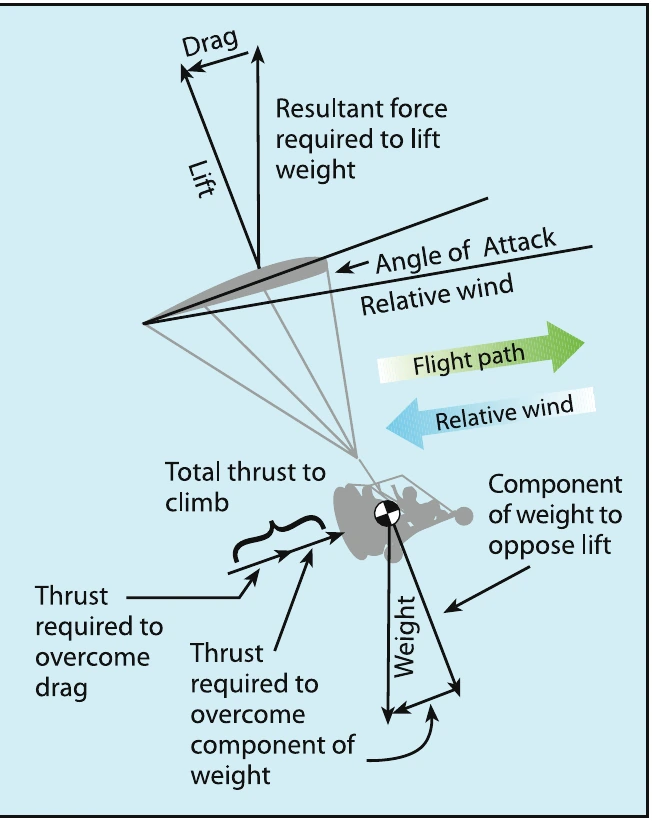
When excess thrust is added to produce climbing flight, the relative air stream becomes an inclined plane leading upward, while angle of attack and speed remain about the same. Just as described in the Pilot’s Handbook of Aeronautical Knowledge for the airplane, the excess thrust determines the climb rate and climb angle of the flight path. [Figure 2-17]
Center of Gravity
The center of gravity (CG) is the theoretical point of concentrated weight of the aircraft. It is the point within the PPC about which all the moments trying to rotate it are balanced. The most obvious difference in the center of gravity for a PPC is the vertical position compared to an airplane, as it is much lower than the wing. The Pilot’s Handbook of Aeronautical Knowledge accurately states the center of gravity is generally in the vertical center of the fuselage. The same is true for the PPC. However, the PPC wing is high above the fuselage (cart) creating the unique pendulum effect flying characteristics of the PPC (which will be covered in detail later).
In a two-seat PPC, the second seat is typically behind the pilot’s seat, and the center of gravity is usually located directly over the rear passenger seat. Therefore, the center of gravity location does not change significantly with or without a passenger. Fuel tanks are typically located near the center of gravity so any differences in fuel quantity will not significantly change the center of gravity fore and aft with different fuel quantities.
Axes of Rotation
Motion about the lateral axis or pitch is primarily controlled by the thrust of the propeller moving the PPC pitch up (nose up) to climb and pitch down (nose down) at reduced throttle.
Turning happens about the longitudinal axis and is the result of the rolling motion similar to an airplane with aileron and rudder control. To turn, pull down the wing trailing edge on the side you want to turn to with the steering controls. This creates drag on the corresponding trailing edge of the wing, thus dropping the inside wing, and rolling the PPC into a banked turn. [Figure 2-18]
There is not significant turning about the vertical axis because the PPC wing is designed to fly directly into the relative wind just like an airplane. Any sideways skidding or yaw is automatically corrected to fly straight with the wing design. An airplane uses the vertical tail to fly directly into the relative wind like a dart. The unique design of the PPC performs the same function through the combination of wing profile/taper, the arch or curvature from tip to tip, washout built into the wing and/or tip stabilizer design. These factors make the PPC track directly into the relative wind and eliminate the need for a vertical tail surface and rudder to make coordinated turns. Designs and methods vary with manufacturer and wing type, but all PPCs are designed to track directly into the relative wind.
Ground Effect
Ground effect is the interference of the ground with the airflow and turbulence patterns created by the wing. The most apparent indication from ground effect is the unexpected lift given to an aircraft as it flies close to the ground — normally during takeoffs and landings.
Ground effect is usually felt when the wing is at altitudes of less than half of the wingspan. The typical PPC wingspan is approximately 38 feet with an average wing height of about 20 feet. Therefore, ground effect is negligible for PPCs and is typically not a factor.
Moments
A body that rotates freely will turn about its center of gravity. In aerodynamic terms for a PPC, the mathematical value of a moment is the product of the force times the distance from the CG (moment arm) at which the force is applied.
Wings generally want to pitch nose down or roll forward and follow the curvature of the airfoil creating a negative pitching moment. This is one of the reasons airplanes have tails. The powered parachute does not need a tail because the airfoil is locked into a specific position relative to the cart by the suspension lines. [Figure 2-19]. Any pitching moment for the wing is counteracted by the strong pendulum effect (weight of the cart hanging directly under the center of lift). Any swinging of the weight creates moments that act to stabilize the swing. The wing aids to dampen swinging. This pendulum effect is unique to the PPC because the cart has the ability to rotate around the PPC pendulum axis of rotation in addition to rotating about the CG.
To understand the pendulum effect, attach a small weight (a pencil or paper clip works) to a 24-inch string. Note the weight always wants to hang directly under where you hold it. If you hold the string still and move the weight to the side, the weight swings and stabilizes under where you hold it. Gravity, pulling down on the weight to stabilize it directly under where it is hanging, is PPC pendulum stability. [Figure 2-20] Pendulum stability is the result of a number of PPC design characteristics: there is no downward force from a horizontal tail that must be counteracted by the wing producing more lift; there is no weight of the tail that must be lifted; and there is no tail to impose extra drag on the aircraft. Gravity is the primary force that stabilizes the aircraft using pendulum stability.