Chapter 2
Aerodynamics of Flight
All wings produce lift in two ways:
- Airfoil shape creating a higher velocity over the top of the wing and a lower velocity over the bottom of the wing with Bernoulli’s venturi effect.
- Downward deflection of airflow because of the curvature of the wing with the principle of Newton’s Third Law of Motion: For every action, there is an equal and opposite reaction.
Both principles determine the lifting force. Review Chapter 2 in the Pilot’s Handbook of Aeronautical Knowledge to understand Newton’s laws of motion and force and Bernoulli’s principle of pressure.
Drag
Drag is the resistance to forward motion through the air. Drag opposes thrust. Aerodynamic drag comes in two forms:
- Induced drag: a result of the wing producing lift;
- Parasite drag: resistance to the airflow from the cart, its occupants, suspension lines from the wing, interference drag from objects in the airstream, and skin friction drag of the wing.
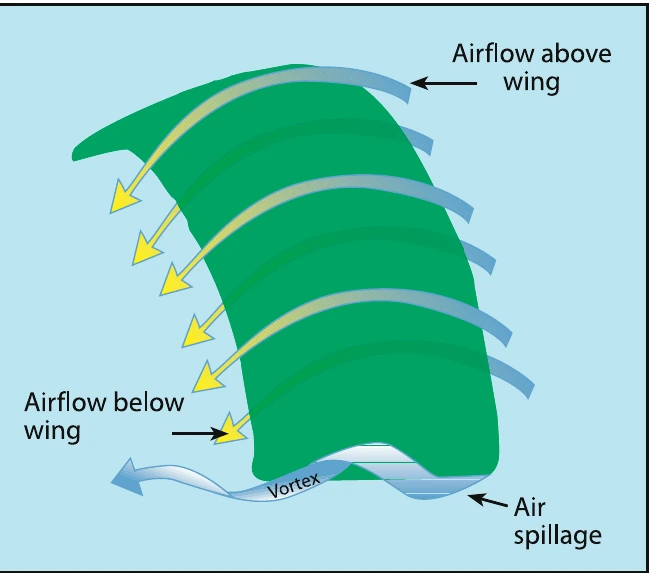
Induced drag is the result of lift, and its amount varies as discussed above for lift. Induced drag creates organized circular vortices off the wing tips that generally track down and out from each wingtip. [Figure 2- 12] This is true for all aircraft that use wings including PPC, weight-shift control and fixed wing aircraft. The bigger and heavier the aircraft, the greater and more powerful the wingtip vortices will be. This organized swirling turbulence is an important factor to understand for flight safety. Refer to Section 7-3 of the Aeronautical Information Manual (AIM) or Chapter 12 of the Pilot’s Handbook of Aeronautical Knowledge (FAA-H- 8083-25) for additional discussion.
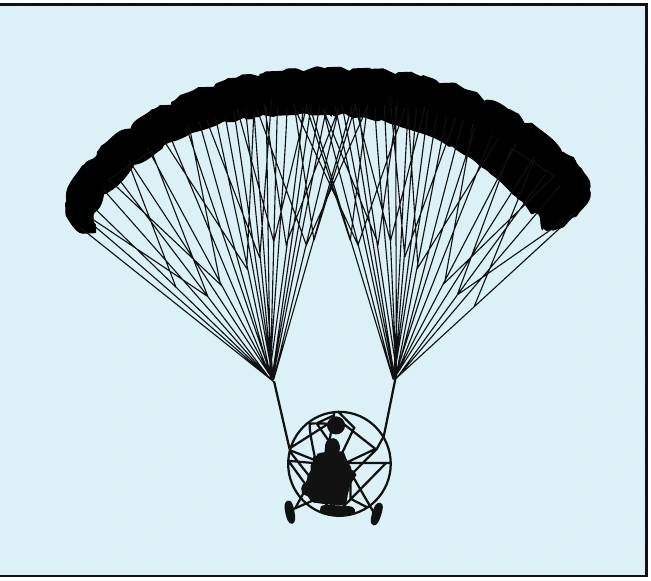
Parasite drag is caused by the friction of air moving over the structure. Just as with lift, parasite drag increases as the surface area of the aircraft increases and dramatically increases as airspeed increases, at the square of the velocity. Therefore, doubling the airspeed will quadruple your parasite drag. [Figure 2-13]
The PPC has relatively slow speeds, but plenty of items (area) for the wind to strike including wing, lines, pilot, cart, engine, wheels, and tubes. Parasitic drag can be reduced by streamlining the items but since the PPC flies at relatively slow airspeeds, the extra weight, cost, and complexity of streamlining the PPC is generally not incorporated into the design.
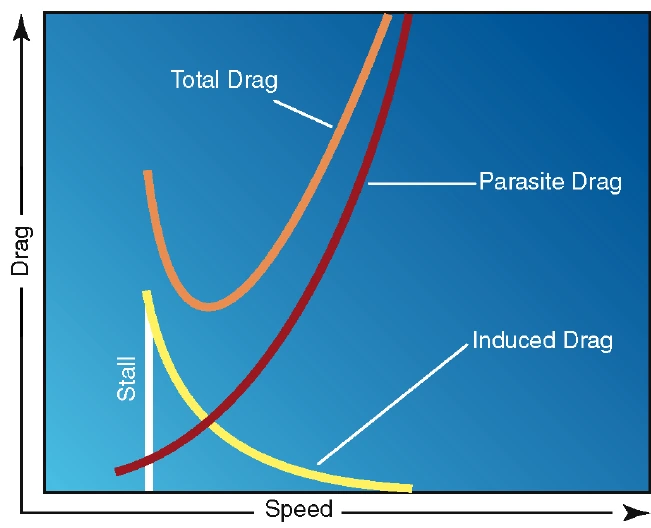
Total Drag is the combination of parasite and induced drag. Total Drag = Parasitic Drag + Induced Drag
To help explain the force of drag, the mathematical equation D = Cd · q · S is used. In this equation drag (D) is the product of drag coefficient (Cd), dynamic pressure (q) determined by the velocity squared times the air density factor, and surface area (S) of the cart and the ram-air wing (S). The drag coefficient is the ratio of drag pressure to dynamic pressure.
Induced and parasitic drag have opposite effects as angle of attack decreases and speed increases. Note the total drag. It is high at the slowest air speeds at high angles of attack near the stall, decreases to the lowest at the most efficient airspeed, and then progressively increases as the speed increases. The PPC wing is typically designed to fly at a speed generally above lowest overall total drag. Too slow, and the wing would be near its critical angle of attack. Too fast, and the power to maintain level flight or climb would be excessive. The manufacturer determines the speed range of the wing based on the weight range, and the resultant location on the total drag diagram. [Figure 2-14]
Weight
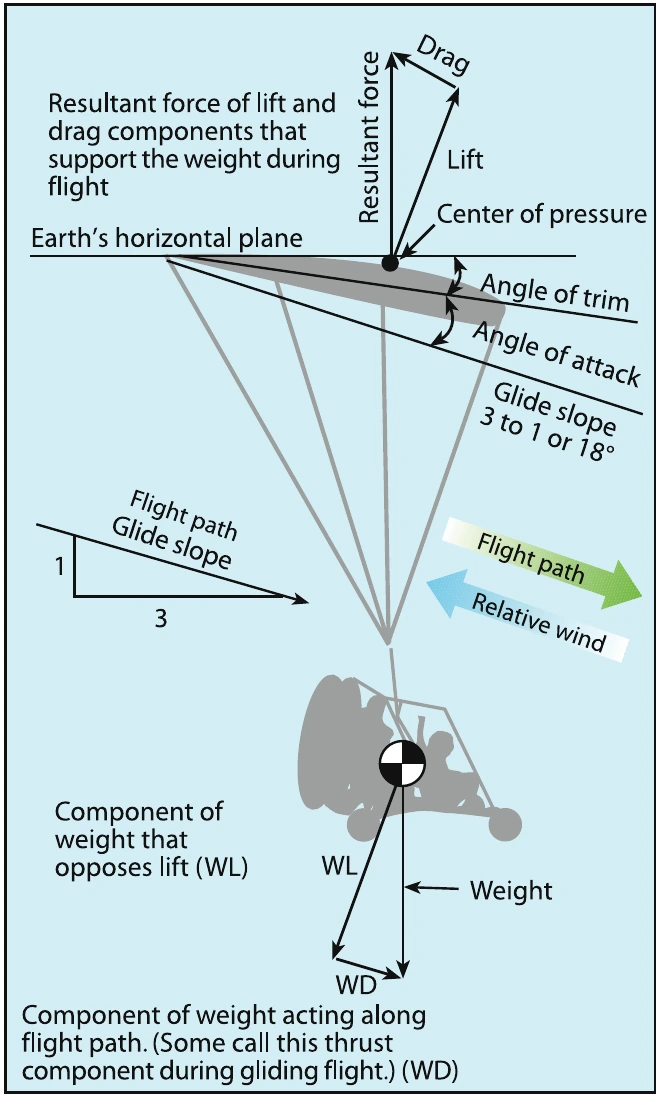
Weight is a measure of the force of gravity acting upon the mass of the PPC. It is the force that opposes lift, and acts vertically downward through the aircraft’s center of gravity. Weight consists of everything directly associated with the powered parachute in flight: the combined load of the total PPC (wing, risers, engine, cart, fuel, oil, etc.), people (clothing, helmets, etc.), and baggage (charts, books, checklists, pencils, handheld GPS, spare clothes, suitcase, etc.). In stabilized level flight, when the vertical component of lift is equal to the weight force, the PPC is in a state of equilibrium and neither gains nor loses altitude.
Because the trim angle is set at the factory, the PPC airspeed is predetermined, before takeoff, by the weight of the aircraft and the wing design. The more weight, the more forward airspeed is generated. Therefore, gravity is the primary force for creating forward speed — pulling the wing through the relative wind while airborne. The forces in gliding flight are very similar to those for an airplane or gliding sailplane. [Figure 2-15] Specific numbers presented in this chapter are examples to serve as a basis to understand the concepts. Each PPC has unique flying characteristics and these numbers will be different, but can be compared to your PPC to provide a greater understanding of your unique performance. Note the component of weight acting along the flight path. This component of weight is called thrust by some but is more accurately the weight component providing the forward force.