Chapter 6
Basic Flight Maneuvers
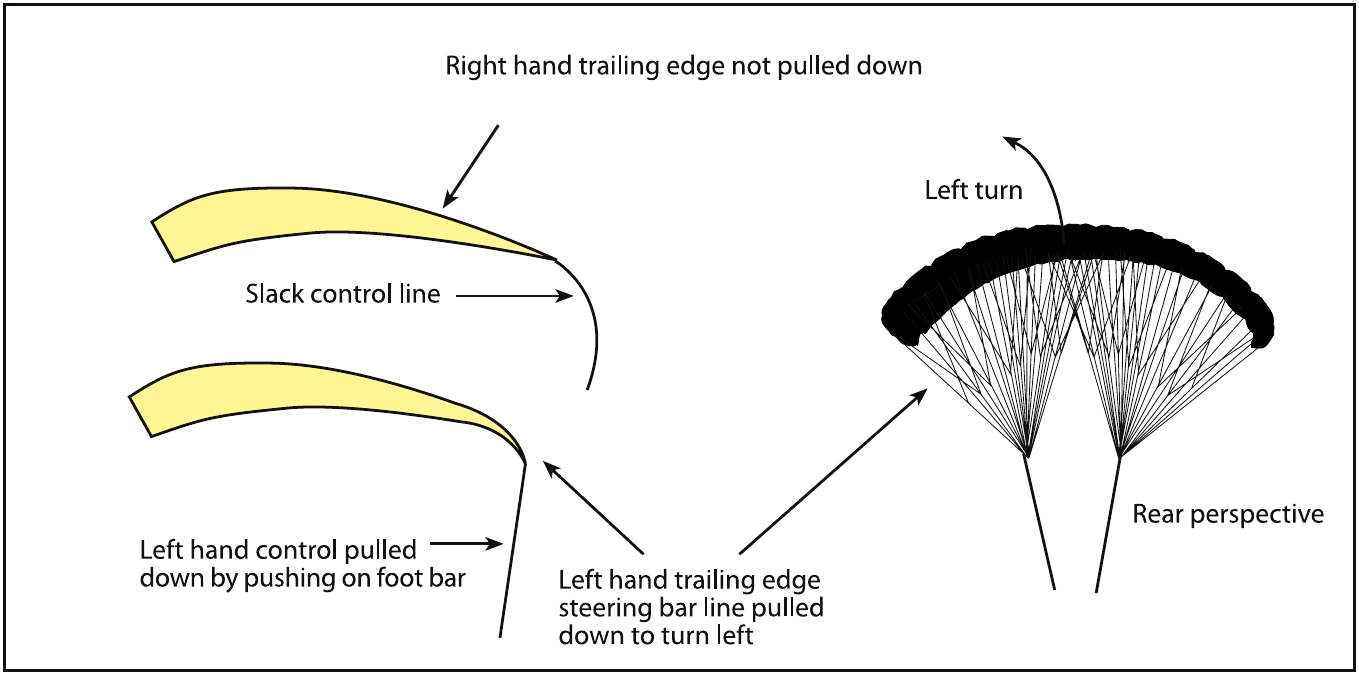
Steering lines run from the foot controls, through a series of pulleys parallel to the risers and suspension lines and are connected to the trailing edge of the corresponding side of the wing. The right steering line at the front end is attached to the right steering control at the cockpit (either foot or hand control), and the other end is directly attached to the trailing edge of the right side of the wing. Hence, when you push a foot steering control, you pull on a steering line and “pull down” the trailing edge of the corresponding side of the wing, which creates drag on that side of the wing’s trailing edge. The drag from the pulled-down trailing edge slows down and drops that side’s wing, and the opposite side of the wing simultaneously pivots around the vertical and longitudinal axes in a coordinated turn. The PPC is designed to fly straight into the relative wind, which is a key factor in the PPC’s ability to automatically perform a coordinated turn. [Figure 6-2] While airborne, you will turn in the same direction of the foot steering control that you push: push right foot—go right; push left foot—go left.
Similar to the pendulum effect with throttle, there can also be a swinging pendulum effect during turns. For example, if you are in a stabilized right, medium-banked turn (approximately 20 to 45 degrees bank), the pendulum is swinging out opposing the lift component of the wing. If an abrupt left turn is initiated, the wing will start to turn but the momentum of the cart cannot respond as quickly. This results in the pilot not coordinating the pendulum effect, and can be avoided with smoother and less abrupt turns so the cart can keep up with the wing.
Feel of the PPC
The ability to sense a flight condition, without relying on cockpit instrumentation, is often called “feel of the PPC,” but senses in addition to “feel” are involved.
Sounds inherent to flight are an important sense in developing “feel.” The air rushes past the PPC pilot, who is not typically masked by enclosures. When the level of sound increases, it indicates that speed is increasing. Also, the powerplant emits distinctive sound patterns in different conditions of flight as the RPM is adjusted. The sound of the engine in cruise flight may be different from that in a climb, and different again from that in a descent and can aid the pilot in estimating not only the present airspeed but the airspeed trend.
The sources of actual “feel” are important to the pilot. The pilot’s own body responds to forces of acceleration. These “G” loads imposed on the cart are also felt by the pilot. Increased G loads force the pilot down into the seat or raise the pilot against the seat belt. Radial accelerations produce side loadings, which will shift the pilot from side to side in the seat. These forces need not be strong, only perceptible by the pilot to be useful.
An accomplished pilot who has excellent “feel” for the PPC will be able to understand and coordinate the rate of bank change so as not to overshoot the desired course or bank, and ultimately be able to anticipate the pendulum effect. The wing trailing edge control surfaces move in the airstream and meet resistance proportional to the speed and weight of the cart. When the cart is heavy and flying faster, the steering controls are stiffer and harder to move because the wing internal pressure is higher. When the cart is light and flying slower, there is less force required and controls move easier.
The senses that contribute to “feel” of the airplane are inherent in people. However, “feel” must be developed. The flight instructor should direct the beginning pilot to be attuned to these senses and teach an awareness of their meaning as it relates to various conditions of flight. To do this effectively, the flight instructor must fully understand the difference between perceiving something and merely noticing it. It is a well established fact that the pilot who develops a “feel” for the PPC early in flight training will have little difficulty with advanced flight maneuvers.
Attitude Flying
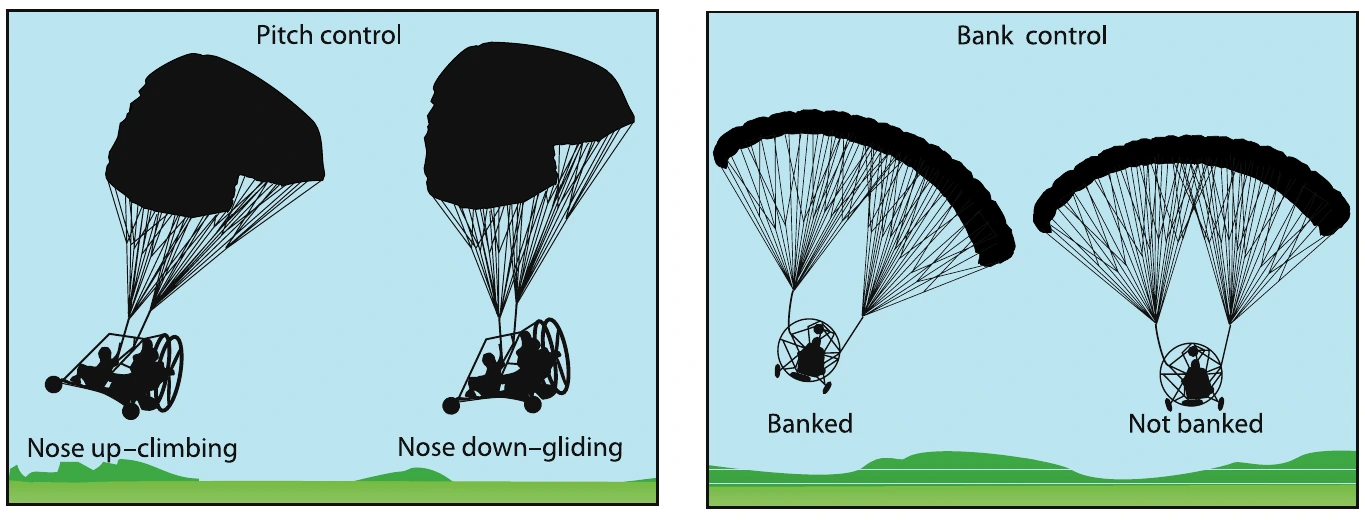
In a PPC, flying by attitude means visually establishing the aircraft’s attitude with reference to the natural horizon. [Figure 6-3] Attitude is the angular difference measured between an aircraft’s axis and the line of the Earth’s horizon. Pitch attitude is the angle formed by the longitudinal axis of the aircraft and the horizon. Bank attitude is the angle formed by the lateral axis with the horizon.
In attitude flying, the PPC pilot controls two components: pitch and bank.
- Pitch control is the control of the PPC about the lateral axis by using the throttle to raise and lower the nose in relation to the natural horizon.
- Bank control is control of the PPC about the longitudinal axis by use of the PPC steering controls to attain a desired bank angle in relation to the natural horizon.
Straight-and-Level Flight
It is impossible to emphasize too strongly the necessity for forming correct habits in flying straight and level. All other flight maneuvers are in essence a deviation from this fundamental flight maneuver. Perfection in straight-and-level flight will not come of itself. It is not uncommon to find a pilot whose basic flying ability consistently falls just short of minimum expected standards, and upon analyzing the reasons for the shortcomings to discover that the cause is the inability to properly fly straight and level.
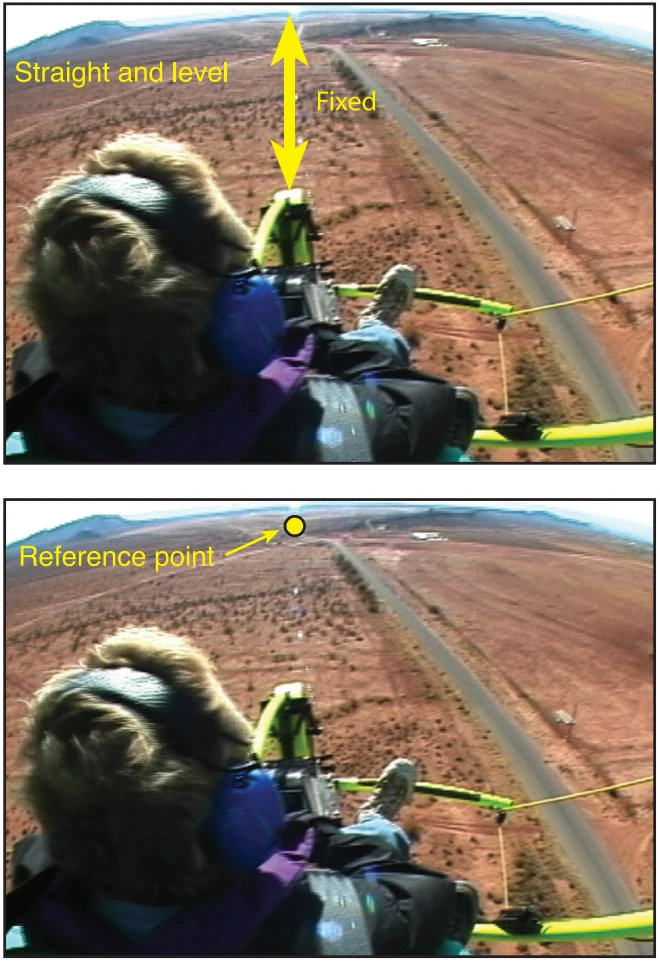
Straight-and-level flight is flight in which a constant heading and altitude are maintained. It is accomplished by making immediate and measured corrections for deviations in direction and altitude from unintentional slight turns, descents, and climbs. Level flight, at first, is a matter of consciously fixing the relationship of the position of some portion of the PPC, used as a reference point, with the horizon. In establishing the reference points, place the PPC in the desired position and select a reference point. No two pilots see this relationship exactly the same. The references will depend on where the pilot is sitting, the pilot’s height (whether short or tall), and the pilot’s manner of sitting. It is, therefore, important that during the fixing of this relationship, you sit in a normal manner; otherwise the points will not be the same when the normal position is resumed.
In learning to control the aircraft in level flight, it is important to use only slight control movements, just enough to produce the desired result. Pilots need to associate the apparent movement of the references with the forces which produce it. In this way, you can develop the ability to regulate the change desired in the aircraft’s attitude by the amount and direction of forces applied to the controls.
The pitch attitude for level flight (constant altitude) is usually obtained by selecting some portion of the aircraft’s nose as a reference point, and then keeping that point in a fixed position relative to the horizon. [Figure 6-4] Using the principles of attitude flying, that position should be cross-checked occasionally against the altimeter (if so equipped) to determine whether or not the pitch attitude is correct. If altitude is being gained or lost, the pitch attitude should be readjusted in relation to the horizon and then the altimeter rechecked to determine if altitude is now being maintained. The application of increasing and decreasing throttle is used to control this attitude.