
Chapter 6
Basic Flight Maneuvers
The greater the bank angle, the greater the throttle required to remain in level flight. Also, with increased bank, greater skill is required to reduce the pendulum effect when coming out of the turn or reversing the direction of the turn. [Figure 6-5]
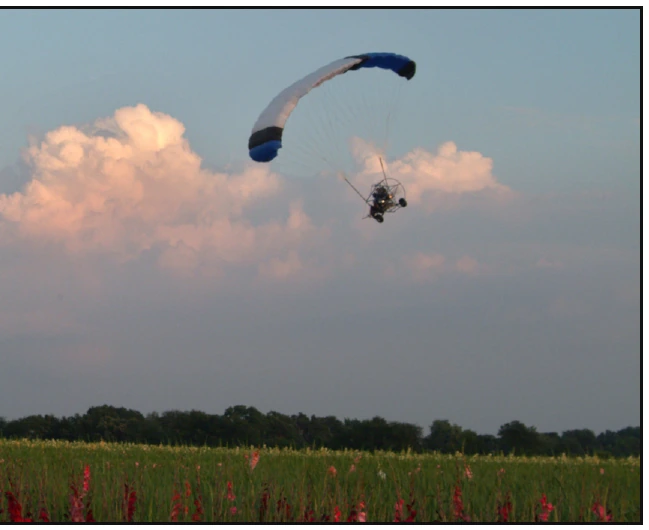
To stop the turn and return to straight-and-level flight, you need to smoothly release the steering control input to achieve pendulum effect coordination. The pendulum stability of the PPC will do the rest to return to the straight flightpath.
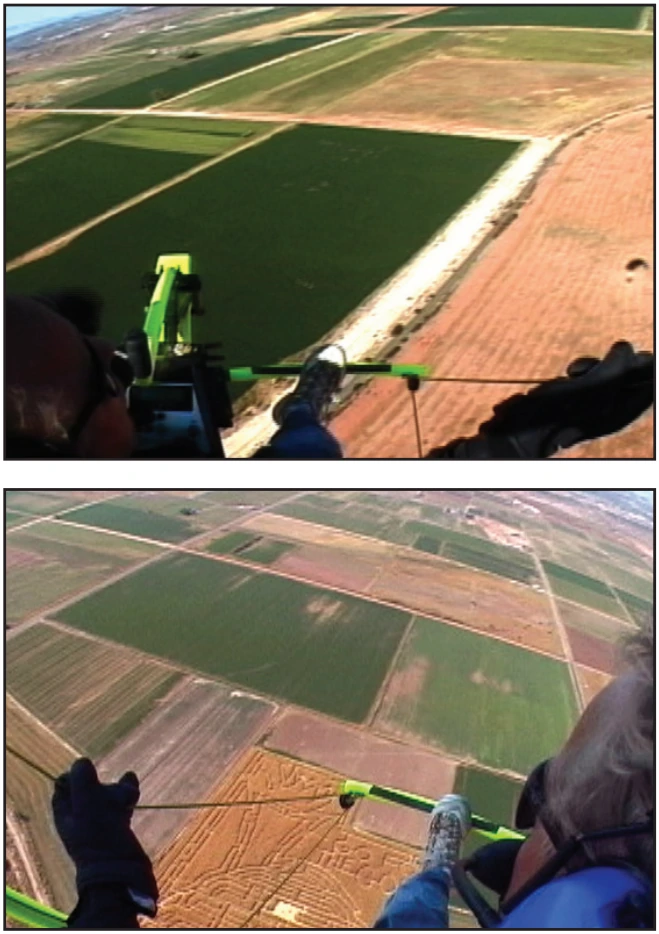
All PPC controls should be manipulated with a smooth and slow motion. This will prevent pilot induced oscillation (PIO). Whether you are pushing the throttle forward to increase the pitch angle, or pushing the steering control to induce a turn, both controls should be operated smoothly and slowly—whether applying input or removing it. [Figure 6-6]
The rate at which a PPC turns is directly related to the amount of steering control input. The more input, the quicker the rate of turn. Be advised, however, if full steering input is used and adequate throttle is not used to compensate, the vertical component of lift is reduced significantly and a rapid descent will ensue as the turn progresses.
Common Errors for Level Turns
- Failure to adequately clear the area before beginning the turn.
- Attempting to sit up straight, in relation to the ground, during a turn, rather than maintaining posture with the cart.
- Insufficient feel for the PPC.
- Gaining proficiency in turning in only one direction; not practicing turns in both directions.
- Failure to coordinate the throttle with the steering controls.
- Altitude gain/loss during the turn.
- Too great of a bank angle.
Climbs and Climbing Turns, Descents and Descending Turns
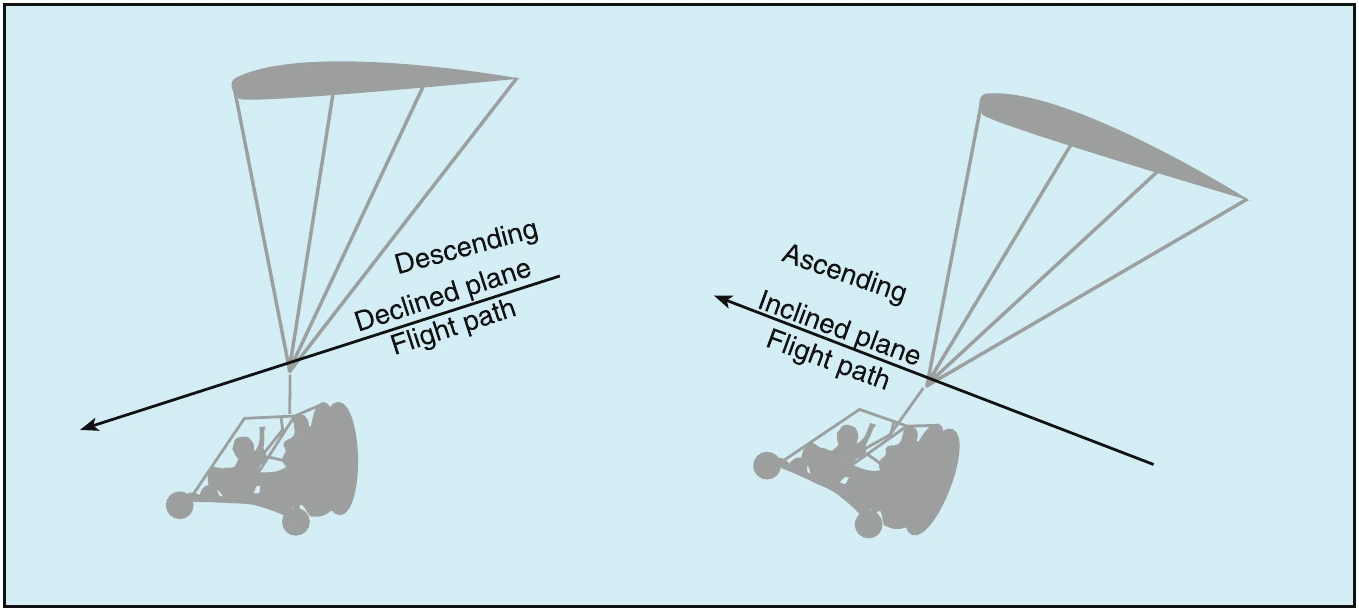
To gain altitude, increase engine RPM. To lose altitude, decrease engine RPM. When a PPC enters a climb, it changes flight path from level or descending (with level or declined planes) to ascending with an inclined plane. [Figure 6-7]
Straight climbs are achieved by increasing throttle above the level flight setting and holding a straight heading. Climbing turns require more throttle than straight climbs.
During any descent, the pilot must clear the area below and to the turning side (if applicable) before beginning these maneuvers.
To descend, reduce throttle below the straight and level RPM while flying straight or in a turn.
Throttle reduction is the basis for determining the descent rate. Banking the aircraft will also increase the descent rate. Greater bank angles result in greater descent rates.
Gliding
A glide is a basic maneuver in which the PPC loses altitude in a controlled descent with little or no engine power.
The PPC glide ratio is the distance the aircraft will travel forward in relation to the altitude it loses. For instance, if the aircraft travels 3,000 feet forward while descending 1,000 feet, its glide ratio is said to be 3 to 1. Wind is a major influence on the gliding distance in relationship to the PPC movement over the ground.
With a tailwind, the PPC will glide farther, perhaps a 5 to 1 glide ratio because of the higher groundspeed. Conversely, with a headwind or a crosswind, the aircraft will not glide as far, perhaps a 2 to 1 glide ratio, because of the slower groundspeed.
Typically, a PPC is designed to fly efficiently near the best lift to drag ratio. Adding flare will normally decrease your speed by increasing your drag and angle of attack, reducing your glide ratio. Do not attempt to “stretch” a glide by applying flare and reducing the airspeed. Attempts to stretch a glide will invariably result in an increase in the descent rate and angle of descent.