
Chapter 4
Assessing Risk
Introduction
Once hazards and their associated risks have been identified, they should be assessed to determine the overall risk level presented by each hazard. This process begins before the flight using the process outlined in the previous chapter. While risk assessment may seem subjective at first, pilots can learn effective risk-management through routine practice and application.
Risk Assessment Components
Risk is the composite of the likelihood (probability) and the severity (consequences) of a particular outcome. Both likelihood and severity can vary in magnitude.
Risk Likelihood
The following terms describe the likelihood of an outcome:
- Probable–An event may occur several times.
- Occasional–An event may occur sometime.
- Remote–An event is unlikely to occur but is possible.
- Improbable–An event is highly unlikely to occur.
To illustrate, consider the likelihood of exceeding airframe structural limits if penetrating a thunderstorm. It is likely that the airframe’s structural limits would be exceeded each time this occurs, making the likelihood “probable.”
As another example, consider a case where a pilot operates at an airport surrounded by rough terrain. The runways are just long enough to accommodate the aircraft. The possibility exists for a runway overrun on each landing. Given this data, an overrun could occur sometime, and the likelihood is “occasional.”
Risk Severity
The following terms describe the severity of an outcome.
- Catastrophic–Results in fatalities and/or total airframe loss.
- Critical–Severe injury or major airframe or property damage.
- Marginal–Minor injury or minor airframe or property damage.
- Negligible–Less than minor injury or damage.
To illustrate, consider the example of penetrating a thunderstorm. A loss of control event exceeding airframe structural limits could result in either severe injuries or fatalities and airframe loss, creating either a “critical” or a “catastrophic” outcome.
In the example of the marginal runway length, an overrun could cause major damage to the aircraft and possible severe injuries, or a “critical” outcome.
Using a Risk Assessment Matrix
Once risk likelihood and severity have been determined, the pilot may use a tabular matrix to find the composite of these two parameters. [Figure 4-1]
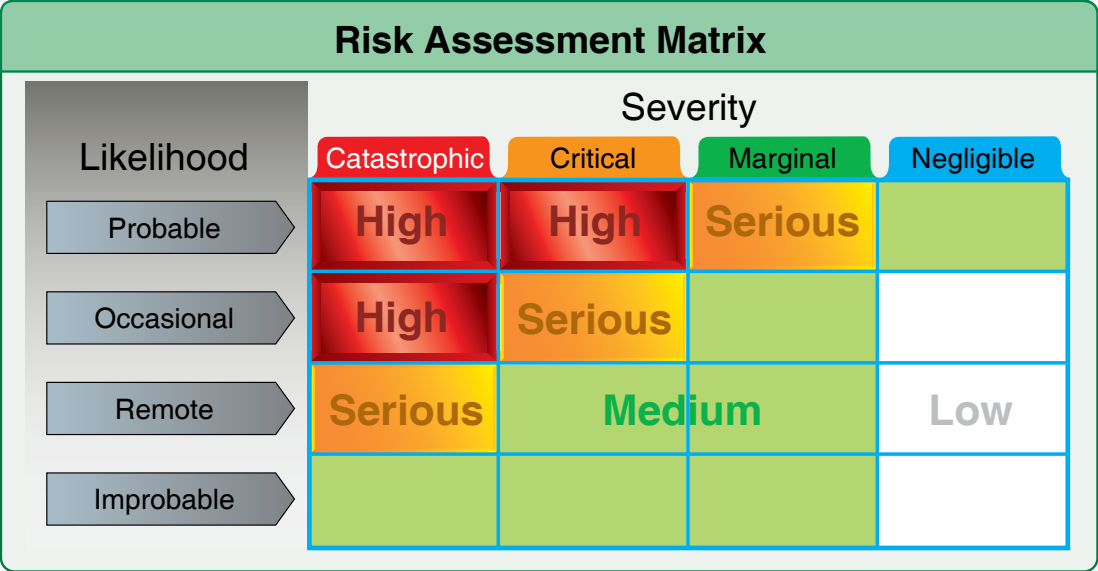
Cross-matching the likelihood and severity on the matrix determines the composite risk. A thunderstorm penetration, with “catastrophic” severity and either “probable” or “occasional” likelihood, constitutes a high (red) risk level. The runway overrun, with “critical” severity and “occasional” likelihood, constitutes a serious (yellow) risk level.
The medium (green) risk level implies a “go” decision for a planned or ongoing flight. However, in this case, risk should still be mitigated if possible.
The high (red) or serious (yellow) categories imply “no-go” unless the pilot finds a means to reduce the risk, such that the next iteration of risk assessment indicates a medium or low risk.