Chapter 12
Attitude Instrument Flying
Common Errors During Unusual Attitude Recoveries
- Failure to make proper pitch correction.
- Failure to make proper bank correction.
- Failure to make proper power correction.
- Overcontrol of pitch and/or bank attitude.
- Overcontrol of power.
- Excessive loss of altitude.
Emergencies
Emergencies under instrument flight are handled similarly to those occurring during VFR flight. A thorough knowledge of the helicopter and its systems, as well as good aeronautical knowledge and judgment, prepares you to better handle emergency situations. Safe operations begin with preflight planning and a thorough preflight. Plan your route of flight so that there are adequate landing sites in the event you have to make an emergency landing. Make sure you have all your resources, such as maps, publications, flashlights, and fire extinguishers readily available for use in an emergency.
During any emergency, you should first fly the aircraft.
This means that you should make sure the helicopter is under control, including the determination of emergency landing sites. Then perform the emergency checklist memory items, followed by written items in the RFM.
Once all these items are under control, you should notify ATC. Declare any emergency on the last assigned ATC frequency, or if one was not issued, transmit on the emergency frequency 121.5. Set the transponder to the emergency squawk code 7700. This code triggers an alarm or a special indicator in radar facilities.
Most in-flight emergencies, including low fuel and a complete electrical failure, require you to land as soon as possible. In the event of an electrical fire, turn all nonessential equipment off and land immediately. Some essential electrical instruments, such as the attitude indicator, may be required for a safe landing. A navigation radio failure may not require an immediate landing as long as the flight can continue safely. In this case, you should land as soon as practical. ATC may be able to provide vectors to a safe landing area. For the specific details on what to do during an emergency, you should refer to the RFM for the helicopter you are flying.
Land as soon as possible— Land without delay at the nearest suitable area, such as an open field, at which a safe approach and landing is assured.
Land immediately— The urgency of the landing is paramount. The primary consideration is to assure the survival of the occupants. Landing in trees, water, or other unsafe areas should be considered only as a last resort.
Land as soon as practical— The landing site and duration of flight are at the discretion of the pilot. Extended flight beyond the nearest approved landing area is not recommended.
Autorotations
Both straight-ahead and turning autorotations should be practiced by reference to instruments. This training will ensure that you can take prompt corrective action to maintain positive aircraft control in the event of an engine failure.
To enter autorotation, reduce collective pitch smoothly to maintain a safe rotor r.p.m. and apply pedal trim to keep the ball of the turn-and-slip indicator centered.
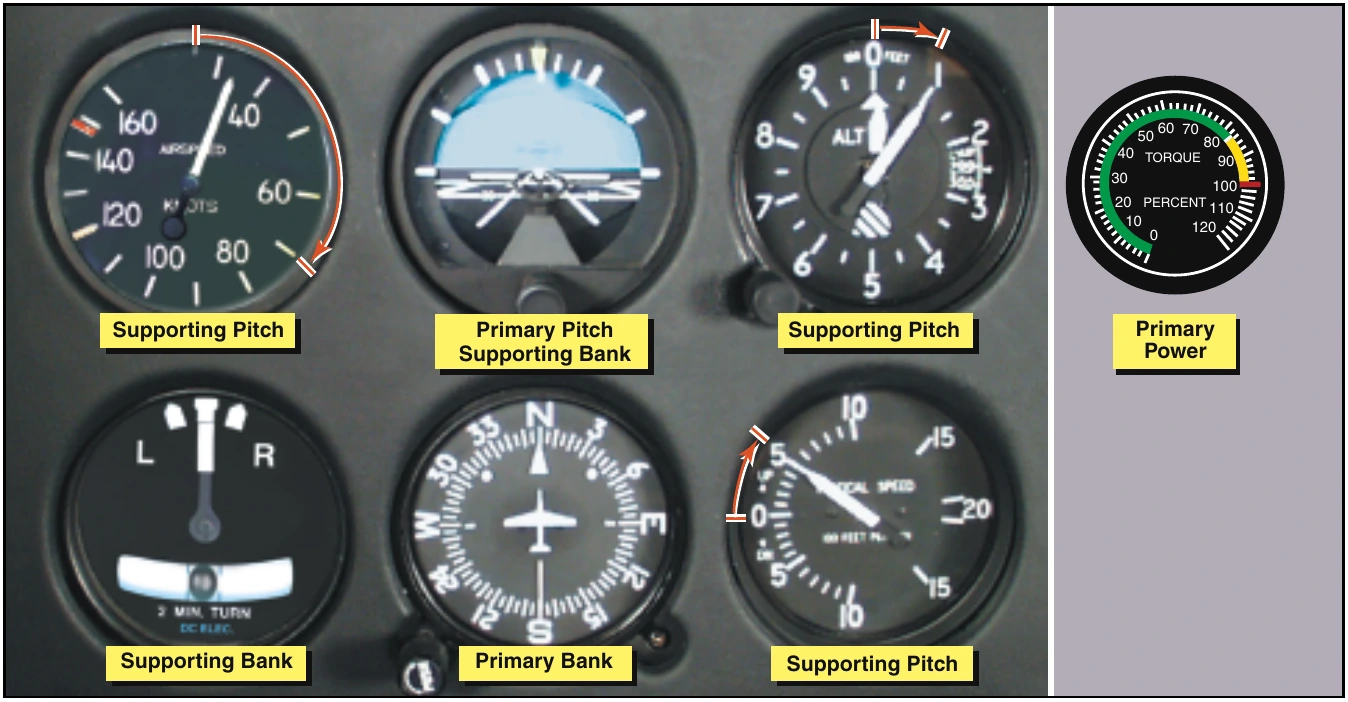
The pitch attitude of the helicopter should be approximately level as shown by the attitude indicator. The airspeed indicator is the primary pitch instrument and should be adjusted to the recommended autorotation speed. The heading indicator is primary for bank in a straight-ahead autorotation. In a turning autorotation, a standard rate turn should be maintained by reference to the needle of the turn-and-slip indicator.
Common Errors During Autorotations
- Uncoordinated entry due to improper pedal trim.
- Poor airspeed control due to improper pitch attitude.
- Poor heading control in straight-ahead autorotations.
- Failure to maintain proper rotor r.p.m.
- Failure to maintain a standard rate turn during turning autorotations.
Servo Failure
Most helicopters certified for single-pilot IFR flight are required to have autopilots, which greatly reduces pilot workload. If an autopilot servo fails, however, you have to resume manual control of the helicopter. How much your workload increases, depends on which servo fails. If a cyclic servo fails, you may want to land immediately as the workload increases tremendously.