
Chapter 12
Attitude Instrument Flying
Pitch and power control techniques are the same as those used during airspeed changes in straight-and-level flight. As discussed previously, the angle of bank necessary for a given rate of turn is proportional to the true airspeed. Since the turns are executed at standard rate, the angle of bank must be varied in direct proportion to the airspeed change in order to maintain a constant rate of turn. During a reduction of airspeed, you must decrease the angle of bank and increase the pitch attitude to maintain altitude and a standard rate turn.
The altimeter and the needle on the turn indicator should remain constant throughout the turn. The altimeter is primary for pitch control, and the turn needle is primary for bank control. The torque meter is primary for power control while the airspeed is changing. As the airspeed approaches the new indication, the airspeed indicator becomes primary for power control.
Two methods of changing airspeed in turns may be used. In the first method, airspeed is changed after the turn is established. In the second method, the airspeed change is initiated simultaneously with the turn entry.
The first method is easier, but regardless of the method used, the rate of cross-check must be increased as you reduce power. As the helicopter decelerates, check the altimeter and VSI for needed pitch changes, and the bank instruments for needed bank changes. If the needle of the turn-and-slip indicator shows a deviation from the desired deflection, change the bank. Adjust pitch attitude to maintain altitude. When the airspeed approaches that desired, the airspeed indicator becomes primary for power control. Adjust the torque meter to maintain the desired airspeed. Use pedal trim to ensure the maneuver is coordinated.
Until your control technique is very smooth, frequently cross-check the attitude indicator to keep from overcontrolling and to provide approximate bank angles appropriate for the changing airspeeds.
30° Bank Turn
A turn using 30° of bank is seldom necessary, or advisable, in IMC, but it is an excellent maneuver to increase your ability to react quickly and smoothly to rapid changes of attitude. Even though the entry and recovery technique are the same as for any other turn, you will probably find it more difficult to control pitch because of the decrease in vertical lift as the bank increases. Also, because of the decrease in vertical lift, there is a tendency to lose altitude and/or airspeed.
Therefore, to maintain a constant altitude and airspeed, additional power is required. You should not initiate a correction, however, until the instruments indicate the need for a correction. During the maneuver, note the need for a correction on the altimeter and vertical speed indicator, then check the indications on the attitude indicator, and make the necessary adjustments. After you have made this change, again check the altimeter and vertical speed indicator to determine whether or not the correction was adequate.
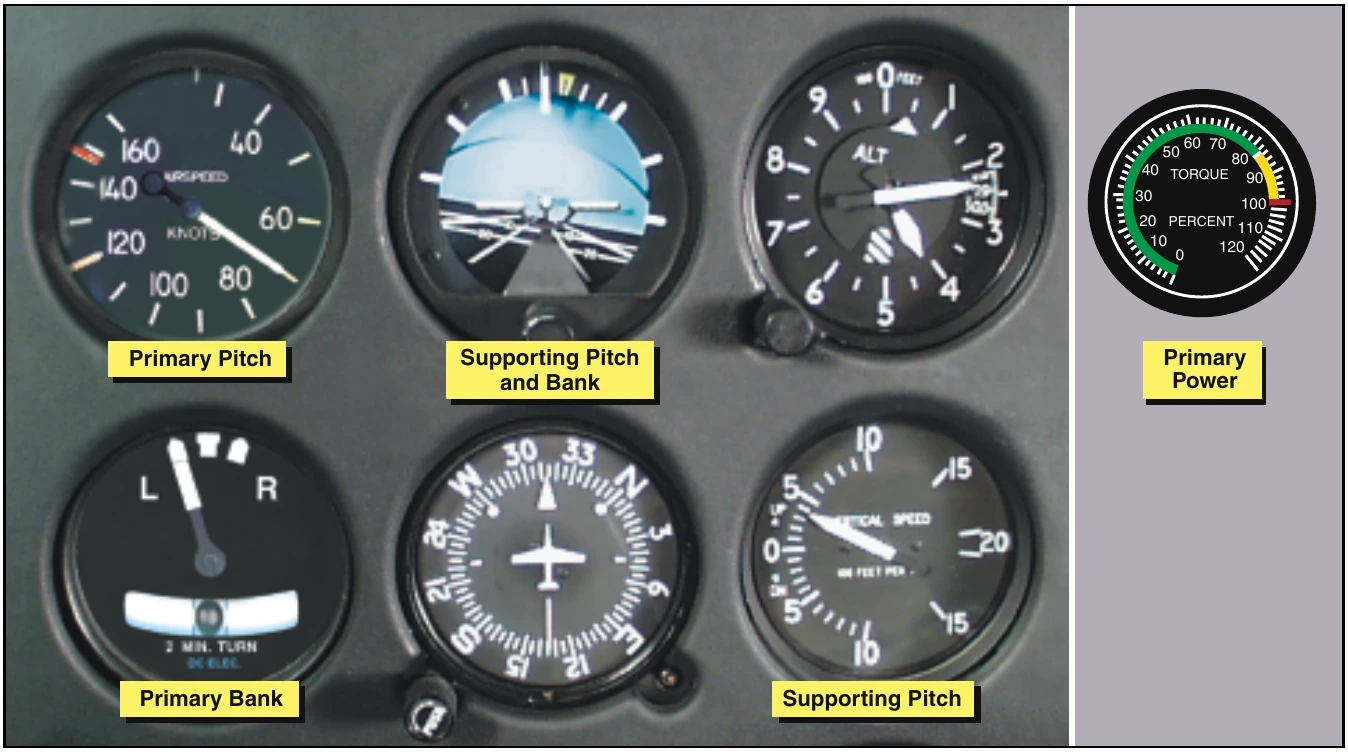
Climbing and Descending Turns
For climbing and descending turns, the techniques described earlier for straight climbs and descents and those for standard rate turns are combined. For practice, start the climb or descent and turn simultaneously. The primary and supporting instruments for a stabilized constant airspeed left climbing turn are illustrated in figure 12-21. The leveloff from a climbing or descending turn is the same as the leveloff from a straight climb or descent. To recover to straight-and-level flight, you may stop the turn and then level off, level off and then stop the turn, or simultaneously level off and stop the turn.
During climbing and descending turns, keep the ball of the turn indicator centered with pedal trim.
Compass Turns
The use of gyroscopic heading indicators make heading control very easy. However, if the heading indicator fails or your helicopter does not have one installed, you must use the magnetic compass for heading reference. When making compass-only turns, you need to adjust for the lead or lag created by acceleration and deceleration errors so that you roll out on the desired heading. When turning to a heading of north, the lead for the roll-out must include the number of degrees of your latitude plus the lead you normally use in recovery from turns. During a turn to a south heading, maintain the turn until the compass passes south the number of degrees of your latitude, minus your normal roll-out lead. For example, when turning from an easterly direction to north, where the latitude is 30°, start the roll-out when the compass reads 037° (30° plus one-half the 15° angle of bank, or whatever amount is appropriate for your rate of roll-out). When turning from an easterly direction to south, start the roll-out when the magnetic compass reads 203° (180° plus 30° minus one-half the angle of bank). When making similar turns from a westerly direction, the appropriate points at which to begin your roll-out would be 323° for a turn to north, and 157° for a turn to south.
Common Errors During Turns
- Failure to maintain desired turn rate.
- Failure to maintain altitude in level turns.
- Failure to maintain desired airspeed.
- Variation in the rate of entry and recovery.
- Failure to use proper lead in turns to a heading.
- Failure to properly compute time during timed turns.
- Failure to use proper leads and lags during the compass turns.
- Improper use of power.
- Failure to use proper pedal trim.
Unusual Attitudes
Any maneuver not required for normal helicopter instrument flight is an unusual attitude and may be caused by any one or a combination of factors, such as turbulence, disorientation, instrument failure, confusion, preoccupation with cockpit duties, carelessness in cross-checking, errors in instrument interpretation, or lack of proficiency in aircraft control. Due to the instability characteristics of the helicopter, unusual attitudes can be extremely critical. As soon as you detect an unusual attitude, make a recovery to straight-and-level flight as soon as possible with a minimum loss of altitude.
To recover from an unusual attitude, correct bank and pitch attitude, and adjust power as necessary. All components are changed almost simultaneously, with little lead of one over the other. You must be able to perform this task with and without the attitude indicator. If the helicopter is in a climbing or descending turn, correct bank, pitch, and power. The bank attitude should be corrected by referring to the turn-and-slip indicator and attitude indicator. Pitch attitude should be corrected by reference to the altimeter, airspeed indicator, VSI, and attitude indicator. Adjust power by referring to the airspeed indicator and torque meter.
Since the displacement of the controls used in recoveries from unusual attitudes may be greater than those for normal flight, take care in making adjustments as straight-and-level flight is approached. Cross-check the other instruments closely to avoid overcontrolling.