Chapter 12
Attitude Instrument Flying
During the preflight, ensure that the static ports are unobstructed. Before lift-off, set the altimeter to the current setting. If the altimeter indicates within 75 feet of the actual elevation, the altimeter is generally considered acceptable for use.
Vertical Speed Indicator
The vertical speed indicator (VSI) displays the rate of climb or descent in feet per minute (f.p.m.) by measuring how fast the ambient air pressure increases or decreases as the helicopter changes altitude. Since the VSI measures only the rate at which air pressure changes, air temperature has no effect on this instrument. [Figure 12-4]
There is a lag associated with the reading on the VSI, and it may take a few seconds to stabilize when showing rate of climb or descent. Rough control technique and turbulence can further extend the lag period and cause erratic and unstable rate indications. Some aircraft are equipped with an instantaneous vertical speed indicator (IVSI), which incorporates accelerometers to compensate for the lag found in the typical VSI.
Instrument Check
During the preflight, ensure that the static ports are unobstructed. Check to see that the VSI is indicating zero before lift-off. During takeoff, check for a positive rate of climb indication.
System Errors
The pitot-static system and associated instruments are usually very reliable. Errors are generally caused when the pitot or static openings are blocked. This may be caused by dirt, ice formation, or insects. Check the pitot and static openings for obstructions during the preflight.
It is also advisable to place covers on the pitot and static ports when the helicopter is parked on the ground.
The airspeed indicator is the only instrument affected by a blocked pitot tube. The system can become clogged in two ways. If the ram air inlet is clogged, but the drain hole remains open, the airspeed indicator registers zero, regardless of airspeed. If both the ram air inlet and the drain hole become blocked, pressure in the line is trapped, and the airspeed indicator reacts like an altimeter, showing an increase in airspeed with an increase in altitude, and a decrease in speed as altitude decreases. This occurs as long as the static port remains unobstructed.
If the static port alone becomes blocked, the airspeed indicator continues to function, but with incorrect readings. When you are operating above the altitude where the static port became clogged, the airspeed indicator reads lower than it should. Conversely, when operating below that altitude, the indicator reads higher than the correct value. The amount of error is proportional to the distance from the altitude where the static system became blocked. The greater the difference, the greater the error. With a blocked static system, the altimeter freezes at the last altitude and the VSI freezes at zero.
Both instruments are then unusable.
Some helicopters are equipped with an alternate static source, which may be selected in the event that the main static system becomes blocked. The alternate source generally vents into the cabin, where air pressures are slightly different than outside pressures, so the airspeed and altimeter usually read higher than normal. Correction charts may be supplied in the flight manual.
Gyroscopic Instruments
The three gyroscopic instruments that are required for instrument flight are the attitude indicator, heading indicator, and turn indicator. When installed in helicopters, these instruments are usually electrically powered.
Gyros are affected by two principles—rigidity in space and precession. Rigidity in space means that once a gyro is spinning, it tends to remain in a fixed position and resists external forces applied to it. This principle allows a gyro to be used to measure changes in attitude or direction.
Precession is the tilting or turning of a gyro in response to pressure. The reaction to this pressure does not occur at the point where it was applied; rather, it occurs at a point that is 90° later in the direction of rotation from where the pressure was applied. This principle allows the gyro to determine a rate of turn by sensing the amount of pressure created by a change in direction. Precession can also create some minor errors in some instruments.
Attitude Indicator
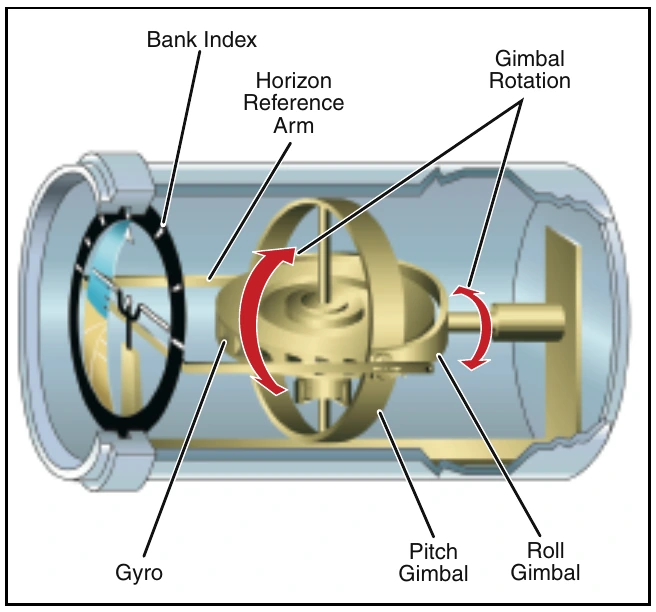
The attitude indicator provides a substitute for the natural horizon. It is the only instrument that provides an immediate and direct indication of the helicopter’s pitch and bank attitude. Since most attitude indicators installed in helicopters are electrically powered, there may be a separate power switch, as well as a warning flag within the instrument, that indicates a loss of power. A caging or “quick erect” knob may be included, so you can stabilize the spin axis if the gyro has tumbled. [Figure 12-5]