
Chapter 12
Attitude Instrument Flying
The magnetic compass can only give you reliable directional information if you understand its limitations and inherent errors. These include magnetic variation, compass deviation, and magnetic dip.
Magnetic Variation
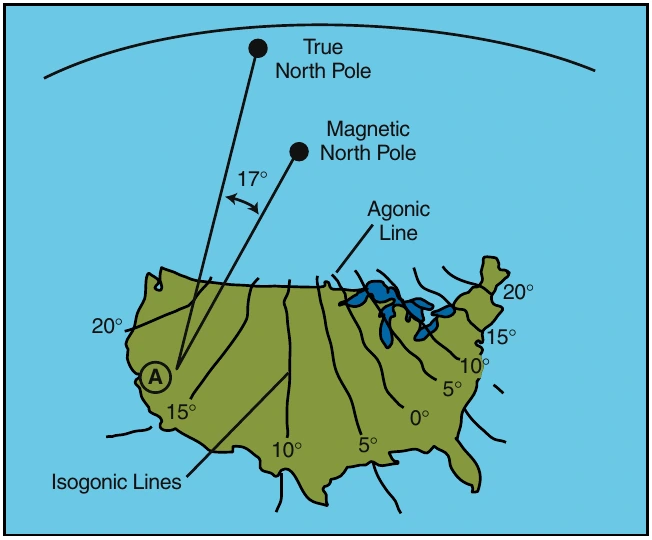
When you fly under visual flight rules, you ordinarily navigate by referring to charts, which are oriented to true north. Because the aircraft compass is oriented to magnetic north, you must make allowances for the difference between these poles in order to navigate properly. You do this by applying a correction called variation to convert a true direction to a magnet direction. Variation at a given point is the angular difference between the true and magnetic poles. The amount of variation depends on where you are located on the earth’s surface. Isogonic lines connect points where the variation is equal, while the agonic line defines the points where the variation is zero. [Figure 12-9]
Compass Deviation
Besides the magnetic fields generated by the earth, other magnetic fields are produced by metal and electrical accessories within the helicopter. These magnetic fields distort the earth’s magnet force and cause the compass to swing away from the correct heading. Manufacturers often install compensating magnets within the compass housing to reduce the effects of deviation. These magnets are usually adjusted while the engine is running and all electrical equipment is operating. Deviation error, however, cannot be completely eliminated; therefore, a compass correction card is mounted near the compass.
The compass correction card corrects for deviation that occurs from one heading to the next as the lines of force interact at different angles.
Magnetic Dip
Magnetic dip is the result of the vertical component of the earth’s magnetic field. This dip is virtually nonexistent at the magnetic equator, since the lines of force are parallel to the earth’s surface and the vertical component is minimal. As you move a compass toward the poles, the vertical component increases, and magnetic dip becomes more apparent at these higher latitudes.
Magnetic dip is responsible for compass errors during acceleration, deceleration, and turns.
Acceleration and deceleration errors are fluctuations in the compass during changes in speed. In the northern hemisphere, the compass swings toward the north during acceleration and toward the south during deceleration. When the speed stabilizes, the compass returns to an accurate indication. This error is most pronounced when you are flying on a heading of east or west, and decreases gradually as you fly closer to a north or south heading. The error does not occur when you are flying directly north or south. The memory aid, ANDS (Accelerate North, Decelerate South) may help you recall this error. In the southern hemisphere, this error occurs in the opposite direction.
Turning errors are most apparent when you are turning to or from a heading of north or south. This error increases as you near the poles as magnetic dip becomes more apparent. There is no turning error when flying near the magnetic equator. In the northern hemisphere, when you make a turn from a northerly heading, the compass gives an initial indication of a turn in the opposite direction. It then begins to show the turn in the proper direction, but lags behind the actual heading. The amount of lag decreases as the turn continues, then disappears as the helicopter reaches a heading of east or west. When you make a turn from a southerly heading, the compass gives an indication of a turn in the correct direction, but leads the actual heading. This error also disappears as the helicopter approaches an east or west heading.
Instrument Check
Prior to flight, make sure that the compass is full of fluid. During hover turns, the compass should swing freely and indicate known headings. Since that magnetic compass is required for all flight operations, the aircraft should never be flown with a faulty compass.
Instrument Flight
To achieve smooth, positive control of the helicopter during instrument flight, you need to develop three fundamental skills. They are instrument cross-check, instrument interpretation, and aircraft control.
Instrument Cross-Check
Cross-checking, sometimes referred to as scanning, is the continuous and logical observation of instruments for attitude and performance information. In attitude instrument flying, an attitude is maintained by reference to the instruments, which produces the desired result in performance. Due to human error, instrument error, and helicopter performance differences in various atmospheric and loading conditions, it is difficult to establish an attitude and have performance remain constant for a long period of time. These variables make it necessary for you to constantly check the instruments and make appropriate changes in the helicopter’s attitude. The actual technique may vary depending on what instruments are installed and where they are installed, as well as your experience and proficiency level. For this discussion, we will concentrate on the six basic flight instruments discussed earlier. [Figure 12-10]
At first, you may have a tendency to cross-check rapidly, looking directly at the instruments without knowing exactly what information you are seeking.
However, with familiarity and practice, the instrument cross-check reveals definite trends during specific flight conditions. These trends help you control the helicopter as it makes a transition from one flight condition to another.