
Chapter 13
Night Operations
Flying at night can be a very pleasant experience. The air is generally cooler and smoother, resulting in better helicopter performance and a more comfortable flight.
You generally also experience less traffic and less radio congestion.
Night Flight Physiology
Before discussing night operations, it is important you understand how your vision is affected at night and how to counteract the visual illusions, which you might encounter.
Vision in Flight
Vision is by far the most important sense that you have, and flying is obviously impossible without it.
Most of the things you perceive while flying are visual or heavily supplemented by vision. The visual sense is especially important in collision avoidance and depth perception. Your vision sensors are your eyes, even though they are not perfect in the way they function or see objects. Since your eyes are not always able to see all things at all times, illusions and blindspots occur. The more you understand the eye and how it functions, the easier it is to compensate for these illusions and blindspots.
The Eye
The eye works in much the same way as a camera. Both have an aperture, lens, method of focusing, and a surface for registering images. [Figure 13-1].
Vision is primarily the result of light striking a photosensitive layer, called the retina, at the back of the eye.
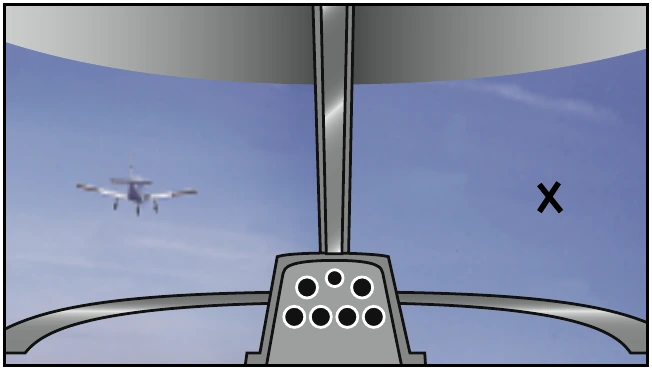
The retina is composed of light-sensitive cones and rods. The cones in your eye perceive an image best when the light is bright, while the rods work best in low light. The pattern of light that strikes the cones and rods is transmitted as electrical impulses by the optic nerve to the brain where these signals are interpreted as an image. The area where the optic nerve meets the retina contains no cones or rods, creating a blind spot in vision. Normally, each eye compensates for the other’s blind spot. [Figure 13-2]
Cones
Cones are concentrated around the center of the retina. They gradually diminish in number as the distance from the center increases. Cones allow you to perceive color by sensing red, blue, and green light.
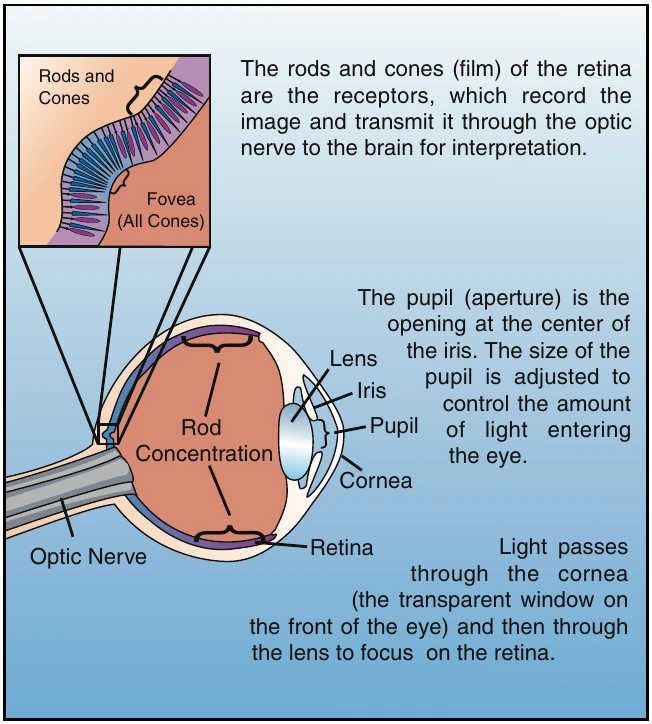
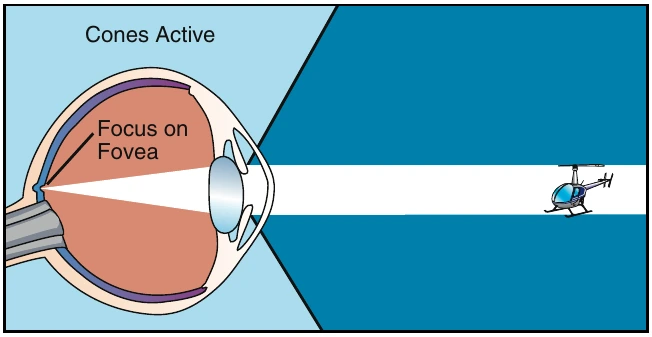
Directly behind the lens, on the retina, is a small, notched area called the fovea. This area contains only a high concentration of cone receptors. When you look directly at an object, the image is focused mainly on the fovea. The cones, however, do not function well in darkness, which explains why you cannot see color as vividly at night as you can during the day. [Figure 13-3]
Rods
The rods are our dim light and night receptors and are concentrated outside the fovea area. The number of rods increases as the distance from the fovea increases.
Rods sense images only in black and white. Because the rods are not located directly behind the pupil, they are responsible for much of our peripheral vision.