Chapter 14
Aeronautical Decision Making
Situational awareness is the accurate perception of the operational and environmental factors that affect the aircraft, pilot, and passengers during a specific period of time. Maintaining situational awareness requires an understanding of the relative significance of these factors and their future impact on the flight. When situationally aware, you have an overview of the total operation and are not fixated on one perceived significant factor. Some of the elements inside the aircraft to be considered are the status of aircraft systems, you as the pilot, and passengers. In addition, an awareness of the environmental conditions of the flight, such as spatial orientation of the helicopter, and its relationship to terrain, traffic, weather, and airspace must be maintained.
To maintain situational awareness, all of the skills involved in aeronautical decision making are used. For example, an accurate perception of your fitness can be achieved through self-assessment and recognition of hazardous attitudes. A clear assessment of the status of navigation equipment can be obtained through workload management, and establishing a productive relationship with ATC can be accomplished by effective resource use.
Obstacles to Maintaining Situational Awareness
Fatigue, stress, and work overload can cause you to fixate on a single perceived important item rather than maintaining an overall awareness of the flight situation. A contributing factor in many accidents is a distraction that diverts the pilot’s attention from monitoring the instruments or scanning outside the aircraft. Many cockpit distractions begin as a minor problem, such as a gauge that is not reading correctly, but result in accidents as the pilot diverts attention to the perceived problem and neglects to properly control the aircraft.
Complacency presents another obstacle to maintaining situational awareness. When activities become routine, you may have a tendency to relax and not put as much effort into performance. Like fatigue, complacency reduces your effectiveness in the cockpit. However, complacency is harder to recognize than fatigue, since everything is perceived to be progressing smoothly. For example, you have just dropped off another group of fire fighters for the fifth time that day. Without thinking, you hastily lift the helicopter off the ground, not realizing that one of the skids is stuck between two rocks. The result is dynamic rollover and a destroyed helicopter.
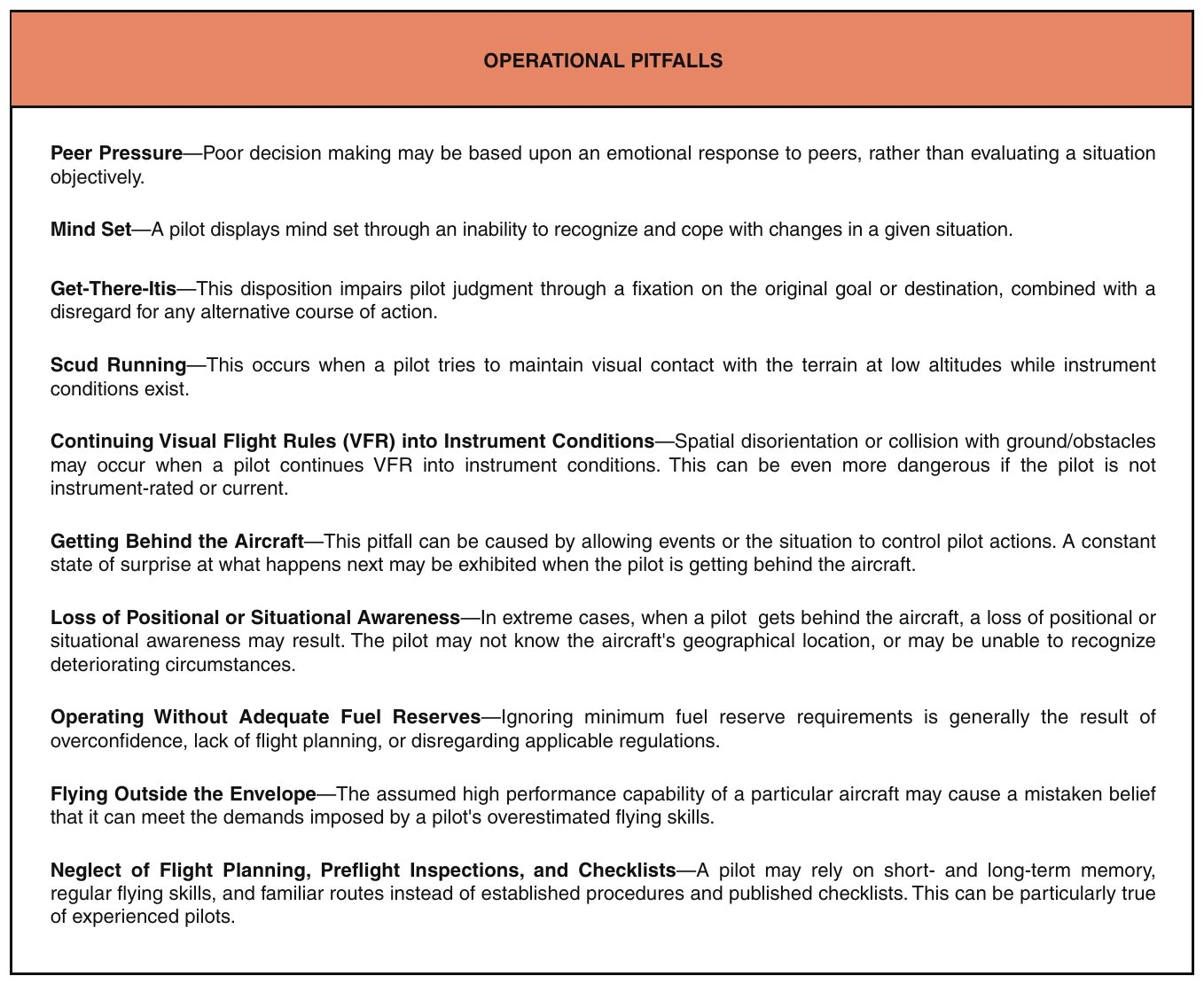
Operational Pitfalls
There are a number of classic behavioral traps into which pilots have been known to fall. Pilots, particularly those with considerable experience, as a rule, always try to complete a flight as planned, please passengers, and meet schedules. The basic drive to meet or exceed goals can have an adverse effect on safety, and can impose an unrealistic assessment of piloting skills under stressful conditions. These tendencies ultimately may bring about practices that are dangerous and often illegal, and may lead to a mishap. You will develop awareness and learn to avoid many of these operational pitfalls through effective ADM training. [Figure 14-10]