
Chapter 14
Aeronautical Decision Making
To make informed decisions during flight operations, you must be aware of the resources found both inside and outside the cockpit. Since useful tools and sources of information may not always be readily apparent, learning to recognize these resources is an essential part of ADM training. Resources must not only be identified, but you must develop the skills to evaluate whether you have the time to use a particular resource and the impact that its use will have upon the safety of flight. For example, the assistance of ATC may be very useful if you are lost. However, in an emergency situation when action needs be taken quickly, time may not be available to contact ATC immediately.
Internal Resources
Internal resources are found in the cockpit during flight. Since some of the most valuable internal resources are ingenuity, knowledge, and skill, you can expand cockpit resources immensely by improving these capabilities. This can be accomplished by frequently reviewing flight information publications, such as the CFRs and the AIM, as well as by pursuing additional training.
A thorough understanding of all the equipment and systems in the aircraft is necessary to fully utilize all resources. For example, advanced navigation and autopilot systems are valuable resources. However, if pilots do not fully understand how to use this equipment, or they rely on it so much that they become complacent, it can become a detriment to safe flight.
Checklists are essential cockpit resources for verifying that the aircraft instruments and systems are checked, set, and operating properly, as well as ensuring that the proper procedures are performed if there is a system malfunction or in-flight emergency. In addition, the FAA-approved rotorcraft flight manual, which is required to be carried on board the aircraft, is essential for accurate flight planning and for resolving in-flight equipment malfunctions. Other valuable cockpit resources include current aeronautical charts, and publications, such as the Airport/Facility Directory.
Passengers can also be a valuable resource. Passengers can help watch for traffic and may be able to provide information in an irregular situation, especially if they are familiar with flying. A strange smell or sound may alert a passenger to a potential problem. As pilot in command, you should brief passengers before the flight to make sure that they are comfortable voicing any concerns.
External Resources
Possibly the greatest external resources during flight are air traffic controllers and flight service specialists.
ATC can help decrease pilot workload by providing traffic advisories, radar vectors, and assistance in emergency situations. Flight service stations can provide updates on weather, answer questions about airport conditions, and may offer direction-finding assistance.
The services provided by ATC can be invaluable in enabling you to make informed in-flight decisions.
Workload Management
Effective workload management ensures that essential operations are accomplished by planning, prioritizing, and sequencing tasks to avoid work overload. As experience is gained, you learn to recognize future workload requirements and can prepare for high workload periods during times of low workload.
Reviewing the appropriate chart and setting radio frequencies well in advance of when they are needed helps reduce workload as your flight nears the airport.
In addition, you should listen to ATIS, ASOS, or AWOS, if available, and then monitor the tower frequency or CTAF to get a good idea of what traffic conditions to expect. Checklists should be performed well in advance so there is time to focus on traffic and ATC instructions. These procedures are especially important prior to entering a high-density traffic area, such as Class B airspace.
To manage workload, items should be prioritized. For example, during any situation, and especially in an emergency, you should remember the phrase “aviate, navigate, and communicate.” This means that the first thing you should do is make sure the helicopter is under control. Then begin flying to an acceptable landing area. Only after the first two items are assured, should you try to communicate with anyone.
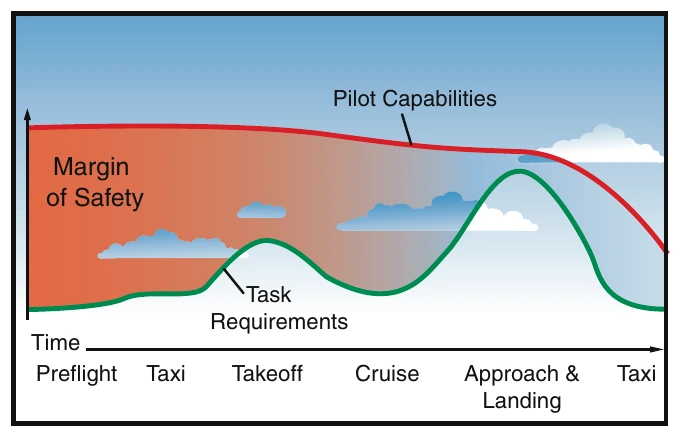
Another important part of managing workload is recognizing a work overload situation. The first effect of high workload is that you begin to work faster. As workload increases, attention cannot be devoted to several tasks at one time, and you may begin to focus on one item. When you become task saturated, there is no awareness of inputs from various sources, so decisions may be made on incomplete information, and the possibility of error increases. [Figure 14-9]
When becoming overloaded, you should stop, think, slow down, and prioritize. It is important that you understand options that may be available to decrease workload. For example, tasks, such as locating an item on a chart or setting a radio frequency, may be delegated to another pilot or passenger, an autopilot, if available, may be used, or ATC may be enlisted to provide assistance.