
Chapter 7
Weight and Balance
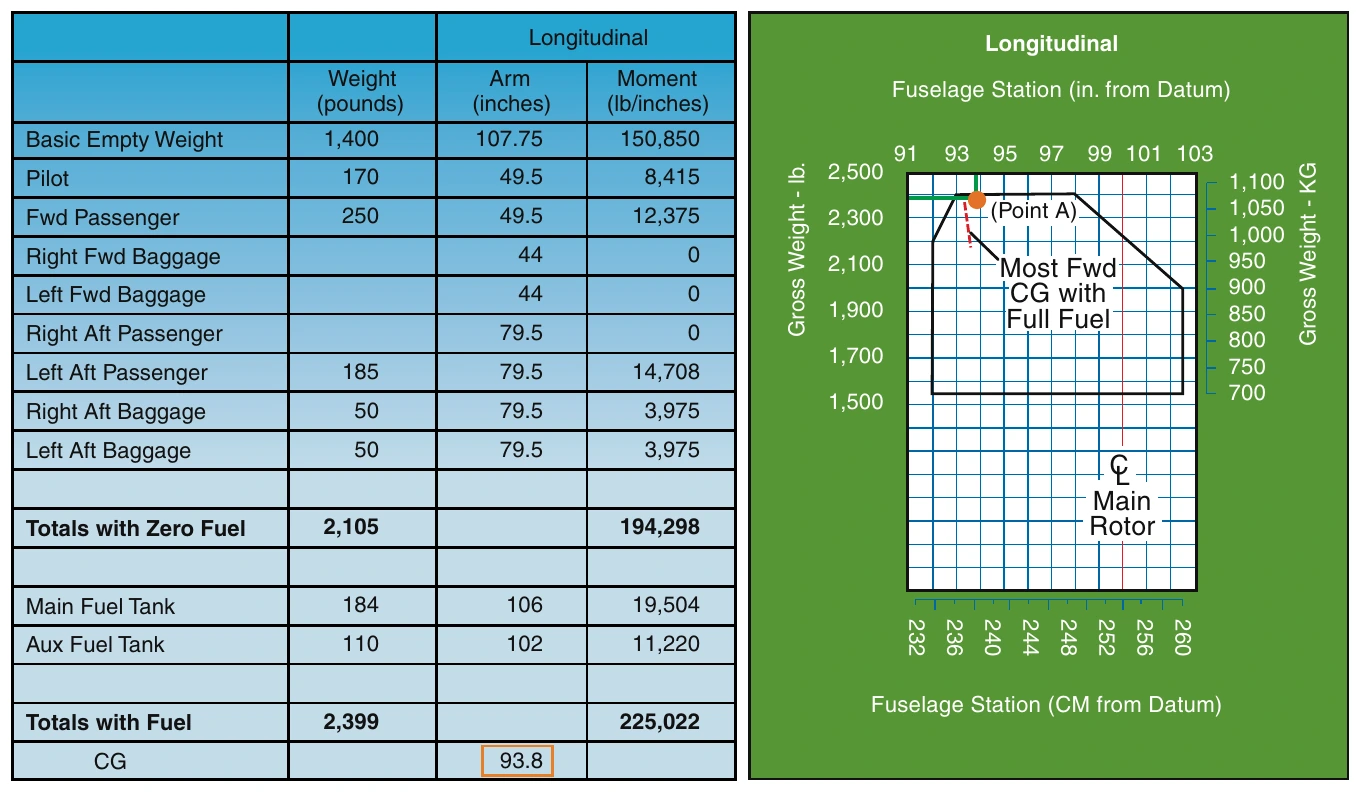
The combination method usually uses the computation method to determine the moments and center of gravity. Then, these figures are plotted on a graph to determine if they intersect within the acceptable envelope. Figure 7-9 illustrates that with a total weight of 2,399 pounds and a total moment of 225,022 pound-inches, the CG is 93.8. Plotting this CG against the weight indicates that the helicopter is loaded within the longitudinal limits (point A).
Calculating Lateral CG
Some helicopter manufacturers require that you also determine the lateral CG limits. These calculations are similar to longitudinal calculations. However, since the lateral CG datum line is almost always defined as the center of the helicopter, you are likely to encounter negative CGs and moments in your calculations.
Negative values are located on the left side while positive stations are located on the right.
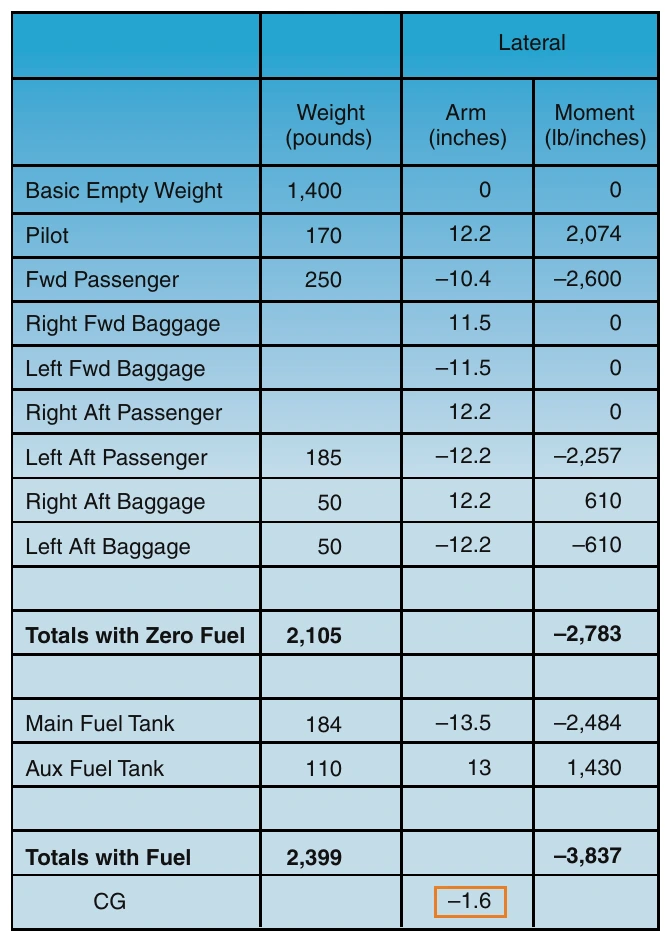
Refer to figure 7-10. When computing moment for the pilot, 170 pounds is multiplied by the arm of 12.2 inches resulting in a moment of 2,074 pound-inches. As with any weight placed right of the aircraft centerline, the moment is expressed as a positive value. The forward passenger sits left of the aircraft centerline. To compute this moment, multiply 250 pounds by –10.4 inches. The result is in a moment of –2,600 pound-inches. Once the aircraft is completely loaded, the weights and moments are totaled and the CG is computed. Since more weight is located left of the aircraft centerline, the resulting total moment is –3,837 pound-inches. To calculate CG, divide –3,837 pound-inches by the total weight of 2,399 pounds. The result is –1.6 inches, or a CG that is 1.6 inches left of the aircraft centerline.
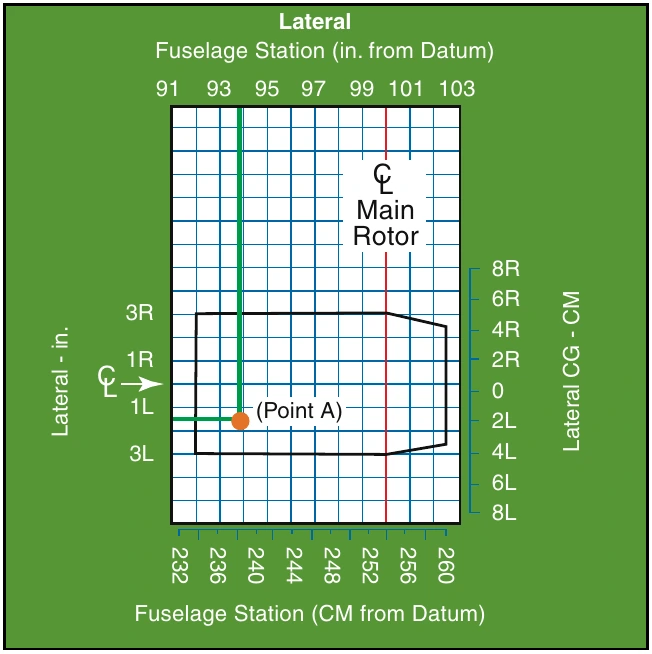
Lateral CG is often plotted against the longitudinal CG.
[Figure 7-11] In this case, –1.6 is plotted against 93.8, which was the longitudinal CG determined in the previous problem. The intersection of the two lines falls well within the lateral CG envelope.