
Chapter 7
Weight and Balance
- Follow the green arrows in figure 7-6. Enter the graph on the left side at 1,375 lb., the subtotal of the empty weight and the passenger weight. Move right to the yellow line. (point A)
- Move up and to the right, parallel to the baggage compartment loading lines to 1,400 lb. (Point B)
- Continue up and to the right, this time parallel to the fuel loading lines, to the total weight of 1,580 lb. (Point C).
Point C is within allowable weight and CG limits.
Sample Problem 2
Assume that the pilot in sample problem 1 discharges the passenger after using only 20 pounds of fuel.
ITEM POUNDS Basic empty weight 1,040 Pilot 135 Subtotal 1,175 (point D) Baggage compartment load 25 Subtotal 1,200 (point E) Fuel load 160 Total weight 1,360 (point F)
Follow the blue arrows in figure 7-6, starting at 1,175 lb. on the left side of the graph, then to point D, E, and F. Although the total weight of the helicopter is well below the maximum allowable gross weight, point F falls outside the aft allowable CG limit.
As you can see, it is important to reevaluate the balance in a helicopter whenever you change the loading. Unlike most airplanes, where discharging a passenger is unlikely to adversely affect the CG, off-loading a passenger from a helicopter could make the aircraft unsafe to fly. Another difference between helicopter and airplane loading is that most small airplanes carry fuel in the wings very near the center of gravity. Burning off fuel has little effect on the loaded CG. However, helicopter fuel tanks are often significantly behind the center of gravity. Consuming fuel from a tank aft of the rotor mast causes the loaded helicopter CG to move forward.
As standard practice, you should compute the weight and balance with zero fuel to verify that your helicopter remains within the acceptable limits as fuel is used.
Sample Problem 3
The loading chart used in the sample problems 1 and 2 is designed to graphically calculate the loaded center of gravity and show whether it is within limits, all on a single chart. Another type of loading chart calculates moments for each station. You must then add up these moments and consult another graph to determine whether the total is within limits. Although this method has more steps, the charts are sometimes easier to use.
To begin, record the basic empty weight of the helicopter, along with its total moment. Remember to use the actual weight and moment of the helicopter you are flying. Next, record the weights of the pilot, passengers, fuel, and baggage on a weight and balance worksheet.
Then, determine the total weight of the helicopter.
Once you have determined the weight to be within prescribed limits, compute the moment for each weight and for the loaded helicopter. Do this with a loading graph provided by the manufacturer. Use figure 7-7 to determine the moments for a pilot and passenger weighing 340 pounds and for 211 pounds of fuel.
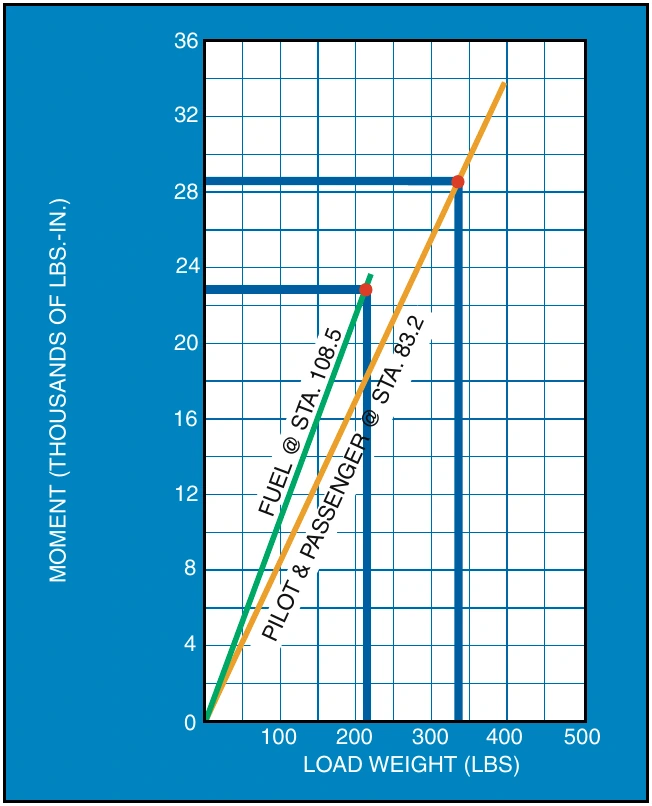
Start at the bottom scale labeled LOAD WEIGHT.
Draw a line from 211 pounds up to the line labeled “FUEL @ STA108.5.” Draw your line to the left to intersect the MOMENT scale and read the fuel moment (22.9 thousand lb.-inches). Do the same for the pilot/passenger moment. Draw a line from a weight of 340 pounds up to the line labeled “PILOT & PASSENGER @STA. 83.2.” Go left and read the pilot/passenger moment (28.3 thousand lb.-inches).
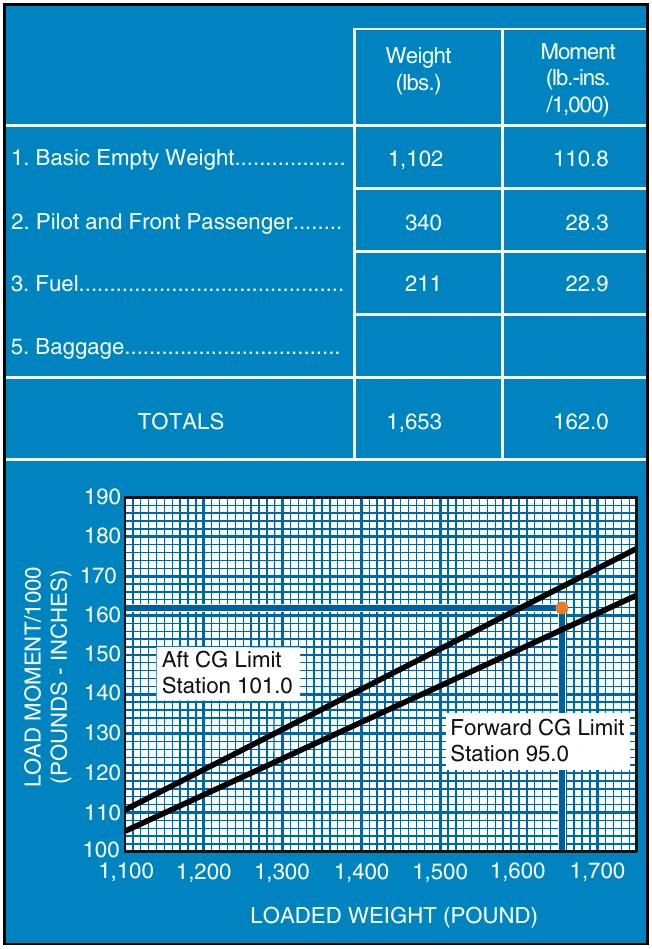
Reduction factors are often used to reduce the size of large numbers to manageable levels. In figure 7-7, the scale on the loading graph gives you moments in thousands of pound-inches. In most cases, when using this type of chart, you need not be concerned with reduction factors because the CG/moment envelope chart normally uses the same reduction factor. [Figure 7-8]
After recording the basic empty weight and moment of the helicopter, and the weight and moment for each item, total and record all weights and moments. Next, plot the calculated takeoff weight and moment on the sample moment envelope graph. Based on a weight of 1,653 pounds and a moment/1,000 of 162 pound-inches, the helicopter is within the prescribed CG limits.