
Chapter 7
Weight and Balance
If the weight of an object is multiplied by its arm, the result is known as its moment. You may think of moment as a force that results from an object’s weight acting at a distance. Moment is also referred to as the tendency of an object to rotate or pivot about a point. The farther an object is from a pivotal point, the greater its force.
Center of Gravity Computation
By totaling the weights and moments of all components and objects carried, you can determine the point where a loaded helicopter would balance. This point is known as the center of gravity.
Weight and Balance Methods
Since weight and balance is so critical to the safe operation of a helicopter, it is important to know how to check this condition for each loading arrangement.
Most helicopter manufacturers use one of two methods, or a combination of the methods, to check weight and balance conditions.
Computational Method
With the computational method, you use simple mathematics to solve weight and balance problems. The first step is to look up the basic empty weight and total moment for the particular helicopter you fly. If the center of gravity is given, it should also be noted. The empty weight CG can be considered the arm of the empty helicopter. This should be the first item recorded on the weight and balance form. [Figure 7-5]
Next, the weights of the oil, if required, pilot, passengers, baggage, and fuel are recorded. Use care in recording the weight of each passenger and baggage.
Recording each weight in its proper location is extremely important to the accurate calculation of a CG. Once you have recorded all of the weights, add them together to determine the total weight of the loaded helicopter.
Now, check to see that the total weight does not exceed the maximum allowable weight under existing conditions. In this case, the total weight of the helicopter is under the maximum gross weight of 3,200 pounds.
Once you are satisfied that the total weight is within prescribed limits, multiply each individual weight by its associated arm to determine its moment. Then, add the moments together to arrive at the total moment for the helicopter. Your final computation is to find the center of gravity of the loaded helicopter by dividing the total moment by the total weight.
After determining the helicopter’s weight and center of gravity location, you need to determine if the CG is within acceptable limits. In this example, the allowable range is between 106.0 inches and 114.2 inches. Therefore, the CG location is within the acceptable range. If the CG falls outside the acceptable limits, you will have to adjust the loading of the helicopter.
Loading Chart Method
You can determine if a helicopter is within weight and CG limits using a loading chart similar to the one in figure 7-6. To use this chart, first subtotal the empty weight, pilot, and passengers. This is the weight at which you enter the chart on the left. The next step is to follow the upsloping lines for baggage and then for fuel to arrive at your final weight and CG. Any value on or inside the envelope is within the range.
Sample Problem 1
Determine if the gross weight and center of gravity are within allowable limits under the following loading conditions for a helicopter based on the loading chart in figure 7-6.
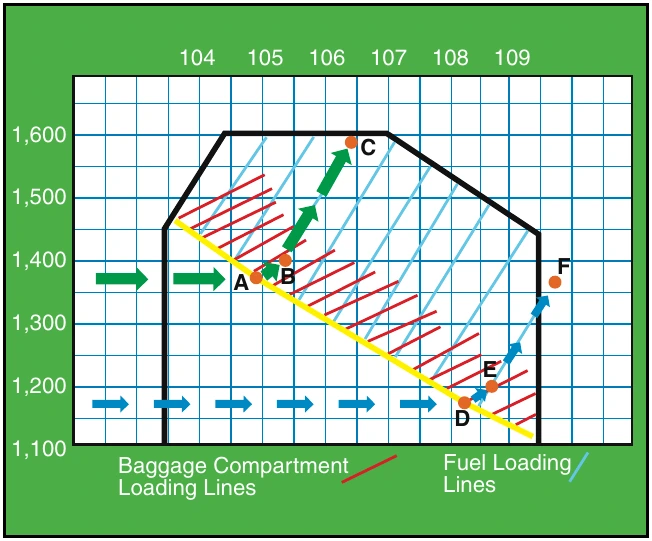
To use the loading chart for the helicopter in this example, you must add up the items in a certain order. The maximum allowable gross weight is 1,600 pounds.
ITEM POUNDS Basic empty weight 1,040 Pilot 135 Passenger 200 Subtotal 1,375 (point A) Baggage compartment load 25 Subtotal 1,400 (point B) Fuel load (30 gallons) 180 Total weight 1,580 (point C)