
Chapter 8
Performance
Sample Problem 2
Once you reach the remote location in the previous problem, you will need to hover out of ground effect for some of the pictures. The pressure altitude at the remote site is 9,000 feet, and you will use 50 pounds of fuel getting there. (The new gross weight is now 1,200 pounds.) The temperature will remain at +15°C.
Using figure 8-3, can you accomplish the mission?
Enter the chart at 9,000 feet (point A) and proceed to point B (+15°C). From there determine that the maximum gross weight to hover out of ground effect is approximately 1,130 pounds (point C). Since your gross weight is higher than this value, you will not be able to hover with these conditions. To accomplish the mission, you will have to remove approximately 70 pounds before you begin the flight.
These two sample problems emphasize the importance of determining the gross weight and hover ceiling throughout the entire flight operation. Being able to hover at the takeoff location with a certain gross weight does not ensure the same performance at the landing point. If the destination point is at a higher density altitude because of higher elevation, temperature, and/or relative humidity, more power is required to hover. You should be able to predict whether hovering power will be available at the destination by knowing the temperature and wind conditions, using the performance charts in the helicopter flight manual, and making certain power checks during hover and in flight prior to commencing the approach and landing.
Takeoff Performance
If takeoff charts are included in the rotorcraft flight manual, they usually indicate the distance it takes to clear a 50-foot obstacle based on various conditions of weight, pressure altitude, and temperature. In addition, the values computed in the takeoff charts usually assume that the flight profile is per the applicable height-velocity diagram.
Sample Problem 3
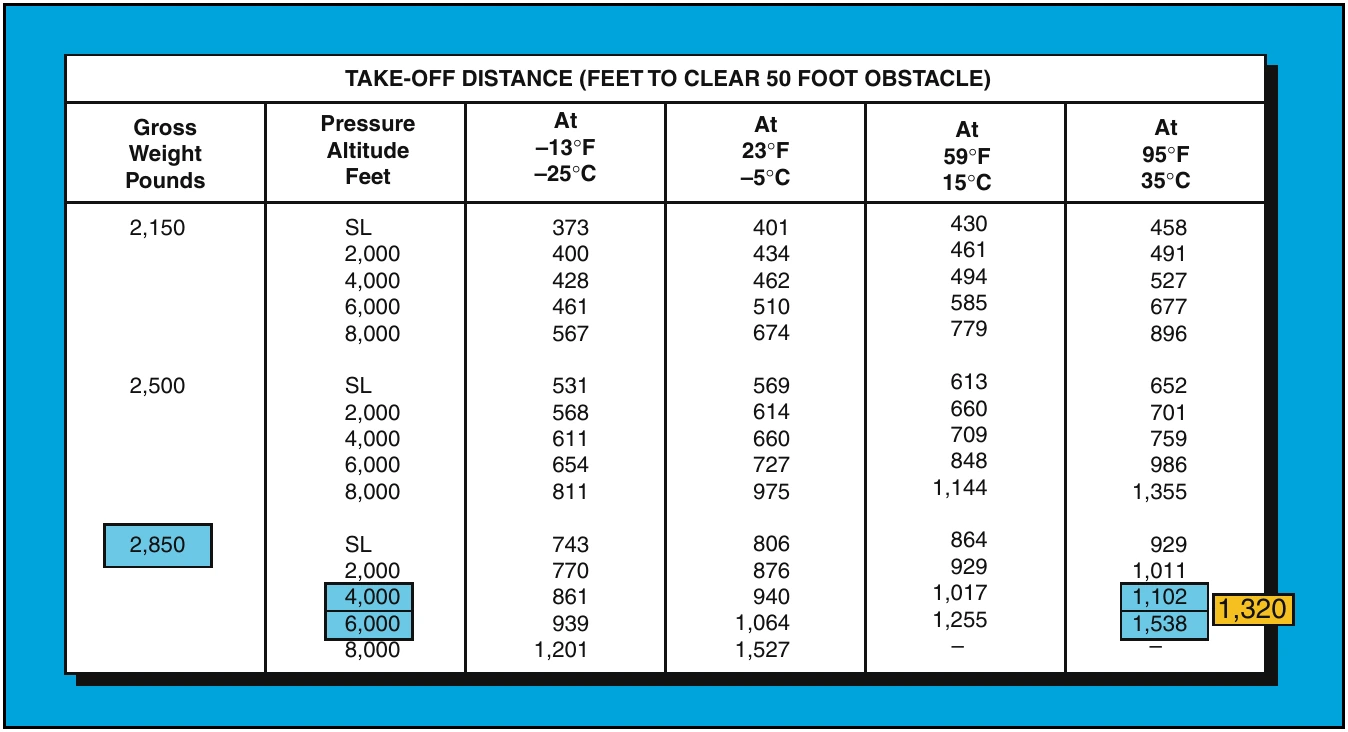
In this example, determine the distance to clear a 50-foot obstacle with the following conditions:
Pressure Altitude..................................5,000 feet Takeoff Gross Weight.....................2,850 pounds
Using figure 8-4, locate 2,850 pounds in the first column. Since the pressure altitude of 5,000 feet is not one of the choices in column two, you have to interpolate between the values from the 4,000- and 6,000-foot lines. Follow each of these rows out to the column headed by 95°F. The values are 1,102 feet and 1,538 feet. Since 5,000 is halfway between 4,000 and 6,000, the interpolated value should be halfway between these two values or 1,320 feet ([1,102 + 1,538] ÷ 2 = 1,320).
Climb Performance
Most of the factors affecting hover and takeoff performance also affect climb performance. In addition, turbulent air, pilot techniques, and overall condition of the helicopter can cause climb performance to vary.
A helicopter flown at the “best rate-of-climb” speed will obtain the greatest gain in altitude over a given period of time. This speed is normally used during the climb after all obstacles have been cleared and is usually maintained until reaching cruise altitude. Rate of climb must not be confused with angle of climb.
Angle of climb is a function of altitude gained over a given distance. The best rate-of-climb speed results in the highest climb rate, but not the steepest climb angle and may not be sufficient to clear obstructions. The “best angle-of-climb” speed depends upon the power available. If there is a surplus of power available, the helicopter can climb vertically, so the best angle-of-climb speed is zero.
Wind direction and speed have an effect on climb performance, but it is often misunderstood. Airspeed is the speed at which the helicopter is moving through the atmosphere and is unaffected by wind.
Atmospheric wind affects only the groundspeed, or speed at which the helicopter is moving over the earth’s surface. Thus, the only climb performance affected by atmospheric wind is the angle of climb and not the rate of climb.
Sample Problem 4
Determine the best rate of climb using figure 8-5. Use the following conditions: