
Chapter 9
Basic Flight Maneuvers
Before beginning any turn, the area in the direction of the turn must be cleared not only at the helicopter’s altitude, but also above and below. To enter a turn from straight-and-level flight, apply sideward pressure on the cyclic in the direction the turn is to be made. This is the only control movement needed to start the turn. Do not use the pedals to assist the turn. Use the pedals only to compensate for torque to keep the helicopter in longitudinal trim. [Figure 9-12]
How fast the helicopter banks depends on how much lateral cyclic pressure you apply. How far the helicopter banks (the steepness of the bank) depends on how long you displace the cyclic. After establishing the proper bank angle, return the cyclic toward the neutral position. Increase the collective and throttle to maintain altitude and r.p.m. As the torque increases, increase the proper antitorque pedal pressure to maintain longitudinal trim. Depending on the degree of bank, additional forward cyclic pressure may be required to maintain airspeed.
Rolling out of the turn to straight-and-level flight is the same as the entry into the turn except that pressure on the cyclic is applied in the opposite direction. Since the helicopter continues to turn as long as there is any bank, start the rollout before reaching the desired heading.
The discussion on level turns is equally applicable to making turns while climbing or descending. The only difference being that the helicopter is in a climbing or descending attitude rather than that of level flight. If a simultaneous entry is desired, merely combine the techniques of both maneuvers—climb or descent entry and turn entry. When recovering from a climbing or descending turn, the desired heading and altitude are rarely reached at the same time. If the heading is reached first, stop the turn and maintain the climb or descent until reaching the desired altitude. On the other hand, if the altitude is reached first, establish the level flight attitude and continue the turn to the desired heading.
Slips
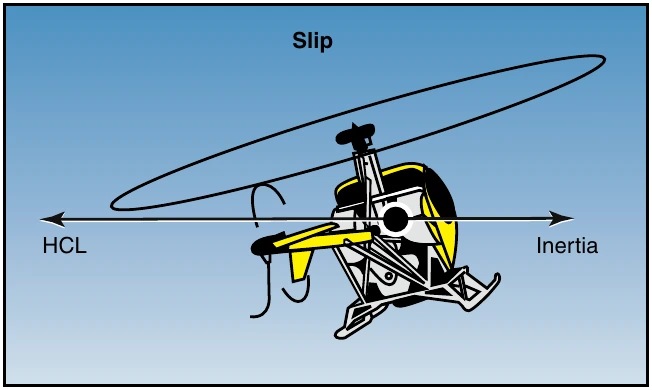
A slip occurs when the helicopter slides sideways toward the center of the turn. [Figure 9-13] It is caused by an insufficient amount of antitorque pedal in the direction of the turn, or too much in the direction opposite the turn, in relation to the amount of power used. In other words, if you hold improper antitorque pedal pressure, which keeps the nose from following the turn, the helicopter slips sideways toward the center of the turn.
Skids
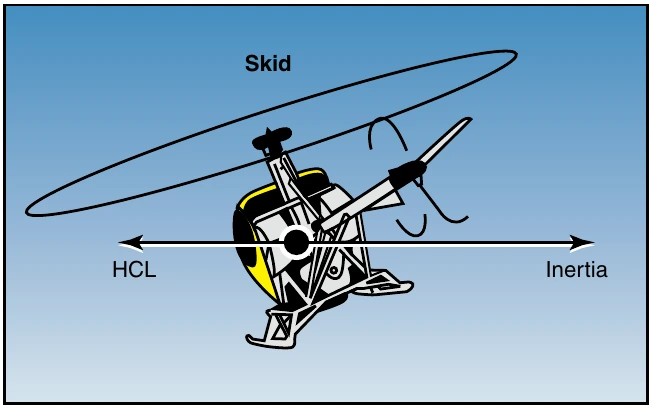
A skid occurs when the helicopter slides sideways away from the center of the turn. [Figure 9-14] It is caused by too much antitorque pedal pressure in the direction of the turn, or by too little in the direction opposite the turn in relation to the amount of power used. If the helicopter is forced to turn faster with increased pedal pressure instead of by increasing the degree of the bank, it skids sideways away from the center of the turn instead of flying in its normal curved pattern.
In summary, a skid occurs when the rate of turn is too fast for the amount of bank being used, and a slip occurs when the rate of turn is too slow for the amount of bank being used.
Common Errors
- Using antitorque pedal pressures for turns. This is usually not necessary for small helicopters.
- Slipping or skidding in the turn.
Normal Climb
The entry into a climb from a hover has already been discussed under “Normal Takeoff from a Hover;” therefore, this discussion is limited to a climb entry from cruising flight.
Technique
To enter a climb from cruising flight, apply aft cyclic to obtain the approximate climb attitude. Simultaneously increase the collective and throttle to obtain climb power and maintain r.p.m. In a counterclockwise rotor system, increase the left antitorque pedal pressure to compensate for the increased torque. As the airspeed approaches normal climb airspeed, adjust the cyclic to hold this airspeed. Throughout the maneuver, maintain climb attitude, heading, and airspeed with the cyclic; climb power and r.p.m. with the collective and throttle; and longitudinal trim with the antitorque pedals.
To level off from a climb, start adjusting the attitude to the level flight attitude a few feet prior to reaching the desired altitude. The amount of lead depends on the rate of climb at the time of level-off (the higher the rate of climb, the more the lead). Generally, the lead is 10 percent of the climb rate. For example, if your climb rate is 500 feet per minute, you should lead the level-off by 50 feet.
To begin the level-off, apply forward cyclic to adjust and maintain a level flight attitude, which is slightly nose low. You should maintain climb power until the airspeed approaches the desired cruising airspeed, then lower the collective to obtain cruising power and adjust the throttle to obtain and maintain cruising r.p.m.
Throughout the level-off, maintain longitudinal trim and heading with the antitorque pedals.