
Chapter 9
Basic Flight Maneuvers
During a crosswind taxi, hold the cyclic into the wind a sufficient amount to eliminate any drifting movement.
Common Errors
- Improper use of cyclic.
- Failure to use antitorque pedals for heading control.
- Improper use of the controls during crosswind operations.
- Failure to maintain proper r.p.m.
Normal Takeoff From a Hover
A normal takeoff from a hover is an orderly transition to forward flight and is executed to increase altitude safely and expeditiously. During the takeoff, fly a profile that avoids the cross-hatched or shaded areas of the height-velocity diagram.
Technique
Refer to figure 9-8 (position 1). Bring the helicopter to a hover and make a performance check, which includes power, balance, and flight controls. The power check should include an evaluation of the amount of excess power available; that is, the difference between the power being used to hover and the power available at the existing altitude and temperature conditions. The balance condition of the helicopter is indicated by the position of the cyclic when maintaining a stationary hover. Wind will necessitate some cyclic deflection, but there should not be an extreme deviation from neutral. Flight controls must move freely, and the helicopter should respond normally. Then visually clear the area all around.
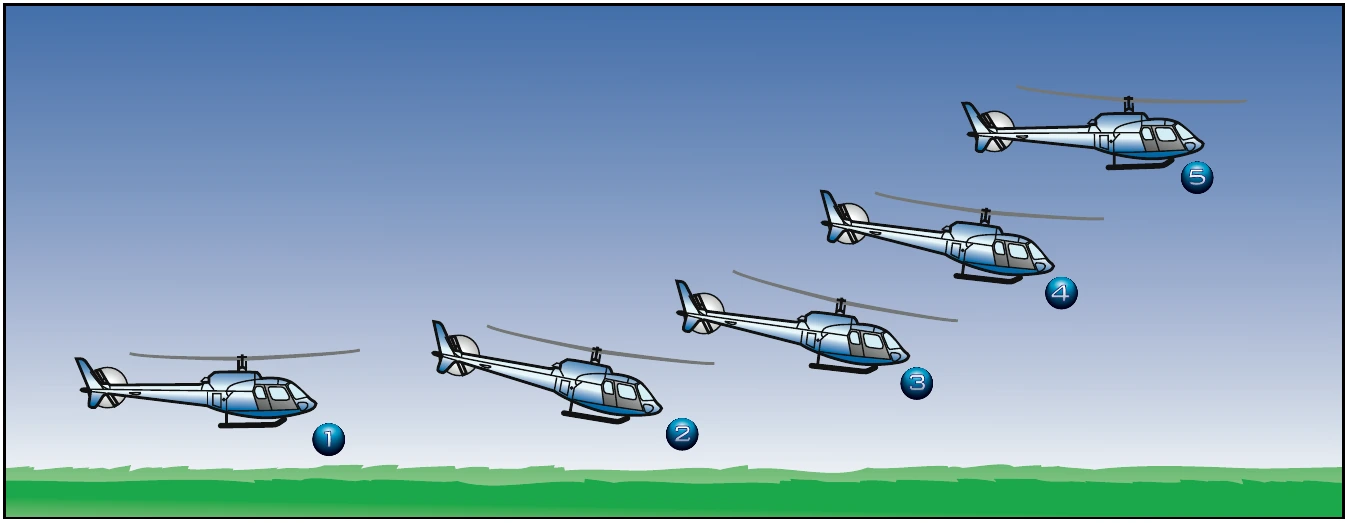
Start the helicopter moving by smoothly and slowly easing the cyclic forward (position 2). As the helicopter starts to move forward, increase the collective, as necessary, to prevent the helicopter from sinking and adjust the throttle to maintain r.p.m. The increase in power requires an increase in the proper antitorque pedal to maintain heading. Maintain a straight takeoff path throughout the takeoff. As you accelerate through effective translational lift (position 3), the helicopter begins to climb and the nose tends to rise due to increased lift.
At this point adjust the collective to obtain normal climb power and apply enough forward cyclic to overcome the tendency of the nose to rise. At position 4, hold an attitude that allows a smooth acceleration toward climbing airspeed and a commensurate gain in altitude so that the takeoff profile does not take you through any of the cross-hatched or shaded areas of the height-velocity diagram. As airspeed increases (position 5), the streamlining of the fuselage reduces engine torque effect, requiring a gradual reduction of antitorque pedal pressure. As the helicopter continues to climb and accelerate to best rate of climb, apply aft cyclic pressure to raise the nose smoothly to the normal climb attitude.
Common Errors
- Failing to use sufficient collective pitch to prevent loss of altitude prior to attaining translational lift.
- Adding power too rapidly at the beginning of the transition from hovering to forward flight without forward cyclic compensation, causing the helicopter to gain excessive altitude before acquiring airspeed.
- Assuming an extreme nose-down attitude near the surface in the transition from hovering to forward flight.
- Failing to maintain a straight flight path over the surface (ground track).
- Failing to maintain proper airspeed during the climb.
- Failing to adjust the throttle to maintain proper r.p.m.
Normal Takeoff From the Surface
Normal takeoff from the surface is used to move the helicopter from a position on the surface into effective translational lift and a normal climb using a minimum amount of power. If the surface is dusty or covered with loose snow, this technique provides the most favorable visibility conditions and reduces the possibility of debris being ingested by the engine.
Technique
Place the helicopter in a stationary position on the surface. Lower the collective to the full down position, and reduce the r.p.m. below operating r.p.m. Visually clear the area and select terrain features, or other objects, to aid in maintaining the desired track during takeoff and climb out. Increase the throttle to the proper r.p.m. and raise the collective slowly until the helicopter is light on the skids. Hesitate momentarily and adjust the cyclic and antitorque pedals, as necessary, to prevent any surface movement. Continue to apply upward collective and, as the helicopter breaks ground, use the cyclic, as necessary, to begin forward movement as altitude is gained. Continue to accelerate, and as effective translational lift is attained, the helicopter begins to climb. Adjust attitude and power, if necessary, to climb in the same manner as a takeoff from a hover.
Common Errors
- Departing the surface in an attitude that is too nose-low. This situation requires the use of excessive power to initiate a climb.
- Using excessive power combined with a level attitude, which causes a vertical climb.
- Too abrupt application of the collective when departing the surface, causing r.p.m. and heading control errors.
Crosswind Considerations During Takeoffs
If the takeoff is made during crosswind conditions, the helicopter is flown in a slip during the early stages of the maneuver. [Figure 9-9] The cyclic is held into the wind a sufficient amount to maintain the desired ground track for the takeoff. The heading is maintained with the use of the antitorque pedals. In other words, the rotor is tilted into the wind so that the sideward movement of the helicopter is just enough to counteract the crosswind effect. To prevent the nose from turning in the direction of the rotor tilt, it is necessary to increase the antitorque pedal pressure on the side opposite the rotor tilt.