
Chapter 9
Basic Flight Maneuvers
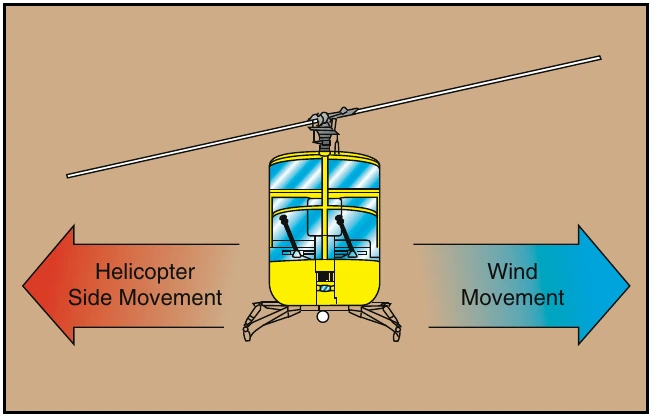
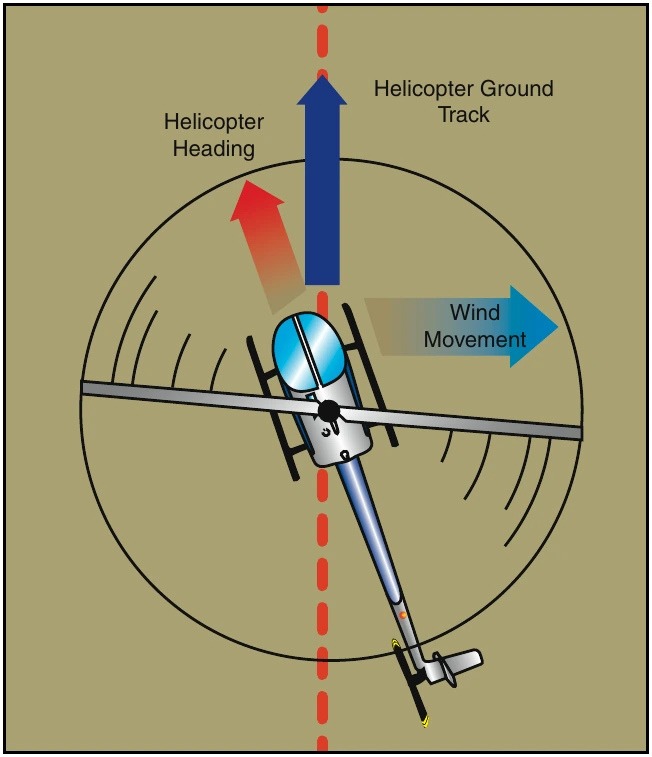
After approximately 50 feet of altitude is gained, make a coordinated turn into the wind to maintain the desired ground track. This is called crabbing into the wind. The stronger the crosswind, the more you have to turn the helicopter into the wind to maintain the desired ground track. [Figure 9-10]
Straight-and-Level Flight
Straight-and-level flight is flight in which a constant altitude and heading are maintained. The attitude of the helicopter determines the airspeed and is controlled by the cyclic. Altitude is primarily controlled by use of the collective.
Technique
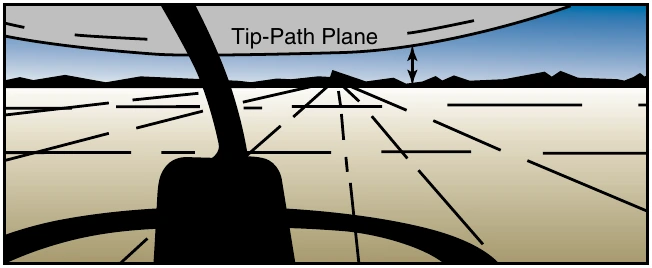
To maintain forward flight, the rotor tip-path plane must be tilted forward to obtain the necessary horizontal thrust component from the main rotor. This generally results in a nose-low attitude. The lower the nose, the greater the power required to maintain altitude, and the higher the resulting airspeed. Conversely, the greater the power used, the lower the nose must be to maintain altitude. [Figure 9-11]
When in straight-and-level flight, any increase in the collective, while holding airspeed constant, causes the helicopter to climb. A decrease in the collective, while holding airspeed constant, causes the helicopter to descend. A change in the collective requires a coordinated change of the throttle to maintain a constant r.p.m. Additionally, the antitorque pedals need to be adjusted to maintain heading and to keep the helicopter in longitudinal trim.
To increase airspeed in straight-and-level flight, apply forward pressure on the cyclic and raise the collective as necessary to maintain altitude. To decrease airspeed, apply rearward pressure on the cyclic and lower the collective, as necessary, to maintain altitude.
Although the cyclic is sensitive, there is a slight delay in control reaction, and it will be necessary to anticipate actual movement of the helicopter. When making cyclic inputs to control the altitude or airspeed of a helicopter, take care not to overcontrol. If the nose of the helicopter rises above the level-flight attitude, apply forward pressure to the cyclic to bring the nose down.
If this correction is held too long, the nose drops too low. Since the helicopter continues to change attitude momentarily after the controls reach neutral, return the cyclic to neutral slightly before the desired attitude is reached. This principal holds true for any cyclic input.
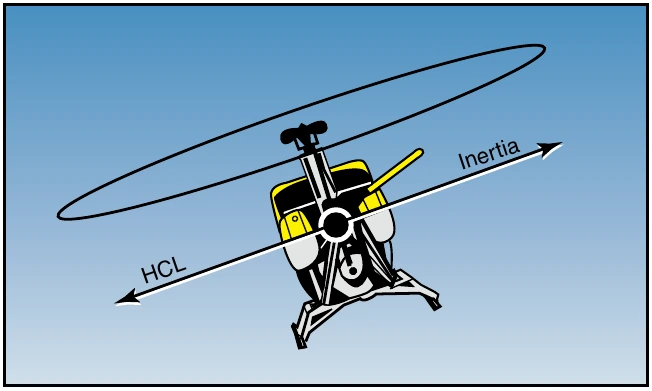
Since helicopters are inherently unstable, if a gust or turbulence causes the nose to drop, the nose tends to continue to drop instead of returning to a straight-and-level attitude as would a fixed-wing aircraft.
Therefore, you must remain alert and FLY the helicopter at all times.
Common Errors
- Failure to properly trim the helicopter, tending to hold antitorque pedal pressure and opposite cyclic. This is commonly called cross-controlling.
- Failure to maintain desired airspeed.
- Failure to hold proper control position to maintain desired ground track.
Turns
A turn is a maneuver used to change the heading of the helicopter. The aerodynamics of a turn were previously discussed in Chapter 3—Aerodynamics of Flight.