
Chapter 6
Seaplane Operations - Landings
Landing Area Reconnaissance and Planning
When a landplane makes an approach at a towered airport, the pilot can expect that the runway surface will be flat and free of obstructions. Wind information and landing direction are provided by the tower. In water operations, the pilot must make a number of judgments about the safety and suitability of the landing area, evaluate the characteristics of the water surface, determine wind direction and speed, and choose a landing direction. It is rare for active airport runways to be used by other vehicles, but common for seaplane pilots to share their landing areas with boats, ships, swimmers, jet-skis, wind-surfers, or barges, as well as other seaplanes.
It is usually a good practice to circle the area of intended landing and examine it thoroughly for obstructions such as pilings or floating debris, and to note the direction of movement of any boats that may be in or moving toward the intended landing site. Even if the boats themselves will remain clear of the landing area, look for wakes that could create hazardous swells if they move into the touchdown zone. This is also the time to look for indications of currents in moving water. Note the position of any buoys marking preferred channels, hidden dangers, or off-limits areas such as no-wake zones or swimming beaches. Just as it is a good idea in a landplane to get a mental picture of the taxiway arrangement at an unfamiliar airport prior to landing, the seaplane pilot should plan a taxi route that will lead safely and efficiently from the intended touchdown area to the dock or mooring spot. This is especially important if there is a significant wind that could make turns difficult while taxiing or necessitate sailing backward or sideways to the dock. If the water is clear, and there is not much wind, it is possible to see areas of waterweeds or obstructions lying below the surface. Noting their position before landing can prevent fouling the water rudders with weeds while taxiing, or puncturing a float on a submerged snag. In confined areas, it is essential to verify before landing that there is sufficient room for a safe takeoff under the conditions that are likely to prevail at the intended departure time. While obstruction heights are regulated in the vicinity of land airports and tall structures are usually well marked, this is not the case with most water landing areas. Be alert for towers, cranes, powerlines, and the masts of ships and boats on the approach path. Finally, plan a safe, conservative path for a go-around should the landing need to be aborted.
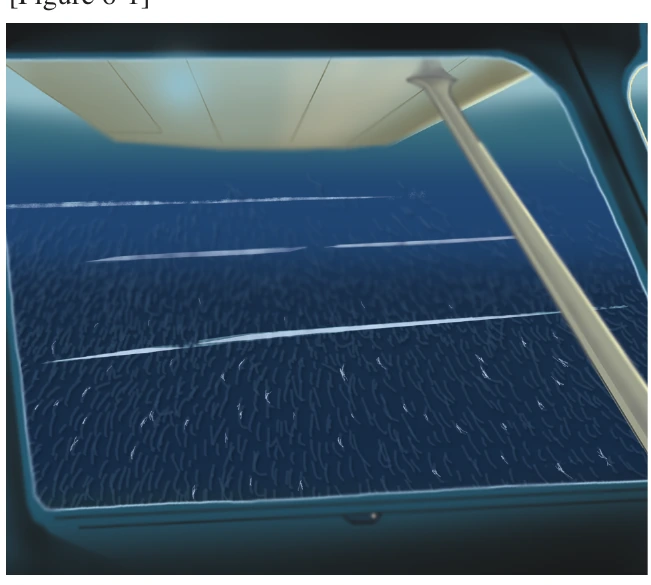
Most established seaplane bases have a windsock, but if one is not visible, there are many other cues to gauge the wind direction and speed prior to landing. If there are no strong tides or water currents, boats lying at anchor weathervane and automatically point into the wind. Be aware that some boats also set a stern anchor, and thus do not move with changes in wind direction. There is usually a glassy band of calm water on the upwind shore of a lake. Sea gulls and other waterfowl usually land into the wind and typically head into the wind while swimming on the surface. Smoke, flags, and the set of sails on sailboats also provide the pilot with a fair approximation of the wind direction. If there is an appreciable wind velocity, wind streaks parallel to the wind form on the water. In light winds, they appear as long, narrow, straight streaks of smooth water through the wavelets. In winds of approximately 10 knots or more, foam accents the streaks, forming distinct white lines. Although wind streaks show direction very accurately, the pilot must still determine which end of the wind streak is upwind. For example, an east-west wind streak could mean a wind from the east or the west—it is up to the pilot to determine which.
If there are whitecaps or foam on top of the waves, the foam appears to move into the wind. This illusion is caused by the motion of the waves, which move more quickly than the foam. As the waves pass under the foam, the foam appears to move in the opposite direction. The shape of shorelines and hills influences wind direction, and may cause significant variations from one area to another. Do not assume that because the wind is from a certain direction on this side of the lake that it is from the same direction on the other side.
Except for glassy water, it is usually best to plan to land on the smoothest water available. When a swell system is superimposed on a second swell system, some of the waves may reinforce each other, resulting in higher waves, while other waves cancel each other out, leaving smoother areas. Often it is possible to avoid the larger waves and land on the smooth areas.
In seaplanes equipped with retractable landing gear (amphibians), it is extremely important to make certain that the wheels are retracted when landing on water. Wherever possible, make a visual check of the wheels themselves, in addition to checking the landing gear position indicators. A wheels-down landing on water is almost certain to capsize the seaplane, and is far more serious than landing the seaplane on land with the wheels up. Many experienced seaplane pilots make a point of saying out loud to themselves before every water landing, “This is a water landing, so the wheels should be up.” Then they confirm that each wheel is up using externally mounted mirrors and other visual indicators. Likewise, they verbally confirm that the wheels are down before every landing on land. The water rudders are also retracted for landings.
When planning the landing approach, be aware that the seaplane has a higher sink rate than its landplane counterpart at the same airspeed and power setting. With some practice, it becomes easy to land accurately on a predetermined spot. Landing near unfamiliar shorelines increases the possibility of encountering submerged objects and debris.
Besides being safe, it is also very important for seaplane pilots to make a conscious effort to avoid inflicting unnecessary noise on other people in the area. Being considerate of others can often mean the difference between a warm welcome and the banning of future seaplane activity in a particular location. The actions of one pilot can result in the closing of a desirable landing spot to all pilots. People with houses along the shore of a lake usually include the quiet as one of the reasons they chose to live there. Sometimes high terrain around a lake or the local topography of a shoreline can reflect and amplify sound, so that a seaplane sounds louder than it would otherwise. A good practice is to cross populated shorelines no lower than 1,000 feet AGL whenever feasible. To the extent possible consistent with safety, avoid overflying houses during the landing approach. If making a go-around, turn back over the water for the climbout, and reduce power slightly after attaining a safe altitude and airspeed. A reduction of 200 r.p.m. makes a significant difference in the amount of sound that reaches the ground.
Landing
In water landings, the major objectives are to touch down at the lowest speed possible, in the correct pitch attitude, without side drift, and with full control throughout the approach, landing, and transition to taxiing.
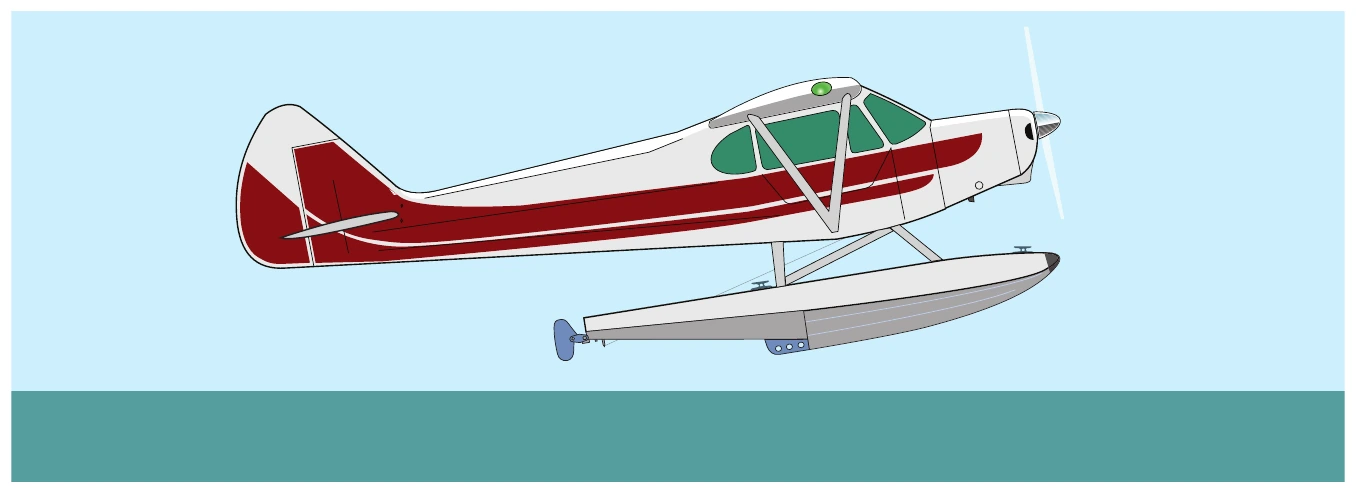
The correct pitch attitude at touchdown in a landplane varies between wide limits. For example, wheel landings in an airplane with conventional-gear, require a nearly flat pitch attitude, with virtually zero angle of attack, while a full-stall landing on a short field might call for a nose-high attitude. The touchdown attitude for a seaplane typically is very close to the attitude for taxiing on the step. The nose may be a few degrees higher. The objective is to touch down on the steps, with the sterns of the floats near or touching the water at the same time. [Figure 6-2] If the nose is much higher or lower, the excessive water drag puts unnecessary stress on the floats and struts, and can cause the nose to pitch down, allowing the bows of the floats to dig into the water. Touching down on the step keeps water drag forces to a minimum and allows energy to dissipate more gradually.
Normal Landing
Make normal landings directly into the wind. Seaplanes can be landed either power-off or power-on, but power-on landings are generally preferred because they give the pilot more positive control of the rate of sink and the touchdown spot. To touch down at the slowest possible speed, extend the flaps fully. Use flaps, throttle, and pitch to control the glidepath and establish a stabilized approach at the recommended approach airspeed. The techniques for glidepath control are similar to those used in a landplane.
As the seaplane approaches the water’s surface, smoothly raise the nose to the appropriate pitch attitude for touchdown. As the floats contact the water, use gentle back pressure on the elevator control to compensate for any tendency of the nose to drop. When the seaplane is definitely on the water, close the throttle and maintain the touchdown attitude until the seaplane begins to come off the step. Once it begins to settle into the plowing attitude, apply full up elevator to keep the nose as high as possible and minimize spray hitting the propeller.
As the seaplane slows to taxi speed, lower the water rudders to provide better directional control. Raise the flaps and perform the after-landing checklist.
The greater the speed difference between the seaplane and the water, the greater the drag at touchdown, and the greater the tendency for the nose to pitch down. This is why the touchdown is made at the lowest possible speed for the conditions. Many landplane pilots transitioning to seaplanes are surprised at the shortness of the landing run, in terms of both time and distance. It is not uncommon for the landing run from touchdown to idle taxi to take as little as 5 or 6 seconds.