
Chapter 6
Seaplane Operations - Landings
There are some simple ways to overcome the visual illusions and increase safety during glassy water landings. Perhaps the simplest is to land near the shoreline, using the features along the shore to gauge altitude. Be certain that the water is sufficiently deep and free of obstructions by performing a careful inspection from a safe altitude. Another technique is to make the final approach over land, crossing the shoreline at the lowest possible safe altitude so that a reliable height reference is maintained to within a few feet of the water surface.
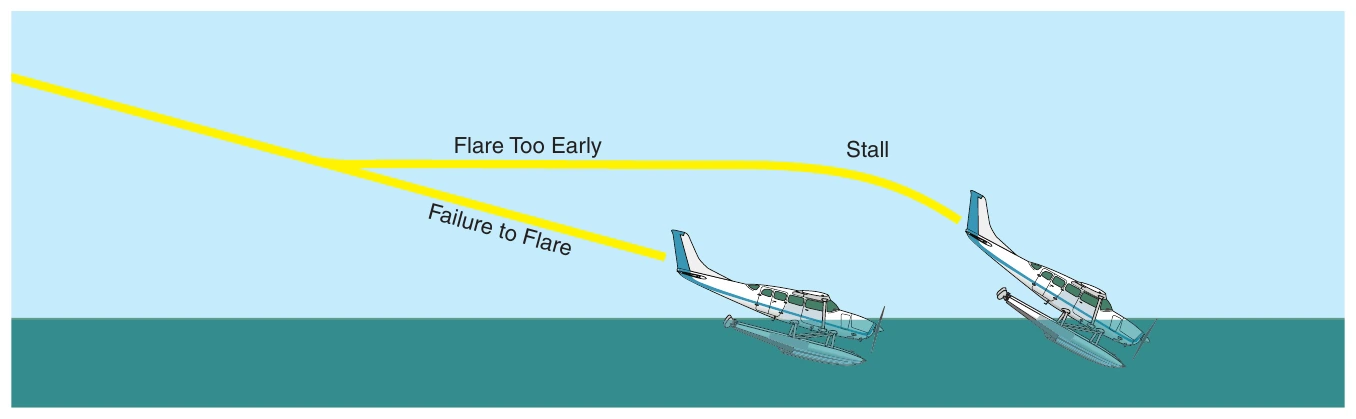
When adequate visual references are not available, make glassy water landings by establishing a stable descent in the landing attitude at a rate that will provide a positive, but not excessive, contact with the water. Recognize the need for this type of landing in ample time to set up the proper final approach. Always perform glassy water landings with power. Perform a normal approach, but prepare as though intending to land at an altitude well above the surface. For example, in a situation where a current altimeter setting is not available and there are few visual cues, this altitude might be 200 feet above the surface. Landing preparation includes completion of the landing checklist and extension of flaps as recommended by the manufacturer. The objective is to have the seaplane ready to contact the water soon after it reaches the target altitude, so at approximately 200 feet above the surface, raise the nose to the attitude normally used for touchdown, and adjust the power to provide a constant descent rate of no more than 150 feet per minute (f.p.m.) at an airspeed approximately 10 knots above stall speed. Maintain this attitude, airspeed, and rate of descent until the seaplane contacts the water. Once the landing attitude and power setting are established, the airspeed and descent rate should remain the same without further adjustment, and the pilot should closely monitor the instruments to maintain this stable glide. Power should only be changed if the airspeed or rate of descent deviate from the desired values. Do not flare, but let the seaplane fly onto the water in the landing attitude. [Figure 6-7]
Upon touchdown, apply gentle back pressure to the elevator control to maintain the same pitch attitude. Close the throttle only after the seaplane is firmly on the water. Three cues provide verification through three different senses—vision, hearing, and body sensation. The pilot sees a slight nose-down pitch at touchdown and perhaps spray thrown to the sides by the floats, hears the sound of the water against the floats, and feels the deceleration force. Accidents have resulted from cutting the power suddenly after the initial touchdown. To the pilot’s surprise, a skip had taken place and as the throttle closed, the seaplane was 10 to 15 feet in the air and not on the water, resulting in a stall and substantial damage. Be sure all of the cues indicate that the seaplane is staying on the water before closing the throttle. After the seaplane settles into a displacement taxi, complete the after-landing checklist and lower the water rudders.
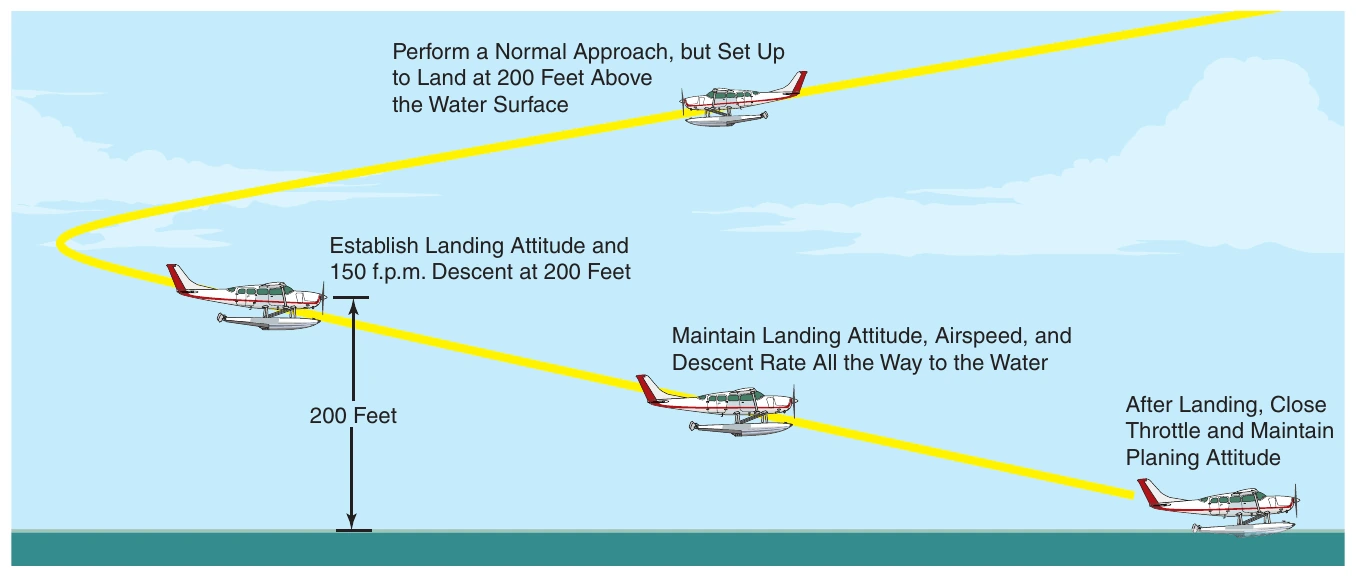
An accurately set altimeter may allow the pilot to set up for the touchdown at an altitude somewhat closer to the surface. If the pilot can be certain that the landing configuration and 150 f.p.m. descent will be established well above the water’s surface, starting the final glide nearer the surface shortens the descent time and overall landing length.
This technique usually produces a safe, comfortable landing, but the long, shallow glide consumes considerable landing distance. Be certain there is sufficient room for the glide, touchdown, and water run.
Rough Water Landing
Rough is a very subjective and relative term. Water conditions that cause no difficulty for small boats can be too rough for a seaplane. Likewise, water that poses no challenge to a large seaplane or an experienced pilot may be very dangerous for a smaller seaplane or a less experienced pilot.
Describing a typical or ideal rough water landing procedure is impractical because of the many variables that affect the water’s surface. Wind direction and speed must be weighed along with the surface conditions of the water. In most instances, though, make the approach the same as for any other water landing. It may be better, however, to level off just above the water surface and increase the power sufficiently to maintain a rather flat attitude until conditions appear more acceptable, and then reduce the power to touch down. If severe bounces occur, add power and lift off to search for a smoother landing spot.
In general, make the touchdown at a somewhat flatter pitch attitude than usual. This prevents the seaplane from being tossed back into the air at a dangerously low airspeed, and helps the floats to slice through the tops of the waves rather than slamming hard against them. Reduce power as the seaplane settles into the water, and apply back pressure as it comes off the step to keep the float bows from digging into a wave face. If a particularly large wave throws the seaplane into the air before coming off the step, be ready to apply full power to go around.
Avoid downwind landings on rough water or in strong winds. Rough water is usually an indication of strong winds, and vice versa. Although the airspeed for landing is the same, wind velocity added to the seaplane’s normal landing speed can result in a much higher groundspeed, imposing excessive stress on the floats, increasing the nose-down tendency at touchdown, and prolonging the water run, since more kinetic energy must be dissipated. As the seaplane slows, the tendency to weathervane may combine with the motion created by the rough surface to create an unstable situation. In strong winds, an upwind landing means a much lower touchdown speed, a shorter water run, and subsequently much less pounding of the floats and airframe.
Likewise, crosswind landings on rough water or in strong winds can leave the seaplane vulnerable to capsizing. The pitching and rolling produced by the water motion increases the likelihood of the wind lifting a wing and flipping the seaplane.
There is additional information on rough water landings in Chapter 8, Emergency Open Sea Operations.
Confined Area Landing
One of the first concerns when considering a landing in a confined area is whether it is possible to get out again. For most seaplanes, the takeoff run is usually much longer than the landing run. Before landing, the pilot should also consider the wind and surface conditions expected when it is time to leave. If the seaplane lands into a stiff breeze on water with small waves, it might be more difficult to leave the next morning when winds are calm and the water is glassy. Conversely, if the seaplane lands in the morning when the air temperature is low, departure in the hot afternoon might mean a significant loss in takeoff performance due to the density altitude.
It is especially important to carefully inspect the landing area for shallow areas, obstructions, or other hazards. After touchdown is not the time to discover factors that make a confined landing area even smaller or less usable than originally supposed. Evaluation of the landing area should include approach and departure paths. Terrain that rises faster than the seaplane can climb is an obvious consideration, both for the eventual takeoff as well as in case of a go-around during landing. If climbout over the terrain is not easily within the seaplane’s capabilities, be certain there is sufficient room to make a gentle turn back over the water for climb.
Go-Around
Whenever landing conditions are not satisfactory, execute a go-around. Potential conflicts with other aircraft, surface vessels or swimmers in the landing area, recognition of a hazard on the water, wind shear, wake turbulence, water surface conditions, mechanical failure, or an unstabilized landing approach are a few of the reasons to discontinue a landing attempt. Climb to a safe altitude while executing the go-around checklist, then evaluate the situation, and make another approach under more favorable conditions. Remember that it is often best to make a gentle climbing turn back over the water to gain altitude, rather than climbing out over a shoreline with rising terrain or noise-sensitive areas. The go-around is a normal maneuver that must be practiced and perfected like any other maneuver.