
Chapter 6
Seaplane Operations - Landings
Sometimes the pilot chooses to remain on the step after touchdown. To do so, merely add sufficient power and maintain the planing attitude immediately after touchdown. It is important to add enough power to prevent the seaplane from coming off the step, but not so much that the seaplane is close to flying speed. With too much taxi speed, a wave or swell could throw the seaplane into the air without enough speed to make a controlled landing. In that situation, the seaplane may stall and contact the water in a nose-down attitude, driving the float bows underwater and capsizing the seaplane. Raising the flaps can help keep the seaplane firmly on the water. To end the step taxi, close the throttle and gradually apply full up elevator as the seaplane slows.
Crosswind Landing
Landing directly into the wind might not be practical due to water traffic in the area, obstructions on or under the water, or a confined landing area, such as a river or canal. In landing a seaplane with any degree of crosswind component, the objectives are the same as when landing a landplane: to minimize sideways drift during touchdown and maintain directional control afterward. Because floats have so much more side area than wheels, even a small amount of drift at touchdown can create large sideways forces. This is important because enough side force can lead to capsizing. Also, the float hardware is primarily designed to take vertical and fore-and-aft loads rather than side loads.
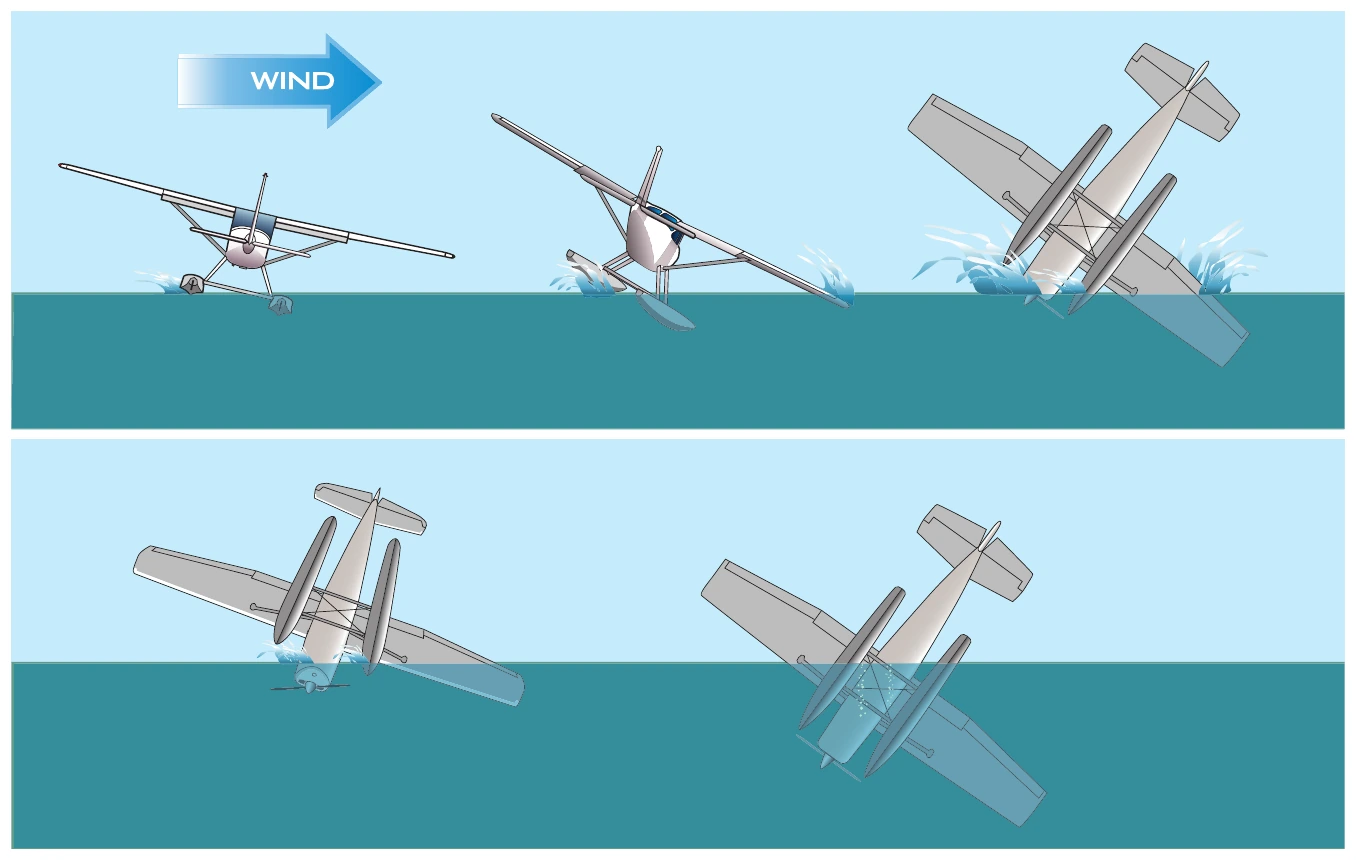
If the seaplane touches down while drifting sideways, the sudden resistance as the floats contact the water creates a skidding force that tends to push the downwind float deeper into the water. The combination of the skidding force, wind, and weathervaning as the seaplane slows down can lead to a loss of directional control and a waterloop. If the downwind float submerges and the wingtip contacts the water when the seaplane is moving at a significant speed, the seaplane could flip over. [Figure 6-3 on next page]
Floatplanes frequently have less crosswind component capability than their landplane counterparts. Directional control can be more difficult on water because the surface is more yielding, there is less surface friction than on land, and seaplanes lack brakes. These factors increase the seaplane’s tendency to weathervane into the wind.
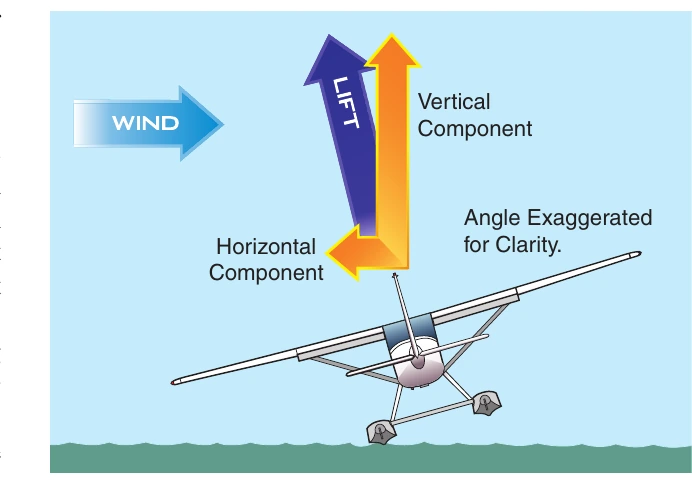
One technique sometimes used to compensate for crosswinds during water operations is the same as that used on land; that is, by lowering the upwind wing while holding a straight course with rudder. This creates a slip into the wind to offset the drifting tendency. The apparent movement of the water’s surface during the landing approach can be deceiving. Wave motion may make it appear that the water is moving sideways, but although the wind moves the waves, the water itself remains virtually stationary. Waves are simply an up-and-down motion of the water surface—the water itself is not moving sideways. To detect side drift over water and maintain a straight path during landing, pick a spot on the shore or a stationary buoy as an aim point. Lower the upwind wing just enough to stop any drift, and use rudder to maintain a straight path. As the seaplane touches down on the upwind float, the water drag will quickly slow the seaplane and the other float will touch down as aerodynamic lift decreases. Close the throttle, and as the seaplane’s speed dissipates, increase aileron to hold the upwind wing down. The seaplane is most unstable as it is coming off the step and transitioning through the plowing phase. Be ready for the seaplane to weathervane into the wind as the air rudder becomes less effective. Many pilots make a turn to the downwind side after landing to minimize weathervaning until the seaplane has slowed to taxi speed. Since the seaplane will weathervane sooner or later, this technique reduces the centrifugal force on the seaplane by postponing weathervaning until speed has dissipated. Once the seaplane settles into the displacement attitude, lower the water rudders for better directional control. [Figure 6-4]
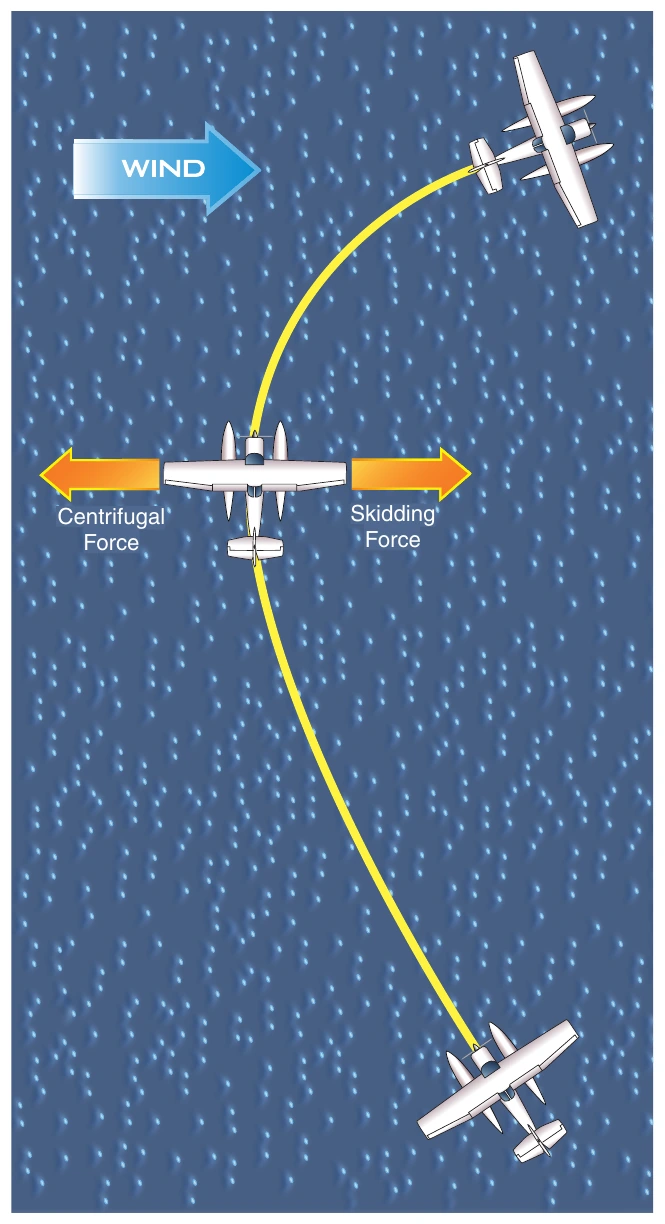
Another technique used to compensate for crosswinds (preferred by many seaplane pilots) is the downwind arc method. Seaplanes need not follow a straight path during landing, and by choosing a curved path, the pilot can create a sideward force (centrifugal force) to offset the crosswind force. This is done by steering the seaplane in a downwind arc as shown in figure 6-5. During the approach, the pilot merely plans a curved landing path and follows this path to produce sufficient centrifugal force to counter the wind force. During the landing run, the pilot can adjust the amount of centrifugal force by varying rudder pressure to increase or decrease the rate of turn. This technique allows the pilot to compensate for a changing wind force during the water run.
Figure 6-5 shows that the tightest curve of the downwind arc is during the time the seaplane is traveling at low speed. Faster speeds reduce the crosswind effect, and at very slow speeds the seaplane can weathervane into the wind without imposing large side loads or stresses. Again, experience plays an important part in successful operation during crosswinds. It is essential that all seaplane pilots have thorough knowledge and skill in these maneuvers.
Downwind Landing
Although downwind landings often require significantly more water area, there are occasions when they are more convenient or even safer than landing into the wind. Sometimes landing upwind would mean a long, slow taxi back along the landing path to get to the dock or mooring area. If winds are less than 5 knots and there is ample room, landing downwind could save taxi time. Unless the winds are light, a downwind landing is seldom necessary. Before deciding to land downwind, the pilot needs a thorough knowledge of the landing characteristics of the seaplane as well as the environmental factors in the landing area.
As with a downwind landing in a landplane, the main concern for a seaplane is the additional groundspeed added by the wind to the normal approach speed. The airspeed, of course, is the same whether landing upwind or downwind, but the wind decreases groundspeed in upwind landings and increases groundspeed in downwind landings. While a landplane pilot seldom thinks about the additional force placed on the landing gear by a higher groundspeed at touchdown, it is a serious concern for the seaplane pilot. A small increase in water speed translates into greatly increased water drag as the seaplane touches down, increasing the tendency of the seaplane to nose over. In light winds, this usually presents little problem if the pilot is familiar with how the seaplane handles when touching down at higher speeds, and is anticipating the increased drag forces. In higher winds, the nose-down force may exceed the ability of the pilot or the flight controls to compensate, and the seaplane will flip over at high speed. If the water’s surface is rough, the higher touchdown speed also subjects the floats and airframe to additional pounding.
If there is a strong current, the direction of water flow is a major factor in choosing a landing direction. The speed of the current, a confined landing area, or the surface state of the water may influence the choice of landing direction more than the direction of the wind. In calm or light winds, takeoffs usually are made in the same direction as the flow of the current, but landings may be made either with or against the flow of the current, depending on a variety of factors. For example, on a narrow river with a relatively fast current, the speed of the current is often more significant than wind direction, and the need to maintain control of the seaplane at taxi speed after the landing run may present more challenges than the landing itself. It is imperative that even an experienced seaplane pilot obtain detailed information about such operations before attempting them for the first time. Often the best source of information is local pilots with comprehensive knowledge of the techniques that work best in specific locations and conditions.
Glassy Water Landing
Flat, calm, glassy water certainly looks inviting and may give the pilot a false sense of safety. By its nature, glassy water indicates no wind, so there are no concerns about which direction to land, no crosswind to consider, no weathervaning, and obviously no rough water. Unfortunately, both the visual and the physical characteristics of glassy water hold potential hazards for complacent pilots. Consequently, this surface condition is frequently more dangerous than it appears for a landing seaplane.
The visual aspects of glassy water make it difficult to judge the seaplane’s height above the water. The lack of surface features can make accurate depth perception very difficult, even for experienced seaplane pilots. Without adequate knowledge of the seaplane’s height above the surface, the pilot may flare too high or too low. Either case can lead to an upset. If the seaplane flares too high and stalls, it will pitch down, very likely hitting the water with the bows of the floats and flipping over. If the pilot flares too late or not at all, the seaplane may fly into the water at relatively high speed, landing on the float bows, driving them underwater and flipping the seaplane. [Figure 6-6]
Besides the lack of surface features, the smooth, reflecting surface can lead to confusing illusions as clouds or shore features are reproduced in stunning detail and full color. When the water is crystal clear and glassy, the surface itself is invisible, and pilots may inadvertently judge height by using the bottom of the lake as a reference, rather than the water surface.
The lack of surface texture also presents a physical characteristic that adds slightly to the risk of glassy water landings. A nice smooth touchdown can result in faster deceleration than expected, for the same reason that the floats seem to stick to the surface during glassy water takeoffs: there is less turbulence and fewer air bubbles between the float bottoms and the water, which effectively increases the wetted surface area of the floats and causes higher drag forces. Naturally, this sudden extra drag at touchdown tends to pull the nose down, but if the pilot is expecting it and maintains the planing attitude with appropriate back pressure, the tendency is easily controlled and presents no problem.