
Chapter 6
Seaplane Operations - Landings
Emergency situations occurring within gliding distance of water usually present no landing difficulty. Although there is some leeway in landing attitude, it is important to select the correct type of landing for the water conditions. If the landing was due to an engine failure, an anchor and paddle are useful after the landing is completed.
Should the emergency occur over land, it is usually possible to land a floatplane with minimal damage in a smooth field. Snow covered ground is ideal if there are no obstructions. The landing should be at a slightly flatter attitude than normal, a bit fast, and directly into the wind. If engine power is available, landing with a small amount of power helps maintain the flatter attitude. Just before skidding to a stop, the tail will begin to rise, but the long front portions of the floats stop the rise and keep the seaplane from flipping over.
A night water landing should generally be considered only in an emergency. They can be extremely dangerous due to the difficulty of seeing objects in the water, judging surface conditions, and avoiding large waves or swell. If it becomes necessary to land at night in a seaplane, seriously consider landing at a lighted airport. An emergency landing can be made on a runway in seaplanes with little or no damage to the floats or hull. Touchdown is made with the keel of the floats or hull as nearly parallel to the surface as possible. After touchdown, apply full back elevator and additional power to lessen the rapid deceleration and nose-over tendency. Do not worry about getting stopped with additional power applied after touchdown. It will stop! The reason for applying power is to provide additional airflow over the elevator to help keep the tail down.
In any emergency landing on water, be as prepared as possible well before the landing. Passengers and crew should put on their flotation gear and adjust it properly. People sitting near doors should hold the liferafts or other emergency equipment in their laps, so no one will need to try to locate or pick it up in the scramble to exit the seaplane. Unlatch all the doors prior to touchdown, so they do not become jammed due to distortion of the airframe. Brief the passengers thoroughly on what to do during and after the landing. These instructions should include how to exit the seaplane even if they cannot see, how to get to the surface, and how to use any rescue aids.
Postflight Procedures
After landing, lower the water rudders and complete the after-landing checklist. The flaps are usually raised after landing, both to provide better visibility and to reduce the effects of wind while taxiing. It is a good practice to remain at least 50 feet from any other vessel during the taxi.
After landing, secure the seaplane to allow safe unloading, as well as to keep winds and currents from moving it around. Knowing a few basic terms makes the following discussions easier to understand. Anchoring uses a heavy hook connected to the seaplane by a line or cable. This anchor digs into the bottom due to tension on the line, and keeps the seaplane from drifting. Mooring means to tie the seaplane to a fixed structure on the surface. The seaplane may be moored to a floating buoy, or to a pier, or to a floating raft. For this discussion, docking means securing the seaplane to a permanent structure fixed to the shore. To beach a seaplane means to pull it up onto a suitable shore surface, so that its weight is supported by relatively dry ground rather than water. Ramping is defined as using a ramp to get the seaplane out of the water and onto the shore.
Anchoring
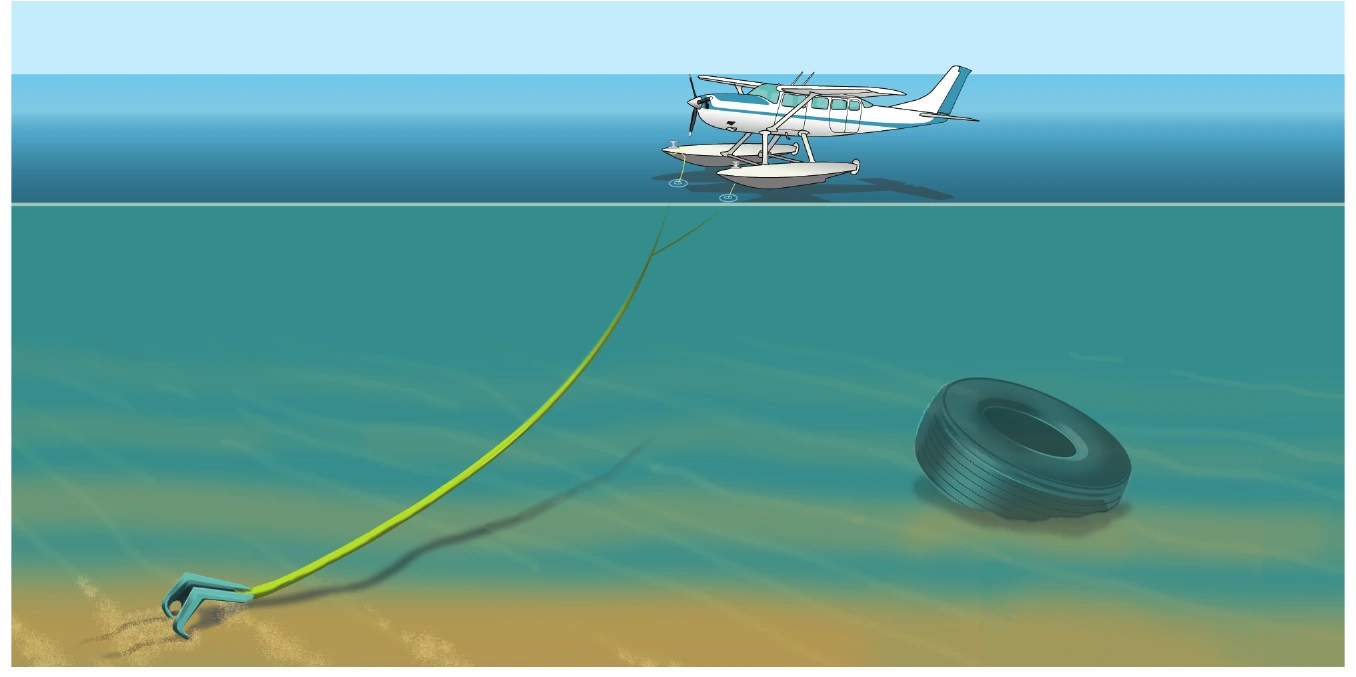
Anchoring is the easiest way to secure a seaplane on the water surface. The area selected should be out of the way of moving vessels, and in water deep enough that the seaplane will not be left aground during low tide. The holding characteristics of the bottom are important in selecting an appropriate anchorage. The length of the anchor line should be about seven times the depth of the water. After dropping the anchor with the seaplane headed into the wind, allow the seaplane to drift backward to set the anchor. To be sure the anchor is holding, watch two fixed points somewhere to the side of the seaplane, one farther away than the other, that are aligned with each other, such as a tree on the shore and a mountain in the distance. If they do not remain aligned, it means that the seaplane is drifting and dragging its anchor along the bottom. The nautical term for when two objects appear directly in line, one behind the other, is “in range” and the two objects are called a range.
When choosing a place to anchor, think about what will happen if the wind shifts. Allow enough room so that the seaplane can swing around the anchor without striking nearby obstacles or other anchored vessels. Be certain the water rudders are retracted, as they can interfere with the seaplane’s ability to respond to wind shifts.
If anchoring the seaplane overnight or for longer periods of time, use a heavier anchor and be sure to comply with maritime regulations for showing an anchor light or daytime visual signals when required. [Figure 6-8] When leaving the seaplane anchored for any length of time, it is a good idea to secure the controls with the elevator down and rudder neutral. Since the seaplane can rotate so that it always faces into the wind, this forces the nose down and reduces the angle of attack, keeping lift and wind resistance at a minimum.
Mooring
Mooring a seaplane eliminates the problem of the anchor dragging. A permanent mooring installation consists of a heavy weight on the bottom connected by a chain or cable to a floating buoy with provisions for securing mooring lines. Approach a mooring at a very low speed and straight into the wind. To keep from overrunning the mooring, shut down the engine early and let the seaplane coast to the mooring. If necessary, the engine can be started again for better positioning.
Never straddle a buoy with a twin-float installation. Always approach while keeping the buoy to the outside of the float to avoid damage to the propeller and underside of the fuselage. Initial contact with the buoy is usually made with a boat hook or a person standing on the deck of one float.
While approaching the mooring, have the person on the float secure one end of a short line to the bottom of a float strut, if one is not there already. Then taxi the seaplane right or left of the mooring so that the float on which the person is standing comes directly alongside the buoy. The free end of the line can then be secured to the mooring.
Exercise extreme caution whenever a person is assisting in securing the seaplane. There have been many instances of helpers being struck by the propeller. On most floatplanes, the floats extend well in front of the propeller arc. Eager to do a good job, an inexperienced helper might forget the spinning propeller while walking forward along the float.
Docking
The procedure for docking is essentially the same as for mooring, except that approaching directly into the wind may not be an option. The keys to successful docking are proper planning of the approach to the dock, compensating for the existing environmental conditions, and skill in handling the seaplane in congested areas. Bear in mind that a seaplane is fragile and hitting an obstruction can result in extensive damage.
Plan the approach to the dock so as to keep the wind on the seaplane’s nose as much as possible. While still well clear of the dock area, check the responsiveness of the water rudders and be sure the seaplane will be able to maneuver in the existing wind and current. If control seems marginal, turn away and plan an alternative method of reaching the dock. While approaching the dock, the person who will be jumping out to secure the seaplane should take off seatbelts and unlatch the door. When it is clear that the seaplane will just make it to the dock, shut down the engine and let the seaplane coast the remaining distance to encounter the dock as gently as possible. The person securing the seaplane should step out onto the float, pick up the mooring line attached to the rear float strut, and step onto the dock as the seaplane stops. The line should be secured to a mooring cleat on the dock. Use additional mooring lines if the seaplane will be left unattended. Be sure to complete any remaining items on the checklist, and to double-check that the mixture, magnetos, and master switch are in the off positions.