
Chapter 1
Weight and Balance Control
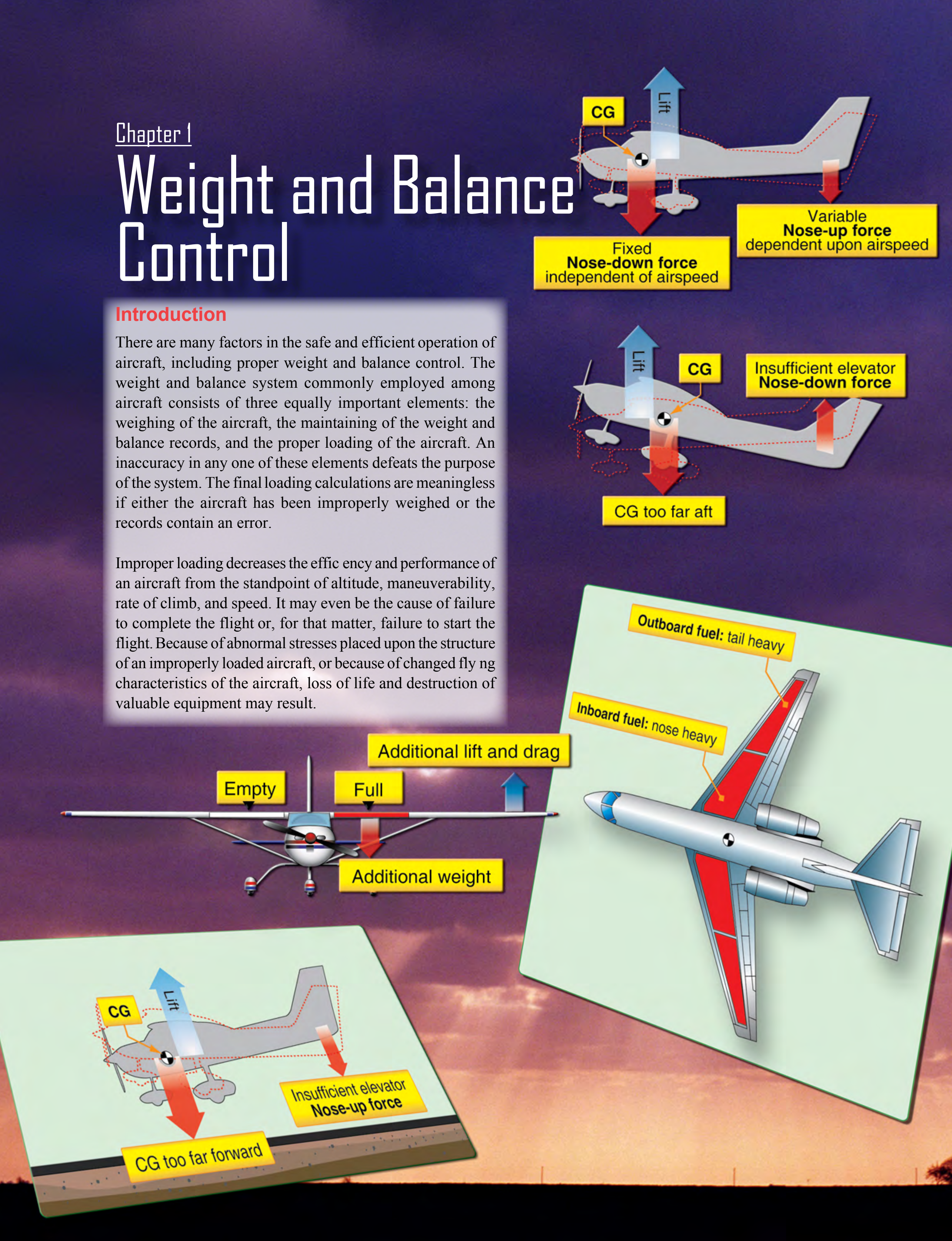
Introduction
There are many factors in the safe and efficient operation of aircraft, including proper weight and balance control. The weight and balance system commonly employed among aircraft consists of three equally important elements: the weighing of the aircraft, the maintaining of the weight and balance records, and the proper loading of the aircraft. An inaccuracy in any one of these elements defeats the purpose of the system. The final loading calculations are meaningless if either the aircraft has been improperly weighed or the records contain an error.
Improper loading decreases the efficiency and performance of an aircraft from the standpoint of altitude, maneuverability, rate of climb, and speed. It may even be the cause of failure to complete the flight or, for that matter, failure to start the flight. Because of abnormal stresses placed upon the structure of an improperly loaded aircraft, or because of changed flying characteristics of the aircraft, loss of life and destruction of valuable equipment may result.
Aircraft can perform safely and achieve their designed efficiency only when they are operated and maintained in the way their designers intended. This safety and efficiency is determined to a large degree by holding the aircraft’s weight and balance parameters within the limits specified for its design. The remainder of this handbook describes how this is done.
Responsibility for Weight and Balance Control
The responsibility for proper weight and balance control begins with the engineers and designers and extends to the technicians who maintain the aircraft and the pilots who operate them. Modern aircraft are engineered utilizing state-of-the-art technology and materials to achieve maximum reliability and performance for the intended category. As much care and expertise must be exercised in operating and maintaining these efficient aircraft as was taken in their design and manufacturing:
- The designers of an aircraft set the maximum weight based on the amount of lift the wings or rotors can provide under the operational conditions for which the aircraft is designed. The structural strength of the aircraft also limits the maximum weight the aircraft can safely carry. The designers carefully determine the ideal center of gravity (CG) and calculate the maximum allowable deviation from this specific location.
- The manufacturer provides the aircraft operator with the empty weight of the aircraft and the location of its empty weight center of gravity (EWCG) at the time the certified aircraft leaves the factory. Amateur-built aircraft must have this information determined and available at the time of certification.
- The FAA-certificated mechanic or repairman who maintains the aircraft keeps the weight and balance records current, recording any changes that have been made because of repairs or alterations.
- The pilot in command (PIC) has the responsibility prior to every flight to know the maximum allowable weight of the aircraft and its CG limits. This allows the pilot to determine during the preflight inspection that the aircraft is loaded so that the CG is within the allowable limits.
Terminology
Pilots and FAA-certificated mechanics or repairmen must ensure they understand the terms as they relate to the aircraft in question. For small aircraft terminology, use the information found in sources associated with Civil Air Regulation (CAR) 3 certification or General Aviation Manufacturers Association (GAMA) Specification No. 1 for part 23 aircraft or part 27 for rotorcraft. For terminology applied to large part 25 aircraft, information can be found in Advisory Circular (AC) 120-27, Aircraft Weight and Balance Control. The glossary contains the most current terms and definitions. Current regulations are available from the Superintendent of Documents; U.S. Government Printing Office; Washington, DC 20402. They are also located on the FAA website at [www.faa.gov](https://www.faa.gov). Earlier regulations may be available in libraries or in the Federal Register.
Weight Control
Weight is a major factor in airplane construction and operation, and it demands respect from all pilots and particular diligence by all maintenance personnel. Excessive weight reduces the efficiency of an aircraft and the available safety margin if an emergency condition should arise.
When an aircraft is designed, it is made as light as the required structural strength allows, and the wings or rotors are designed to support the maximum allowable weight. When the weight of an aircraft is increased, the wings or rotors must produce additional lift and the structure must support not only the additional static loads, but also the dynamic loads imposed by flight maneuvers. For example, the wings of a 3,000-pound airplane must support 3,000 pounds in level flight, but when the airplane is turned smoothly and sharply using a bank angle of 60°, the dynamic load requires the wings to support twice this or 6,000 pounds.
Severe uncoordinated maneuvers or flight into turbulence can impose dynamic loads on the structure great enough to cause failure. In accordance with Title 14 of the Code of Federal Regulations (14 CFR) part 23, the structure of a normal category airplane must be strong enough to sustain a load factor of 3.8 times its weight. Every pound of weight added to a normal category aircraft requires that the structure be strong enough to support 3.8 pounds. An aircraft operated in the utility category must sustain a load factor of 4.4 times its weight, and acrobatic category aircraft must be strong enough to withstand 6.0 times their weight.
The lift produced by a wing is determined by its airfoil shape, angle of attack, speed through the air, and air density. When an aircraft takes off from an airport with a high density altitude, it must accelerate to a speed faster than would be required at sea level to produce enough lift to allow takeoff; therefore, a longer takeoff run is necessary. The distance needed may be longer than the available runway. When operating from a high density altitude airport, the Pilot’s Operating Handbook (POH) or Airplane Flight Manual (AFM) must be consulted to determine the maximum weight allowed for the aircraft under the conditions of altitude, temperature, wind, and runway conditions.
Effects of Weight
Most modern aircraft are so designed that, when all seats are occupied, the baggage compartment is full, and all fuel tanks are full, the aircraft is grossly overloaded. This type of design requires the pilot to give great consideration to the requirements of each specific flight. If maximum range is required, occupants or baggage must be left behind, or if the maximum load must be carried, the range, dictated by the amount of fuel on board, must be reduced.
Overloading an aircraft can create a variety of problems:
- The aircraft needs a higher takeoff speed, which results in a longer takeoff run.
- Both the rate and angle of climb are reduced.
- The service ceiling is lowered.
- The cruising speed is reduced.
- The cruising range is shortened.
- Maneuverability is decreased.
- A longer landing roll is required because the landing speed is higher.
- Excessive loads are imposed on the structure, especially the landing gear.
The POH or AFM includes tables or charts that give the pilot an indication of the performance expected for any weight. An important part of careful preflight planning includes a check of these charts to determine if the aircraft is loaded so the proposed flight can be safely made.