
Chapter 2
Weight and Balance Theory
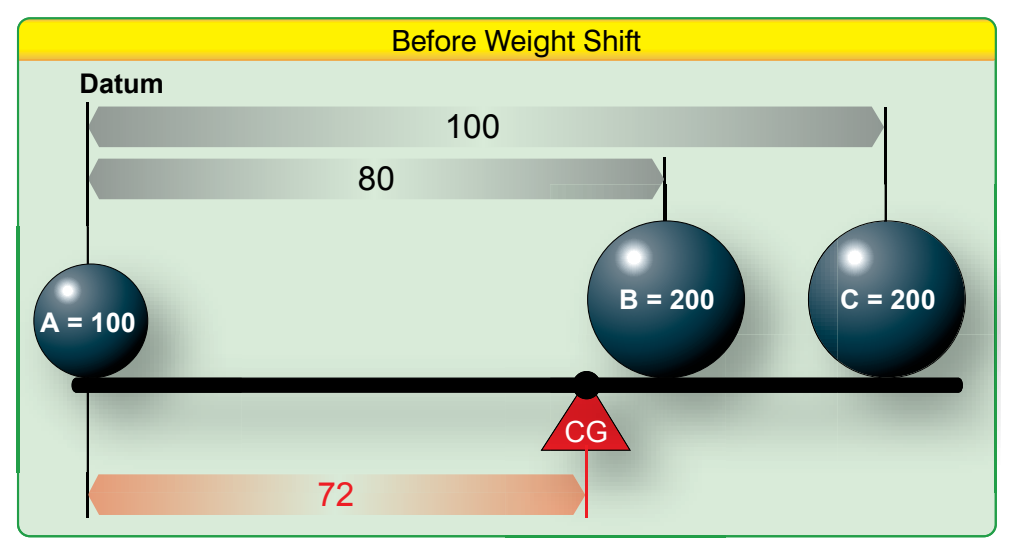
To shift weight B so the lever balances about its center, 50 inches from the CG of weight A, first determine the arm of weight B that produces a moment that causes the total moment of all three weights around this desired balance point to be zero. The combined moment of weights A and C around this new balance point is 5,000 lb-in, so the moment of weight B must be –5,000 lb-in for the lever to balance. [Figure 2-12]
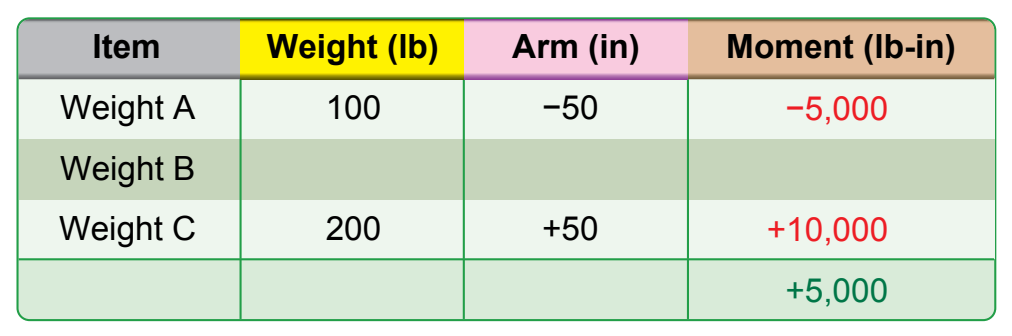
Determine the arm of weight B by dividing its moment, –5,000 lb-in, by its weight of 200 pounds. The arm is –25 inches. To balance the lever at its center, weight B must be placed so its CG is 25 inches to the left of the center of the lever. [Figure 2-13]
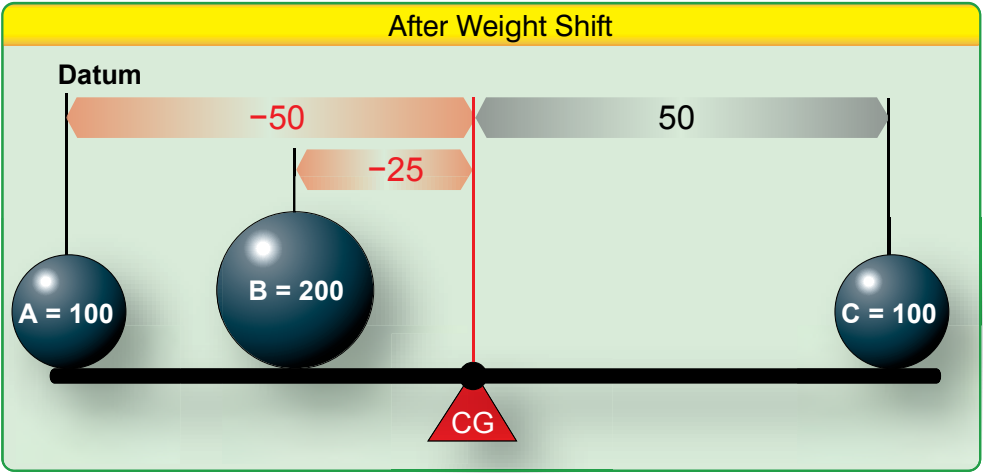
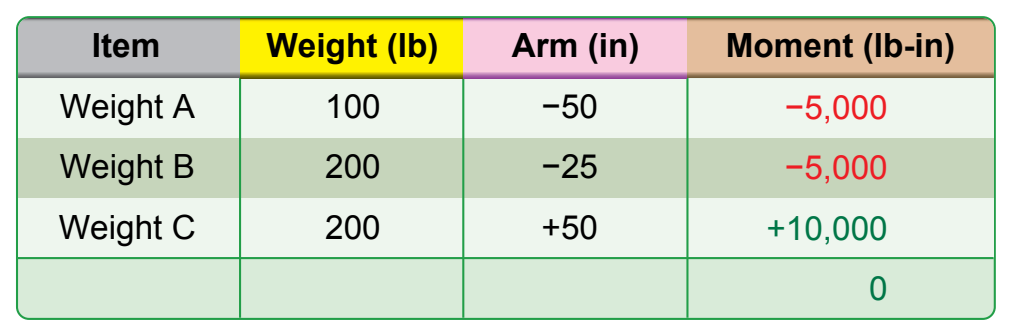
Figure 2-14 indicates that the shift in weight depicted in Figure 2-13 allows the lever to balance as the sum of the moments is zero.
Basic Weight and Balance Equation
The following formulas can be used to determine the distance weight must be shifted to obtain a desired change in the CG location. The equation can also be rearranged to find the amount of weight required to be shifted to move the CG to a desired location, to find the distance the CG is moved when a specified amount of weight is shifted, or to find the total weight that would allow shifting a specified amount of weight to move the CG a given distance.
Weight to be shifted / Total weight = ΔCG / Distance weight is shifted
Total weight = (Weight shifted × Distance weight is shifted) / ΔCG
Weight shifted = (Total weight × ΔCG) / Distance weight is shifted
ΔCG = (Weight shifted × Distance weight is shifted) / Total weight
Distance weight is shifted = (Total weight × ΔCG) / Weight shifted
Solution by Formula
The problem in Figure 2-11 can be solved by using variations of this basic equation. First, rearrange the formula to determine the distance weight B must be shifted:
Distance weight B is shifted = (Total weight × ΔCG) / Weight shifted
= (500 × –22) / 200
= –55 inches
The CG of the lever in Figure 2-11 was 72 inches from the datum. This CG can be shifted to the center of the lever as in Figure 2-13 by moving weight B. If the 200-pound weight B is moved 55 inches to the left, the CG shifts from +72 inches to +50 inches, a distance of 22 inches.