
Chapter 2
Weight and Balance Theory
When the distance the weight is to be shifted is known, the amount of weight to be shifted to move the CG to any location can be determined by another arrangement of the basic equation. Use the following arrangement of the formula to determine the amount of weight that has to be shifted from station +80 to station +25, to move the CG from station +72 to station +50.
Weight shifted = (Total weight × ΔCG) / Distance weight is shifted
= (500 × 22) / 55
= 200 pounds
If the 200-pound weight B is shifted from station +80 to station +25, the CG moves from station +72 to station +50.
A third arrangement of this basic equation is used to determine the amount the CG is shifted when a given amount of weight is moved for a specified distance (as it was done in Figure 2-11). The following formula is used to determine the amount the CG is shifted when 200-pound weight B is moved from +80 to +25.
ΔCG = (Weight shifted × Distance it is shifted) / Total weight
= (200 × 55) / 500
= 22 inches
Moving weight B from +80 to +25 moves the CG 22 inches from its original location at +72 to its new location at +50 as seen in Figure 2-13.
To complete the calculations, return to the original formula and enter the appropriate numbers.
Weight to be shifted / Total weight = ΔCG / Distance weight is shifted
200 / 500 = 22 / 55
.4 = .4
The equation is balanced.
Mean Aerodynamic Chord
The CG point affects the stability of the aircraft. To ensure the aircraft is safe to fly, the CG must fall within specified limits established by the manufacturer.
On some aircraft, the CG is expressed as a percentage of the length of the mean aerodynamic chord (MAC) or “percent MAC.” [Figure 2-14] In order to make such a calculation, the position of the leading edge of the MAC must be known ahead of time.
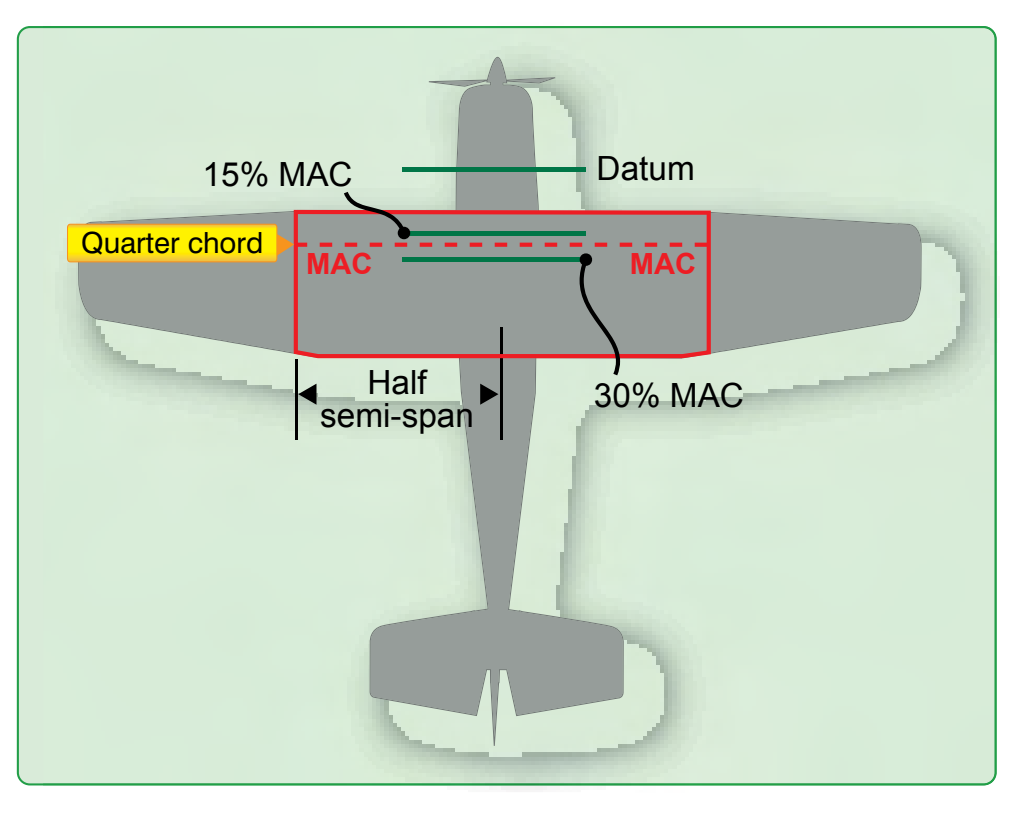
CG limits are specified forward and aft and/or lateral (left and right) limits within which the aircraft’s CG must be located during flight. The area between the limits is called the CG range of the aircraft.