User-friendly explanations of instrument approach charts, planviews, profiles, minimums, airport diagrams, departures, arrivals, and visual procedures.
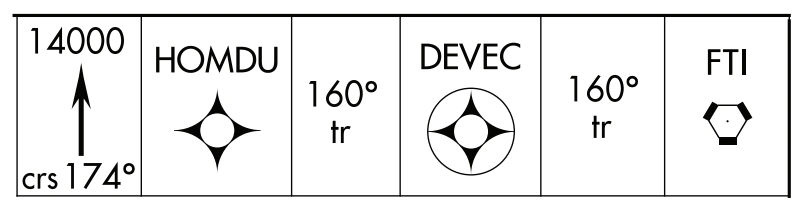
Missed-approach icon row — climb to 14000 on course 174°; HOMDU; DEVEC; FTI — source page 115.
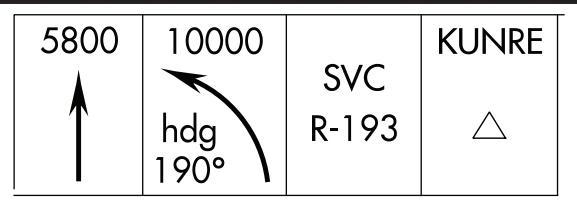
Missed-approach icon row — climb to 5800, then 10000 via heading 190°; SVC R-193; KUNRE — source page 115.
MISSED APPROACH INFORMATION Missed approach information is shown in 3 locations on the chart: • The Middle Briefing Strip - The complete textual missed approach instructions are provided at the top of the approach chart in the middle pilot briefing strip. • The Planview - The missed approach track is drawn using a thin, hash marked line with a directional arrow. If any portion of the missed approach procedure track is off the chart, the missed approach track shall extend to the chart border. Missed approach holding patterns that lie outside the geographic parameters of the planview and are unable to be shown with a scale break will be shown as a boxed inset. All alternate missed approach holding patterns will be shown in an inset. • The Profile Box - Missed Approach Icons will be depicted in the upper left or upper right of the profile box. The Missed Approach Icons are intended to provide quick, at a glance intuitive guidance to the pilot, to supplement the textual missed approach instructions in the briefing strip. Space permitting, all textual missed approach instructions will be graphically depicted in sequence. If space does not permit the depiction of all missed approach icons, only the first four icon boxes will be shown. Example Missed Approach Icons Missed Approach Text MISSED APPROACH: Climb to 13000 on RIL VOR/DME R-250 to TEKGU INT/RIL 19 DME and on EKR VOR/DME R-179 to WOKPA/EKR 44.2 DME and hold, continue climb-inhold to 13000. MISSED APPROACH: Climbing left turn to 8000 via SVC R-128, then reverse course to SVC VOR/DME and hold. MISSED APPROACH: Climb to 9000 on track 112° to JETRY, cross JETRY at or above 6700, and on track 112° to PAKPE, right turn to WULKU, and on track 289° to JNC VOR/DME and hold. MISSED APPROACH: Climb to 14000 via 174° course to HOMDU and via 160° track to DEVEC and 160° track to FTI VORTAC and hold. MISSED APPROACH: Climb to 5800, then climbing left turn to 10000 via heading 190° and SVC VOR/DME R-193 to KUNRE INT/SVC VOR/DME 24.1 DME and hold.
Source page 116
PROFILE VIEW
A profile diagram of the instrument approach procedure is shown below the planview. The published descent profile and graphical depiction of the vertical path using those facilities, intersections, fixes, etc. identified in the procedure to the runway are shown. A profile view of the procedure track is shown. The approach track begins toward the top of the primary facility line, unless otherwise dictated by the procedure, and shall descend to where the final approach ends and the missed approach begins.
When a reference mark (*, **, #, etc.) is shown in the profile, the qualifying footnote is provided within the profile section.
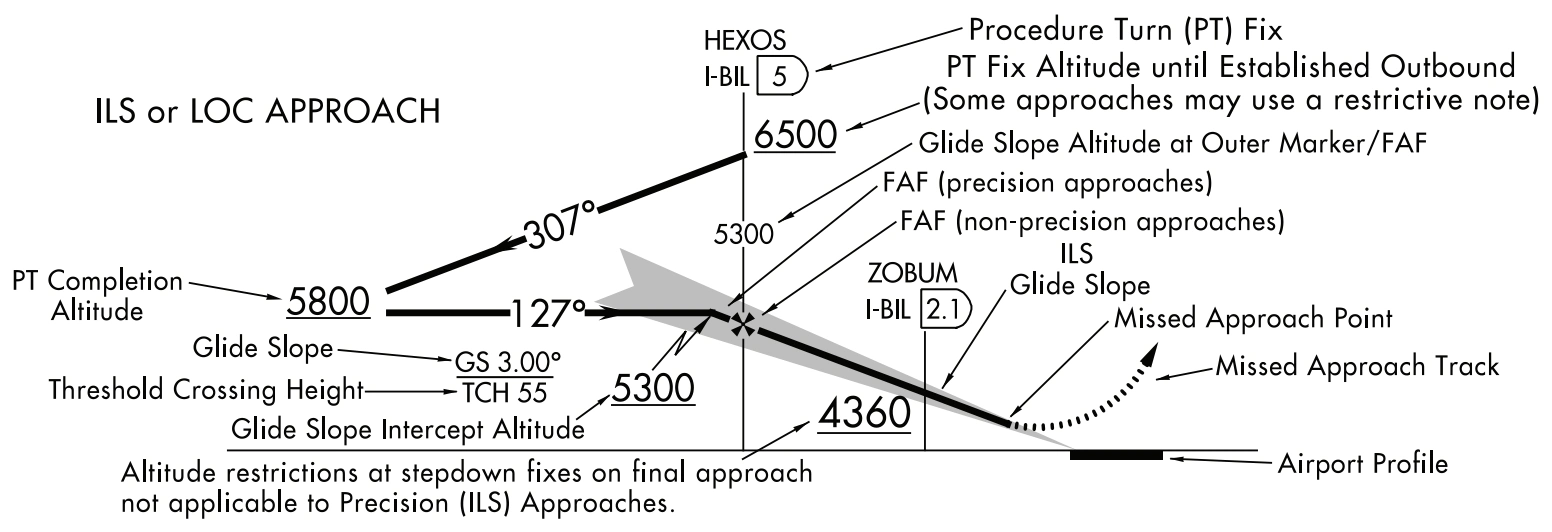
Annotated ILS or LOC approach profile — HEXOS/I-BIL procedure-turn fix, ZOBUM FAF/ILS glideslope, missed-approach point and track — source page 116.
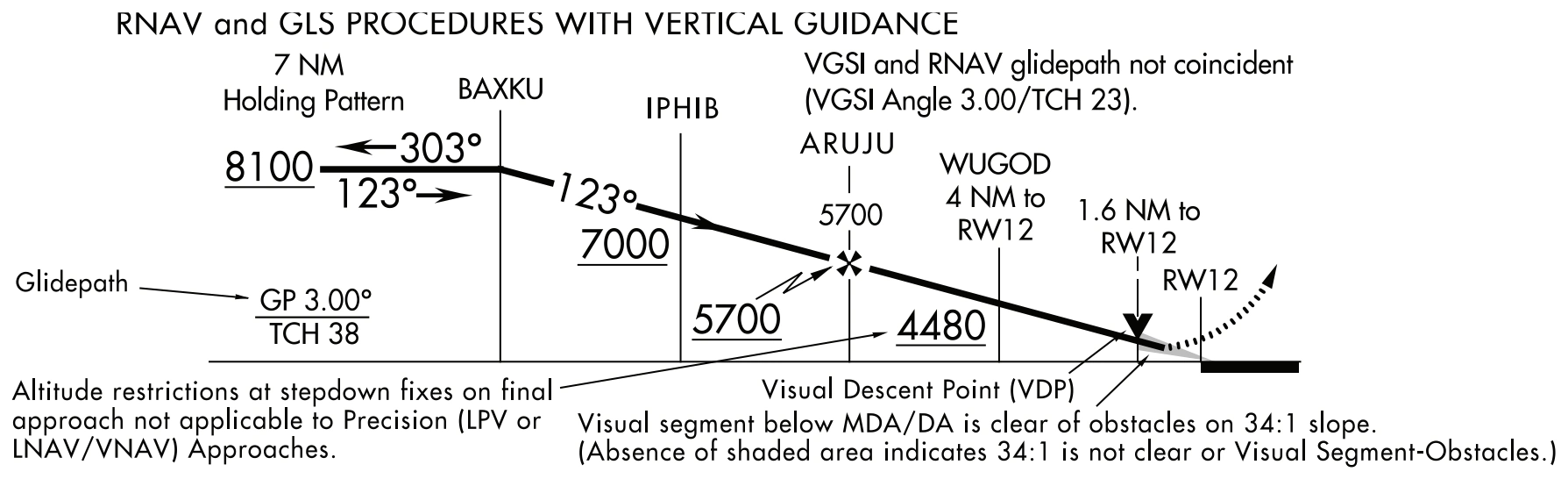
RNAV and GLS procedures with vertical guidance profile — BAXKU, IPHIB, ARUJU, WUGOD, VDP — source page 116.
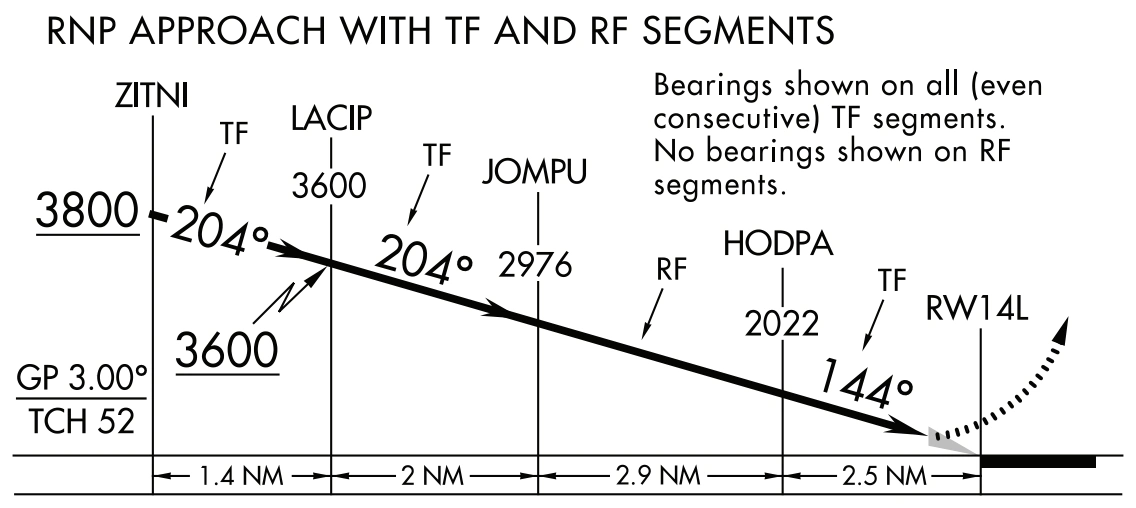
RNP approach with TF and RF segments — ZITNI, LACIP, JOMPU, HODPA, RWY14L — source page 116.
Profile distances between procedure components and from the last component to the approach end of the runway are depicted. On the procedure source, these distances are provided to the hundredths place and then rounded to tenths for charting. As a result, the charted distances between components may not always add up exactly to the total unrounded distance.
Altitudes
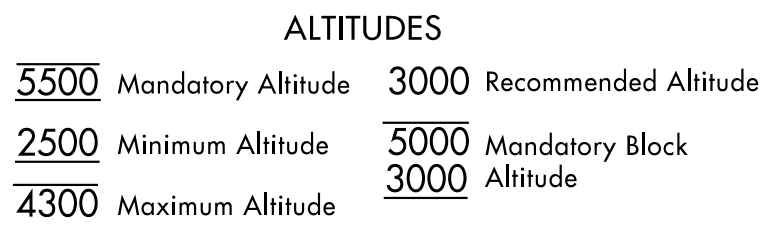
Minimum, Maximum, Mandatory and Recommended Altitudes are identified with the component to which they apply.
Minimum, Maximum, Mandatory and Recommended Altitudes are identified with the component to which they apply. — source page 116.
PROFILE VIEW A profile diagram of the instrument approach procedure is shown below the planview. The published descent profile and graphical depiction of the vertical path using those facilities, intersections, fixes, etc. identified in the procedure to the runway are shown. A profile view of the procedure track is shown. The approach track begins toward the top of the primary facility line, unless otherwise dictated by the procedure, and shall descend to where the final approach ends and the missed approach begins. When a reference mark (*, **, #, etc.) is shown in the profile, the qualifying footnote is provided within the profile section. Profile distances between procedure components and from the last component to the approach end of the runway are depicted. On the procedure source, these distances are provided to the hundredths place and then rounded to tenths for charting. As a result, the charted distances between components may not always add up exactly to the total unrounded distance. Altitudes Minimum, Maximum, Mandatory and Recommended Altitudes are identified with the component to which they apply.
Source page 117
Precision Approaches
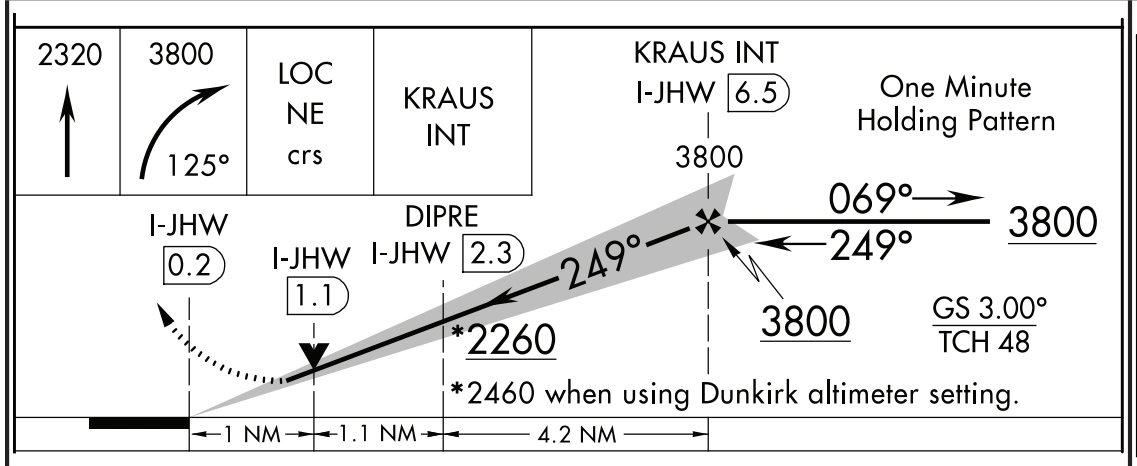
On precision approaches, the glideslope (GS) intercept altitude is illustrated by a lightning bolt symbol and an altitude. This is the minimum altitude for GS interception after completion of the procedure turn. Precision approach profiles also depict the GS angle of descent, threshold crossing height (TCH) and GS altitude at the outer marker (OM) or designated fix. The missed approach track is symbolized using the hatched line pattern. Where separate missed approach points exist for precision and non-precision approaches on the same chart, e.g., ILS and LOC, the track will be shown from the precision point only.
|
Traditional (NAVAID) Approach | RNAV Approach
Traditional (NAVAID) precision-approach profile — I-JHW/KRAUS INT, GS 3.00°, TCH 48 — source page 117.
Cookie Preferences
We use cookies to operate this website, improve performance, understand site traffic, and personalize your experience. Essential cookies are always active because they are required for the website to function.
Required for basic site functionality and security.
Help us understand how visitors use the website so we can improve it.
May be used for advertising, remarketing, or social media features.
You can update your choices anytime using Cookie Settings. View Privacy Policy