
Chapter 5
Maintaining Aircraft Control: Upset Prevention and Recovery Training
It is important to be familiar with VA or VO, how it relates to accelerated stalls, and how it changes depending on the airplane's weight. VA is the maximum speed at which the positive design load limit can be imposed either by gusts or full one-sided deflection with one control surface without causing structural damage. VO is a historical operating limitation applicable to certain airplanes only. It represents the maximum speed where, at any given weight, the pilot may apply full control excursion without exceeding the design limit load factor. Performing accelerated stalls at speeds up to the applicable VA or VO, ensures the airplane will reach the critical AOA, which unloads the wing, before exceeding the design load limit. At speeds above VA or VO, the airplane can reach its design load limit at less than the critical AOA. This condition makes it possible to add additional load and overstress the airplane. Additional information on the effects of aircraft weight on stall speeds and structural limits while maneuvering is available in the "Aerodynamics of Flight" chapter of the Pilot’s Handbook of Aeronautical Knowledge (FAA-H-8083-25).
There are two methods for performing an accelerated stall. The most common accelerated stall procedure starts from straight-and- level flight at an airspeed at or below VA or VO. The pilot rolls the airplane into a coordinated, level-flight 45° turn and then smoothly, firmly, and progressively increase the AOA through back elevator pressure until a stall occurs. Alternatively, the pilot rolls the airplane into a coordinated, level-flight 45° turn at an airspeed above VA or VO. After the airspeed slows to VA or VO, and at an airspeed 5 to 10 percent faster than the unaccelerated stall speed, the pilot progressively increases the AOA through back elevator pressure until a stall occurs. The increased back elevator pressure increases lift and the G load. The G load pushes the pilot’s body down in the seat. The increased lift also increases drag, which may cause the airspeed to decrease. The pilot should know the published stall speed for 45° of bank, flaps up, before performing the maneuver. This speed is typically published in the AFM.
An airplane typically stalls during a level, coordinated turn similar to the way it does in wings-level flight, except that the stall buffet can be sharper. If the turn is coordinated at the time of the stall, the airplane’s nose pitches away from the pilot just as it does in a wings-level stall since both wings will tend to stall nearly simultaneously. If the airplane is not properly coordinated at the time of stall, the stall behavior may include a change in bank angle until the AOA has been reduced. It is important to take recovery action at the first indication of a stall (if impending stall training/checking) or immediately after the stall has fully developed (if full stall training/checking) by applying forward elevator pressure as required to reduce the AOA and to eliminate the stall warning, level the wings using ailerons, coordinate with rudder, and adjust power as necessary. Stalls that result from abrupt maneuvers tend to be more aggressive than unaccelerated +1G stalls. Because they occur at higher-than-normal airspeeds or may occur at lower-than-anticipated pitch attitudes, they can surprise an inexperienced pilot. Since an accelerated stall may put the airplane in an unexpected attitude. Failure to execute an immediate recovery may result in a spin or other departure from controlled flight.
Cross-Control Stall
The objective of the cross-control stall demonstration is to show the effects of uncoordinated flight on stall behavior and to emphasize the importance of maintaining coordinated flight while making turns. This is a demonstration-only maneuver; only flight instructor applicants may be required to perform it on a practical test. However, all pilots should be familiar with the situations that can lead to a cross-control stall, how to recognize and avoid this stall, and how to recover should one occur.
The aerodynamic effects of the uncoordinated, cross-control stall can surprise the unwary pilot because this stall can occur with very little warning and can be deadly if it occurs close to the ground. The nose may pitch down, the bank angle may suddenly change, and the airplane may continue to roll to an inverted orientation, which is usually the beginning of a spin. It is therefore essential for the pilot to follow the stall recovery procedure by reducing the AOA until the stall warning has been eliminated, then roll wings level using ailerons, and coordinate with rudder inputs before the airplane enters a spiral or spin.
A cross-control stall occurs when the critical AOA is exceeded with aileron pressure applied in one direction and rudder pressure in the opposite direction, causing uncoordinated flight. A skidding cross-control stall is most likely to occur in the traffic pattern during a poorly planned and executed base-to-final approach turn. There may be an unrecognized tailwind component and higher groundspeed on the base leg, which causes the pilot to turn late or with inadequate bank. The airplane overshoots the runway centerline, and the pilot attempts to correct by increasing the bank angle, increasing back elevator pressure, and applying excess rudder in the direction of the turn (i.e., inside or bottom rudder pressure) to bring the nose around further to align it with the runway. The difference in lift between the inside and outside wing will increase, resulting in an unwanted increase in bank angle. At the same time, the nose of the airplane slices downward through the horizon. The natural reaction to this may be for the pilot to pull back on the elevator control, increasing the AOA toward critical. Should a stall be encountered with these inputs, the airplane may rapidly enter a spin. The safest action for an “overshoot” is to perform a go-around. At the relatively low altitude of a base-to-final approach turn, a pilot should be reluctant to use bank angles greater than 30 degrees and should not make a skidding turn if correcting for any overshoot.
Before performing this stall, the pilot should establish a safe altitude for entry and recovery in the event of a spin, and clear the area of other traffic while slowly retarding the throttle. The next step is to lower the landing gear (if equipped with retractable gear), close the throttle, and maintain altitude until the airspeed approaches the normal glide speed. To avoid the possibility of exceeding the airplane’s limitations, the pilot should not extend the flaps. While the gliding attitude and airspeed are being established, the airplane should be retrimmed. Once the glide is stabilized, the airplane should be rolled into a medium-banked turn to simulate a final approach turn that overshoots the centerline of the runway.
During the turn, the pilot should smoothly apply excessive rudder pressure in the direction of the turn and hold the bank constant by applying opposite aileron pressure. At the same time, the pilot increases back elevator pressure to keep the nose from lowering. All of these control pressures should be increased until the airplane stalls. When the stall occurs, the pilot applies nose-down elevator pressure to reduce the AOA until the stall warning has been eliminated, removes the excessive rudder input and levels the wings, and adds power as needed to return to complete the recovery and return to the desired flightpath.
Elevator Trim Stall
The elevator trim stall demonstration shows what can happen when the pilot applies full power for a go-around without maintaining positive control of the airplane. [Figure 5-14] This is a demonstration-only maneuver; only flight instructor applicants may be required to perform it on a practical test. However, all pilots should be familiar with the situations that can cause an elevator trim stall, recognize its development, and take appropriate action to prevent it.
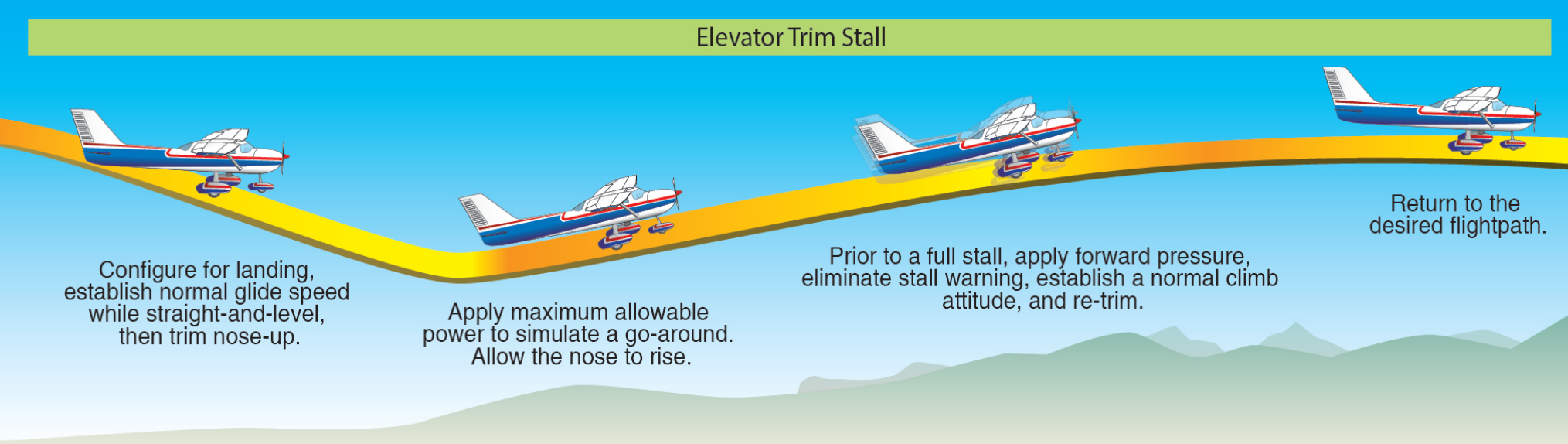
This situation may occur during a go-around procedure from a normal landing approach or a simulated, forced-landing approach, or immediately after a takeoff, with the trim set for a normal landing approach glide at idle power. The demonstration shows the importance of making smooth power applications, overcoming strong trim forces, maintaining positive control of the airplane to hold safe flight attitudes, and using proper and timely trim techniques. It also develops the pilot’s ability to avoid actions that could result in this stall, to recognize when an elevator trim stall is approaching, and to take prompt and correct action to prevent a full stall condition. It is imperative to avoid the occurrence of an elevator trim stall during an actual go-around from an approach to landing.
At a safe altitude and after ensuring that the area is clear of other air traffic, the pilot should slowly retard the throttle and extend the landing gear (if the airplane is equipped with retractable gear). The next step is to extend the flaps to the one-half or full position, close the throttle, and maintain altitude until the airspeed approaches the normal glide speed.
When the normal glide is established, the pilot should trim the airplane nose-up for the normal landing approach glide. During this simulated final approach glide, the throttle is then advanced smoothly to maximum allowable power, just as it would be adjusted to perform a go-around.
The combined effects of increased propwash over the tail and elevator trim tend to make the nose rise sharply and turn to the left. With the throttle fully advanced, the pitch attitude increases above the normal climbing attitude. When it is apparent the airplane is approaching a stall, the pilot should apply sufficient forward elevator pressure to reduce the AOA and eliminate the stall warning before returning the airplane to the normal climbing attitude. The pilot will need to adjust trim to relieve the heavy control pressures and then complete the normal go around procedures and return to the desired flightpath. If taken to the full stall, recovery will require a significant nose-down attitude to reduce the AOA below its critical AOA, along with a corresponding significant loss of altitude.
Common Errors
Common errors in the performance of intentional stalls are:
- Failure to adequately clear the area.
- Over-reliance on the airspeed indicator and slip-skid indicator while excluding other cues after recovery.
- Inadvertent accelerated stall by pulling too fast on the controls during a power-off or power-on stall entry.
- Inability to recognize an impending stall condition.
- Failure to take timely action to prevent a full stall during the conduct of impending stalls.
- Failure to maintain a constant bank angle during turning stalls.
- Failure to maintain proper coordination with the rudder throughout the stall and recovery.
- Recovering before reaching the critical AOA when practicing the full stall maneuver.
- Not disconnecting the wing leveler or autopilot, if equipped, prior to reducing AOA.
- Recovery is attempted without recognizing the importance of pitch control and AOA.
- Not maintaining a nose down control input until the stall warning is eliminated.
- Pilot attempts to level the wings before reducing AOA.
- Pilot attempts to recover with power before reducing AOA.
- Failure to roll wings level after AOA reduction and stall warning is eliminated.
- Inadvertent secondary stall during recovery.
- Excessive forward-elevator pressure during recovery resulting in low or negative G load.
- Excessive airspeed buildup during recovery.
- Losing situational awareness and failing to return to desired flightpath or follow ATC instructions.