Chapter 5
Maintaining Aircraft Control: Upset Prevention and Recovery Training
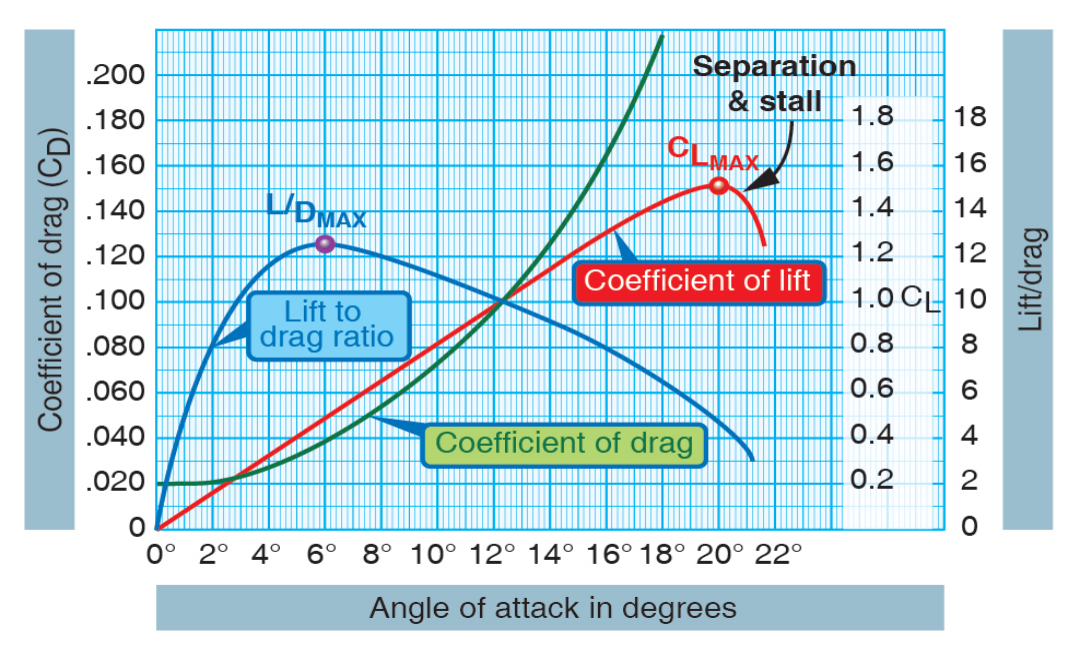
It is also important to note that an airplane flying below L/DMAX, exhibits a characteristic known as “speed instability” and the airspeed will continue to decay without appropriate pilot action. For example, if the airplane is disturbed by turbulence and the airspeed decreases, the airspeed may continue to decrease without the appropriate pilot action of reducing the AOA or adding power. [Figure 5-6]
Performing the Slow Flight Maneuver
Slow flight training includes:
- Slowing the airplane smoothly and promptly from cruising to approach speeds without changes in altitude or heading, while increasing the angle of attack and setting the required power and trim.
- Configuration changes, such as extending the landing gear and adding flaps, while maintaining heading and altitude.
- Turning while maintaining altitude.
- Straight-ahead climbs and climbing medium-banked (approximately 20 degrees) turns, and straight-ahead power-off gliding descents and descending turns, which represent the takeoff and landing phases of flight.
Slow flight in a single-engine airplane should be conducted so the maneuver can be completed no lower than 1,500 feet AGL (3,000 for multiengine airplanes), or higher, if recommended by the manufacturer. In all cases, practicing slow flight should be conducted at an adequate height above the ground for recovery should the airplane inadvertently stall.
To begin the slow flight maneuver, the pilot should clear the area and gradually reduce thrust from cruise power and adjust the pitch to allow the airspeed to decrease while maintaining altitude. As the speed of the airplane decreases, there is a change in the sound of the airflow. As the speed approaches the target slow flight speed, which is an airspeed just above the stall warning in the desired configuration (i.e., approximately 5–10 knots above the stall speed for that flight condition), additional power will be needed to maintain altitude. During these changing flight conditions, the pilot should trim the airplane to compensate for changes in control pressures. If the airplane remains trimmed at the pre-maneuver cruising speed, strong aft (back) control pressure is needed on the elevator, which will make precise control difficult.
Slow flight is typically performed and evaluated in the landing configuration. Therefore, both the landing gear and the flaps should be extended to the landing position, as applicable. It is recommended the prescribed before-landing checks be completed to configure the airplane. The extension of gear and flaps typically occurs once cruise power has been reduced and at appropriate airspeeds to ensure limitations for extending those devices are not exceeded. Practicing this maneuver in other configurations, such as a clean or takeoff configuration, is also good training and may be evaluated on the practical test.
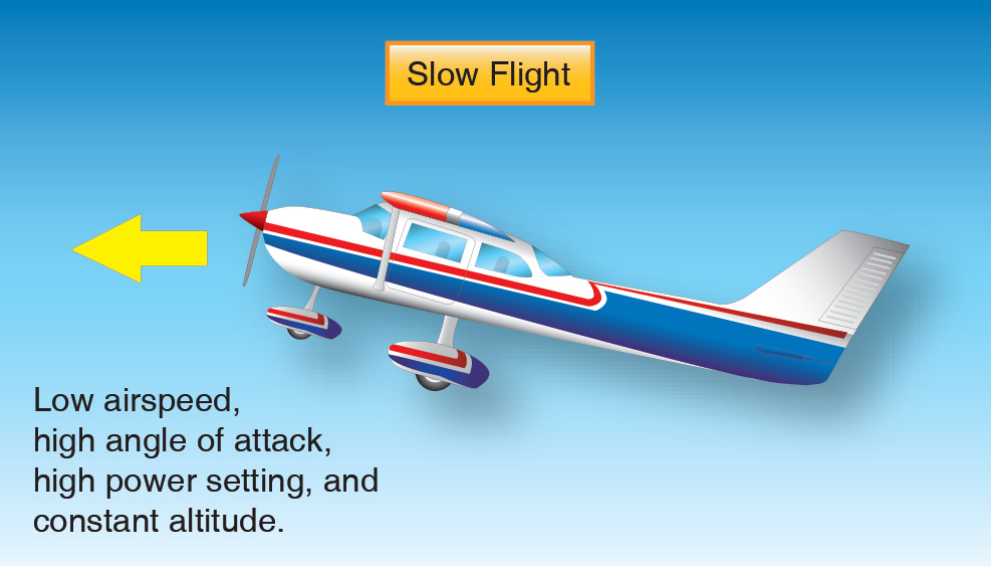
With an AOA just under the AOA which may cause an aerodynamic buffet or stall warning, the flight controls are less effective. [Figure 5-7] The elevator control is less responsive and larger control movements are necessary to retain control of the airplane. In propeller-driven airplanes, torque, slipstream effect, and P-factor may produce a strong left yaw, which requires right rudder input to maintain coordinated flight. The closer the airplane is to the 1G stall, the greater the amount of right rudder pressure required.
Maneuvering in Slow Flight
When the desired pitch attitude and airspeed have been established in straight-and-level slow flight, the pilot needs to maintain awareness of outside references and continually cross-check the airplane’s instruments to maintain control. The pilot should note the feel of the flight controls, especially the airspeed changes caused by small pitch adjustments, and the altitude changes caused by power changes. The pilot should practice turns to determine the airplane’s controllability characteristics at this low speed. During the turns, it will be necessary to increase power to maintain altitude. Abrupt or rough control movements during slow flight may result in a stall. For instance, abruptly raising the flaps while in slow flight can cause the plane to stall.
The pilot should also practice climbs and descents by adjusting the power when stabilized in straight-and-level slow flight. The pilot should note the increased yawing tendency at high power settings and counter it with rudder input as needed.
To exit the slow flight maneuver, add power. As airspeed and lift increase, apply forward control pressure to reduce the AOA and maintain altitude. Maintain coordinated flight, level the wings as necessary, and return to the desired flightpath. As airspeed increases, clean up the airplane by retracting flaps and landing gear, if they were extended, and adjust trim as needed. A pilot should anticipate the changes to the AOA as the landing gear and flaps are retracted to avoid a stall.
Common Errors
Common errors in the performance of slow flight are:
- Failure to adequately clear the area
- Inadequate back-elevator pressure as power is reduced, resulting in altitude loss
- Excessive back-elevator pressure as power is reduced, resulting in a climb followed by rapid reduction in airspeed
- Insufficient right rudder to compensate for left yaw
- Fixation on the flight instruments
- Failure to anticipate changes in AOA as flaps are extended or retracted
- Inadequate power management
- Inability to adequately divide attention between airplane control and orientation
- Failure to properly trim the airplane 1
- Failure to respond to a stall warning
Stalls
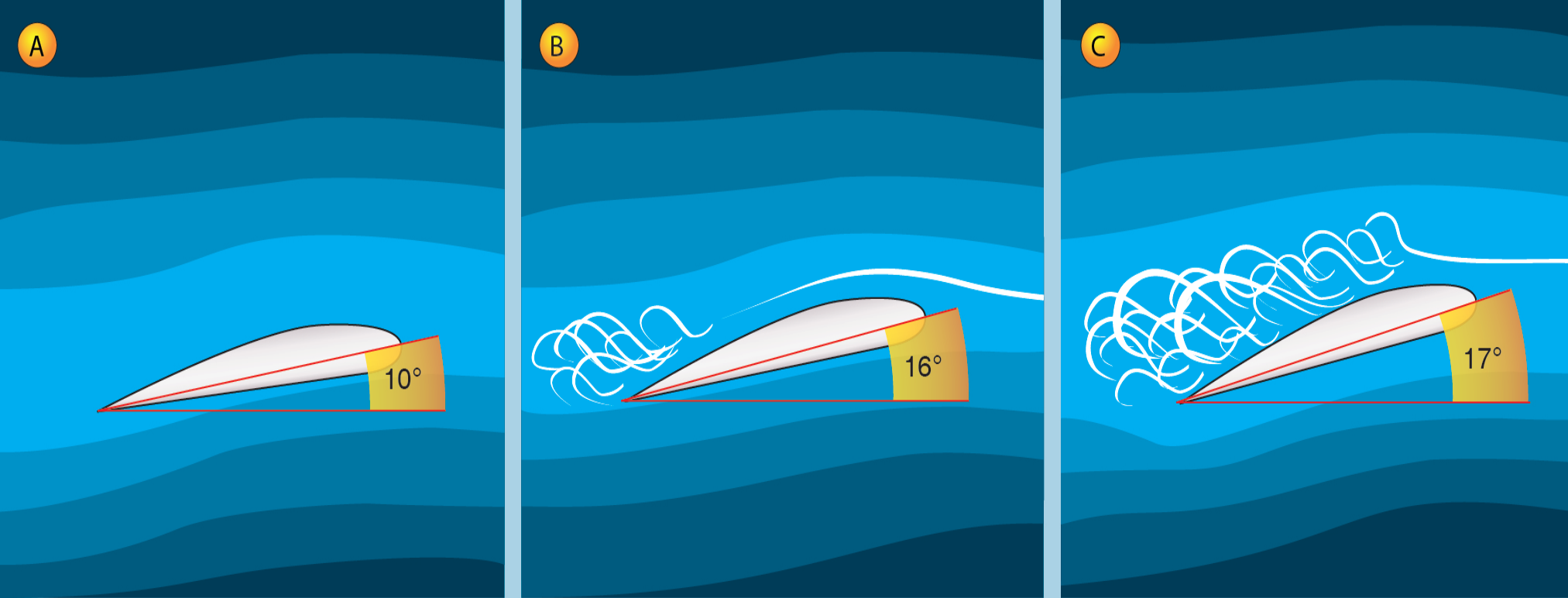
A stall is an aerodynamic condition which occurs when smooth airflow over the airplane’s wings is disrupted, resulting in loss of lift. Specifically, a stall occurs when the AOA—the angle between the chord line of the wing and the relative wind—exceeds the wing’s critical AOA. It is possible to exceed the critical AOA at any airspeed, at any attitude, and at any power setting. [Figure 5-8]