
Chapter 5
Maintaining Aircraft Control: Upset Prevention and Recovery Training
Stall Characteristics
Different airplane designs can result in different stall characteristics. The pilot should know the stall characteristics of the airplane being flown and the manufacturer’s recommended recovery procedures. Factors that can affect the stall characteristics of an airplane include its geometry, CG, wing design, and high-lift devices. Engineering design variations make it impossible to specifically describe the stall characteristics for all airplanes; however, there are enough similarities in small general aviation training-type airplanes to offer broad guidelines.
Most training airplanes are designed so that the wings stall progressively outward from the wing roots (where the wing attaches to the fuselage) to the wingtips. Some wings are manufactured with a certain amount of twist, known as washout, resulting in the outboard portion of the wings having a slightly lower AOA than the wing roots. This design feature causes the wingtips to have a smaller AOA during flight than the wing roots. Thus, the wing roots of an airplane exceed the critical AOA before the wingtips, meaning the wing roots stall first. Therefore, when the airplane is in a stalled condition, the ailerons should still have a degree of control effectiveness until/unless stalled airflow migrates outward along the wings. Although airflow may still be attached at the wingtips, a pilot should exercise caution using the ailerons prior to the reduction of the AOA because it can exacerbate the stalled condition. For example, if the airplane rolls left at the stall (“rolls-off”), and the pilot applies right aileron to try to level the wing, the downward-deflected aileron on the left wing produces a greater AOA (and more induced drag), and a more complete stall at the tip as the critical AOA is exceeded. This can cause the wing to roll even more to the left, which is why it is important to first reduce the AOA before attempting to roll the airplane.
The pilot should also understand how the factors that affect stalls are interrelated. In a power-off stall, for instance, the cues (buffeting, shaking) are less noticeable than in the power-on stall. In the power-off, 1G stall, the predominant cue may be the elevator control position (full up elevator against the stops) and a high descent rate.
Fundamentals of Stall Recovery
Depending on the complexity of the airplane, stall recovery could consist of as many as six steps. Even so, the pilot should remember the most important action to an impending stall or a full stall is to reduce the AOA. There have been numerous situations where pilots did not first reduce AOA, and instead prioritized power and maintaining altitude, which resulted in a loss of control. This section provides a generic stall recovery procedure for light general aviation aircraft adapted from a template developed by major airplane manufacturers and can be adjusted appropriately for the aircraft used. [Figure 5-10] However, a pilot should always follow the aircraft-specific manufacturer’s recommended procedures if published and current.
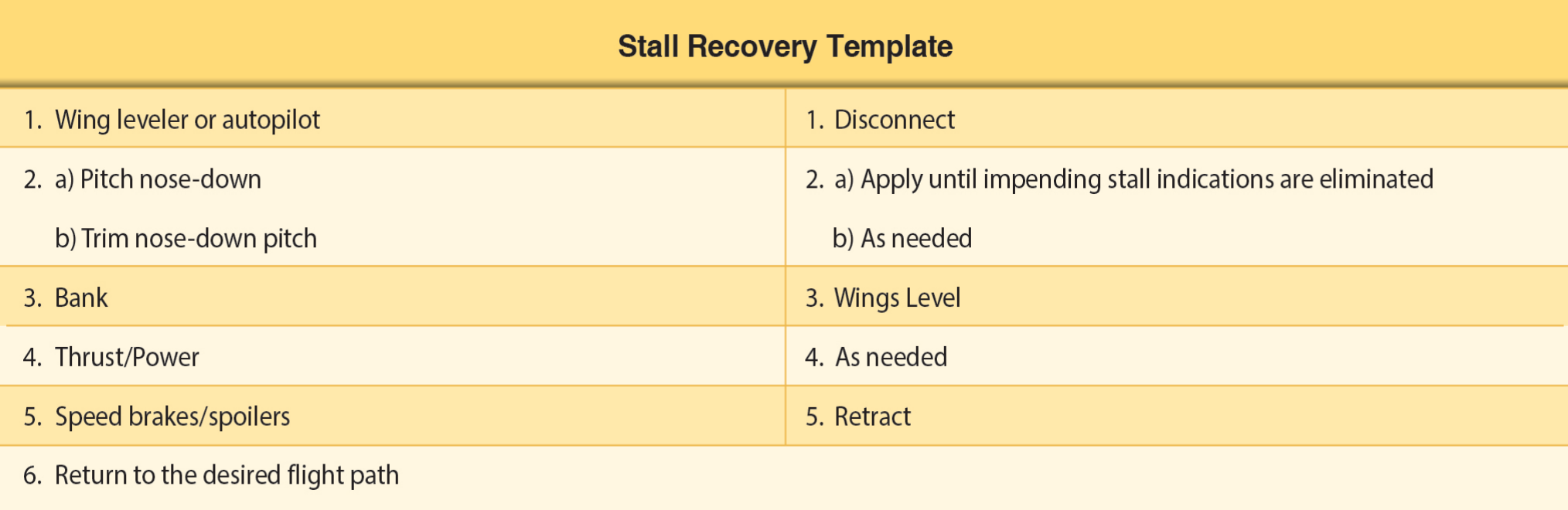
The recovery actions should be made in a procedural manner; they can be summarized in Figure 5-10. The following discussion explains each of the six steps:
- Disconnect the wing leveler or autopilot (if equipped). Manual control is essential to recovery in all situations. Disconnecting this equipment should be done immediately and allow the pilot to move to the next crucial step quickly. Leaving the wing leveler or autopilot connected may result in inadvertent changes or adjustments to the flight controls or trim that may not be easily recognized or appropriate, especially during high workload situations.
- Pitch nose-down control. Reducing the AOA is crucial for all stall recoveries. Push forward on the flight controls to reduce the AOA below the critical AOA until the impending stall indications are eliminated before proceeding to the next step.
- Trim nose-down pitch. If the elevator does not provide the needed response, pitch trim may be necessary. However, excessive use of pitch trim may aggravate the condition, or may result in loss of control or high structural loads.
- Roll wings level. This orients the lift vector properly for an effective recovery. It is important not to be tempted to control the bank angle prior to reducing AOA. Both roll stability and roll control will improve considerably after getting the wings flying again. It is also imperative to proactively cancel yaw with proper use of the rudder to prevent a stall from progressing into a spin.
- Add thrust/power. Power should be added as needed, as stalls can occur at high power or low power settings or at high airspeeds or low airspeeds. Advance the throttle promptly, but smoothly, as needed while using rudder and elevator controls to stop any yawing motion and prevent any undesirable pitching motion. Adding power typically reduces the loss of altitude during a stall recovery, but it does not eliminate a stall. The reduction in AOA is imperative. For propeller-driven airplanes, power application increases the airflow around the wing, assisting in stall recovery.
- Retract speedbrakes/spoilers (if equipped). This will improve lift and the stall margin.
- Return to the desired flightpath. Apply smooth and coordinated flight control movements to return the airplane to the desired flightpath being careful to avoid a secondary stall. However, be situationally aware of the proximity to terrain during the recovery and take the necessary flight control action to avoid contact with it.
The above procedure can be adapted for the type of aircraft flown. For example, a single-engine training airplane without an autopilot would likely only use four of the six steps. The first step is not applicable. The actual first step is the reduction of the AOA until the stall warning is eliminated. Use of pitch trim is less of a concern in a training airplane because most pilots can overpower the trim in these airplanes. Any improper trim can be corrected when returning to the desired flightpath. The next step is rolling the wings level followed by the addition of power as needed all while maintaining coordinated flight. If the airplane is not equipped with speedbrakes or spoilers, this step is also skipped. Returning to the desired flightpath concludes the recovery.
Similarly, a glider pilot does not have an autopilot; therefore, the first step is the reduction of AOA until the stall warning is eliminated. The pilot would then roll wings level while maintaining coordinated flight. Since there is no power to add, this step would not apply. Retracting speedbrakes or spoilers would be the next step for a glider pilot followed by returning to the desired flightpath.
Stall Training
Practice in both power-on and power-off stalls is important because it simulates stall conditions that could occur during normal flight maneuvers. It is important for pilots to understand the possible flight scenarios in which a stall could occur. Stall accidents usually result from an inadvertent stall at a low altitude, with the recovery not completed prior to ground contact. For example, power-on stalls are practiced to develop the pilot’s awareness of what could happen if the airplane is pitched to an excessively nose-high attitude immediately after takeoff, during a climbing turn, or when trying to clear an obstacle. Power-off turning stalls develop the pilot’s awareness of what could happen if the controls are improperly used during a turn from the base leg to the final approach. The power-off straight-ahead stall simulates the stall that could occur when trying to stretch a glide after the engine has failed, or if low on the approach to landing.
As in all maneuvers that involve significant changes in altitude or direction, the pilot should ensure that the area is clear of other air traffic at and below their altitude and that sufficient altitude is available for a recovery before executing the maneuver. It is recommended that stalls be practiced at an altitude that allows recovery no lower than 1,500 feet AGL for single-engine airplanes, or higher if recommended by the AFM/POH. Losing altitude during recovery from a stall is to be expected.
Approaches to Stalls (Impending Stalls), Power-On or Power-Off
An impending stall occurs when the airplane is approaching, but does not exceed the critical AOA. The purpose of practicing impending stalls is to learn to retain or regain full control of the airplane immediately upon recognizing that it is nearing a stall, or that a stall is likely to occur if the pilot does not take appropriate action. Pilot training should emphasize teaching the same recovery technique for impending stalls and full stalls.
The practice of impending stalls is of particular value in developing the pilot’s sense of feel for executing maneuvers in which maximum airplane performance is required. These maneuvers require flight in which the airplane approaches a stall, but the pilot initiates recovery at the first indication, such as by a stall warning device activation.
Impending stalls may be entered and performed in the same attitudes and configurations as the full stalls or other maneuvers described in this chapter. However, instead of allowing the airplane to reach the critical AOA, the pilot should immediately reduce AOA once the stall warning device goes off, if installed, or recognizes other cues such as buffeting. The pilot should hold the nose- down control input as required to eliminate the stall warning. Then level the wings maintain coordinated flight, and then apply whatever additional power is necessary to return to the desired flightpath. The pilot will have recovered once the airplane has returned to the desired flightpath with sufficient airspeed and adequate flight control effectiveness and no stall warning. Performance of the impending stall maneuver is unsatisfactory if a full stall occurs, if an excessively low pitch attitude is attained, or if the pilot fails to take timely action to avoid excessive airspeed, excessive loss of altitude, or a spin.
Full Stalls, Power-Off
The practice of power-off stalls is usually performed with normal landing approach conditions to simulate an accidental stall occurring during approach to landing. However, power-off stalls should be practiced at all flap settings to ensure familiarity with handling arising from mechanical failures, icing, or other abnormal situations. Airspeed in excess of the normal approach speed should not be carried into a stall entry since it could result in an abnormally nose-high attitude.