
Chapter 9
Approaches and Landings
There are steps and procedures pilots should follow in a simulated emergency landing. Although they may differ somewhat from the procedures used in an actual emergency, they should be learned thoroughly and each step called out to the instructor. The use of a checklist is strongly recommended. Most airplane manufacturers provide a checklist of the appropriate items. [Figure 9-29]
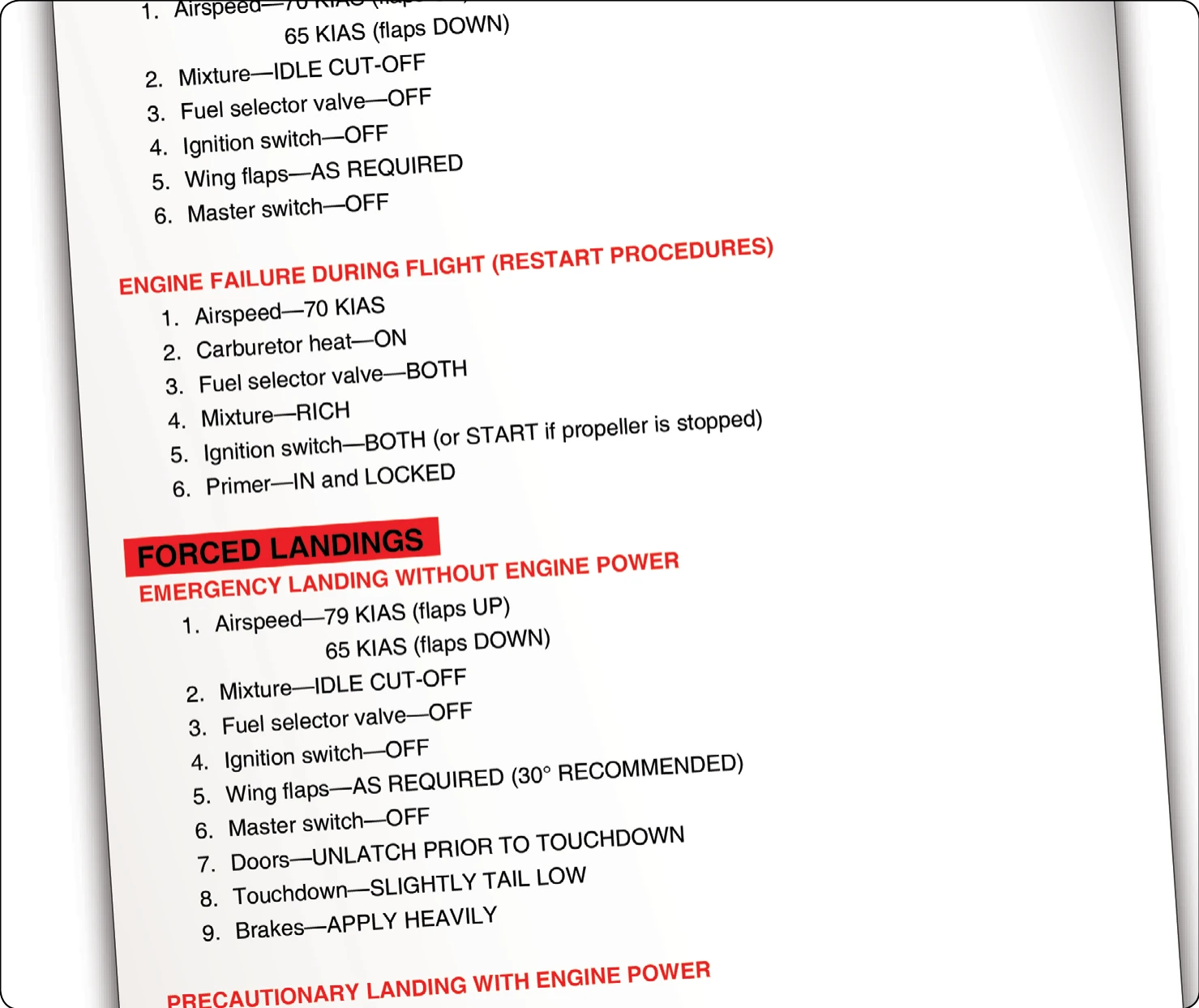
Critical items to be checked include the position of the fuel tank selector, the quantity of fuel in the tank selected, the fuel pressure gauge to see if the electric fuel pump is needed, the position of the mixture control, the position of the magneto switch, and the use of carburetor heat. Many actual emergency landings have been made and later found to be the result of the fuel selector valve being positioned to an empty tank while the other tank had plenty of fuel. It may be wise to change the position of the fuel selector valve even though the fuel gauge indicates fuel in all tanks because fuel gauges can be inaccurate. Many actual emergency landings could have been prevented if the pilots had developed the habit of checking these critical items during flight training.
Instruction in emergency procedures is not limited to simulated emergency landings caused by power failures. Other emergencies associated with the operation of the airplane should be explained, demonstrated, and practiced if practicable. Among these emergencies are fire in flight, electrical or hydraulic system malfunctions, unexpected severe weather conditions, engine overheating, imminent fuel exhaustion, and the emergency operation of airplane systems and equipment.
Faulty Approaches and Landings
Landing involves many precise, time-sensitive, and sequential control inputs. When corrected early, small errors are often not noticeable. On the other hand, uncorrected errors may place the airplane and occupants in an undesirable state. Since pilot training normally includes exposure to landing deviations and their appropriate remedies, this section covers several common landing imperfections.
Low Final Approach
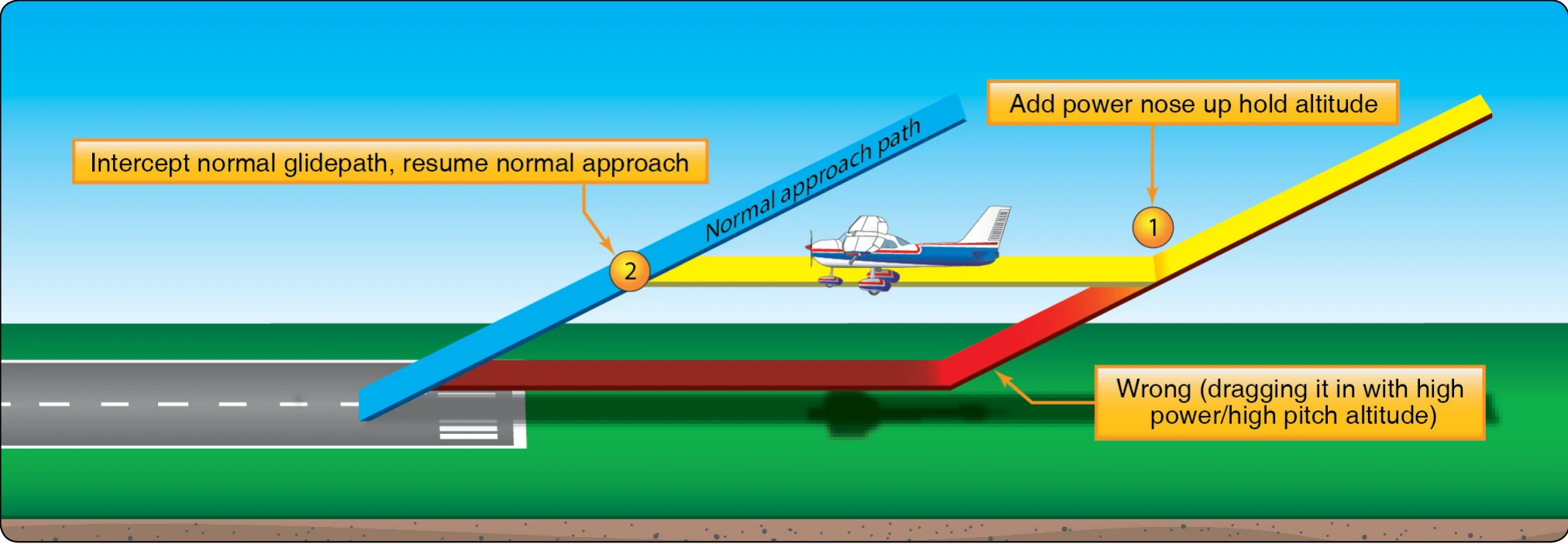
When the base leg is too low, insufficient power is used, landing flaps are extended prematurely, or the velocity of the wind is misjudged, the airplane may be well below the proper final approach path. In such a situation, the pilot would have to apply considerable power to fly the airplane (at an excessively low altitude) up to the runway threshold. When it is realized the runway cannot be reached unless appropriate action is taken, power should be applied immediately to maintain the airspeed while the pitch attitude is raised to increase lift and stop the descent. When the proper approach path has been intercepted, the correct approach attitude is reestablished and the power reduced and a stabilized approach maintained. [Figure 9-30] The pilot should not increase the pitch attitude without increasing the power because the airplane decelerates rapidly and may approach the critical AOA and stall. In addition, the pilot should not retract the flaps since this causes a sudden decrease in lift and causes the airplane to sink more rapidly. If there is any doubt about the approach being safely completed, it is advisable to execute an immediate go-around.
High Final Approach
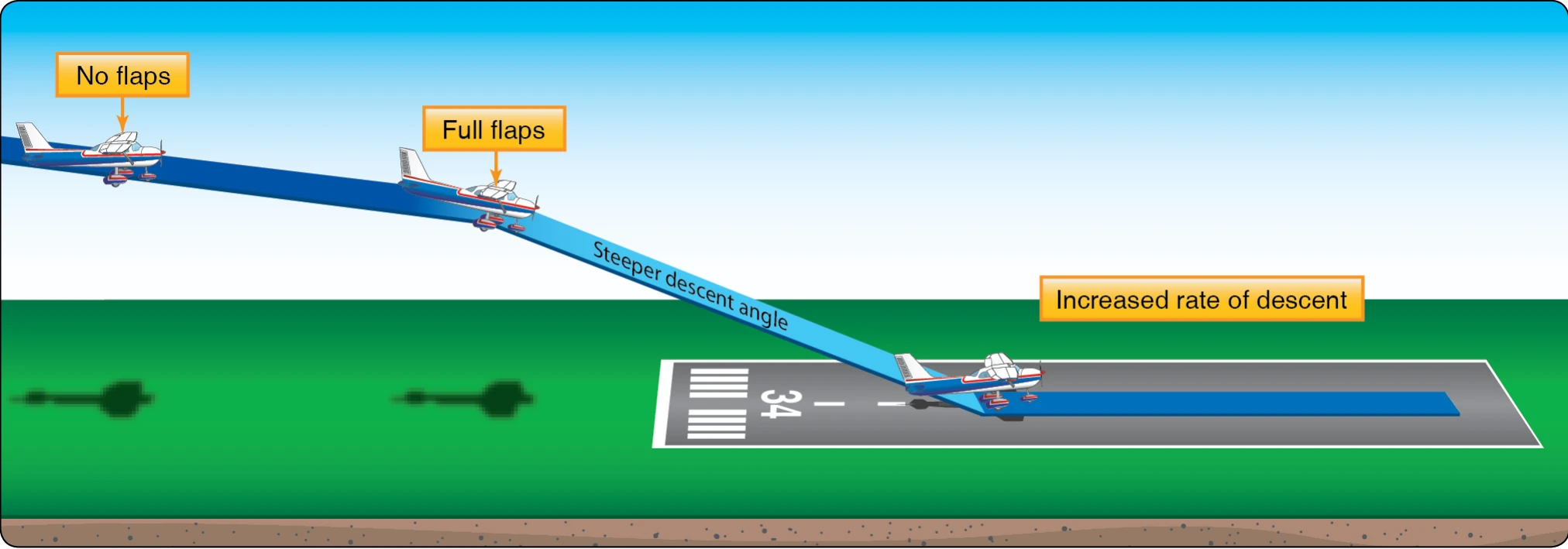
When the final approach is too high, the pilot may lower the flaps as required. Further reduction in power may be necessary, while lowering the nose simultaneously to maintain approach airspeed and steepen the approach path. [Figure 9-31] Alternatively, the pilot could use a forward slip to increase the descent angle and rate of descent while maintaining proper approach speed. Since a sink rate in excess of 800–1,000 feet per minute (fpm) is considered excessive, either technique avoids the high sink rates that would occur if the pilot dives the airplane toward the aiming point. Since a high sink rate continued close to the surface makes it be difficult to slow to a proper rate prior to ground contact, it is not a good idea to dive toward the aiming point. Therefore, when intercepting the proper approach path from above, the pilot adjusts the power as required to maintain a stabilized approach. A go-around should be initiated if the sink rate becomes excessive.
Slow Final Approach
On the final approach, when the airplane is flown at a slower than normal airspeed, the pilot’s judgment of the rate of sink (descent) and the height of round out is difficult. During an excessively slow approach, the wing is operating near the critical AOA and, depending on the pitch attitude changes and control usage, the airplane may stall or sink rapidly, contacting the ground with a hard impact.
Whenever a slow speed approach is noted, the pilot should apply power to accelerate the airplane and increase the lift to reduce the sink rate and to prevent a stall. This is done while still at a high enough altitude to reestablish the correct approach airspeed and attitude. If too slow and too low, it is best to execute a go-around.
Use of Power
Power can be used effectively during the approach and round out to compensate for errors in judgment. Power may be added to accelerate the airplane, to increase lift without increasing the AOA, and to slow the descent to an acceptable rate. The increased propwash over the wing behind the propeller(s) also provides an immediate boost in lift that also helps slow the descent rate. If the proper landing attitude is attained and the airplane is only slightly high, the landing attitude is held constant and sufficient power applied to help ease the airplane onto the ground. After the airplane has touched down, the pilot closes the throttle so the additional thrust and lift are removed and the airplane remains on the ground.
High Round Out
Sometimes when the airplane appears to temporarily stop moving downward, the round out has been made too rapidly and the airplane is flying level, too high above the runway. Continuing the round out further reduces the airspeed and increases the AOA to the critical angle. This results in the airplane stalling and dropping hard onto the runway. To prevent this, the pitch attitude is held constant until the airplane decelerates enough to again start descending. Then the round out is continued to establish the proper landing attitude. This procedure is only used when there is adequate airspeed. It may be necessary to add a slight amount of power to keep the airspeed from decreasing excessively and to avoid losing lift too rapidly.
When the proper landing attitude is attained, the airplane is approaching a stall because the airspeed is decreasing and the critical AOA is being approached, even though the pitch attitude is no longer being increased. [Figure 9-32]