
Chapter 9
Approaches and Landings
Once the airplane has slowed sufficiently and has turned onto the taxiway and stopped, the pilot performs the after-landing checklist. Many accidents have occurred as a result of the pilot unintentionally operating the landing gear control and retracting the gear instead of the flap control when the airplane was still rolling. The habit of positively identifying both of these controls, before actuating them, should be formed from the very beginning of flight training and continued in all future flying activities. If available runway permits, the speed of the airplane is allowed to dissipate in a normal manner.
Common Errors
Common errors in the performance of normal approaches and landings are:
- Failure to complete the landing checklist in a timely manner.
- Inadequate wind drift correction on the base leg.
- An overshooting, undershooting, too steep, or too shallow a turn onto final approach.
- A skidding turn from base leg to final approach as a result of overshooting/inadequate wind drift correction.
- Poor coordination during turn from base to final approach.
- Unstable approach.
- Failure to adequately compensate for flap extension.
- Poor trim technique on final approach.
- Attempting to maintain altitude or reach the runway using elevator alone.
- Focusing too close to the airplane resulting in a too high round out.
- Focusing too far from the airplane resulting in a too low round out.
- Touching down prior to attaining proper landing attitude.
- Failure to hold sufficient back-elevator pressure after touchdown.
- Excessive braking after touchdown.
- Loss of aircraft control during touchdown and rollout.
Go-Arounds (Rejected Landings)
A go-around is a normal maneuver that is used when approach and landing parameters deviate from expectations or when it is hazardous to continue. Situations such as air traffic control (ATC) requirements, unexpected appearance of hazards on the runway, overtaking another airplane, wind shear, wake turbulence, mechanical failure, or an unstable approach are all reasons to discontinue a landing approach. Like any other normal maneuver, the go-around should be practiced and perfected. The flight instructor should emphasize
early on, and the pilot should understand, that any approach or landing may result in a go-around. The assumption that an aborted landing is invariably the consequence of a poor approach, which in turn is due to insufficient experience or skill, is a fallacy.
Although the need to discontinue a landing may arise at any point in the landing process, the most critical go-around is one started when very close to the ground. The go-around maneuver is not inherently dangerous in itself. It becomes dangerous only when delayed unduly or executed improperly. Delay in initiating the go-around normally stems from two sources:
- Landing expectancy or set—the anticipatory belief that conditions are not as threatening as they are and that the approach is sure to terminate with a safe landing.
- Pride—the mistaken belief that the act of going around is an admission of failure—failure to execute the approach properly.
The proper execution of a go-around maneuver includes three cardinal principles:
- Power
- Attitude
- Configuration
Power
Power is the pilot’s first concern. The instant a pilot decides to go around, full or maximum allowable takeoff power should be applied smoothly, without hesitation, and held until flying speed and controllability are restored. An airplane that is settling toward the ground has inertia that needs to be overcome, and sufficient power is needed to stop the descent. The application of power is smooth, as well as positive. Abrupt movements of the throttle in some airplanes cause the engine to falter. Carburetor heat is turned off to obtain maximum power, as applicable.
Attitude
A pilot executing a go-around needs to accept the fact that an airplane cannot fly below stall speed, and it cannot climb below minimum power required speed. The pilot should resist any impulse to pitch-up for a climb if airspeed is insufficient. In some circumstances, it may be desirable to lower the nose briefly to gain airspeed and not be on the backside of the power curve.
At the time a pilot decides to go around, a trim setting for low airspeed is in place. The sudden addition of power tends to raise the airplane’s nose and causes left yaw. Allowing the nose to rise too early could result in an unrecoverable stall when the go-around occurs at a low altitude. The pilot should anticipate the need for considerable forward elevator pressure to hold the nose level or in a safe climb attitude. The pilot applies sufficient right rudder pressure to counteract torque and P-factor. Trim helps to relieve adverse control pressures and assists in maintaining a proper pitch attitude. After attaining the appropriate airspeed and adjusting pitch attitude for a climb, the pilot should “rough trim” the airplane to relieve any adverse control pressures. More precise trim adjustments can be made when flight conditions have stabilized. On airplanes that produce high control pressures when using maximum power on go-arounds, the pilot should use caution when reaching for the flap handle. Airplane control is the first consideration during this high-workload phase.
Configuration
After establishing the proper climb attitude and power settings, the pilot's next concern is flap retraction. After the descent has been stopped, the landing flaps are partially retracted or placed in the takeoff position as recommended by the manufacturer. Depending on the airplane’s altitude and airspeed, it is wise to retract the flaps intermittently in small increments to allow time for the airplane to accelerate progressively as they are being raised. A sudden and complete retraction of the flaps could cause a loss of lift resulting in the airplane settling into the ground. [Figure 9-12]
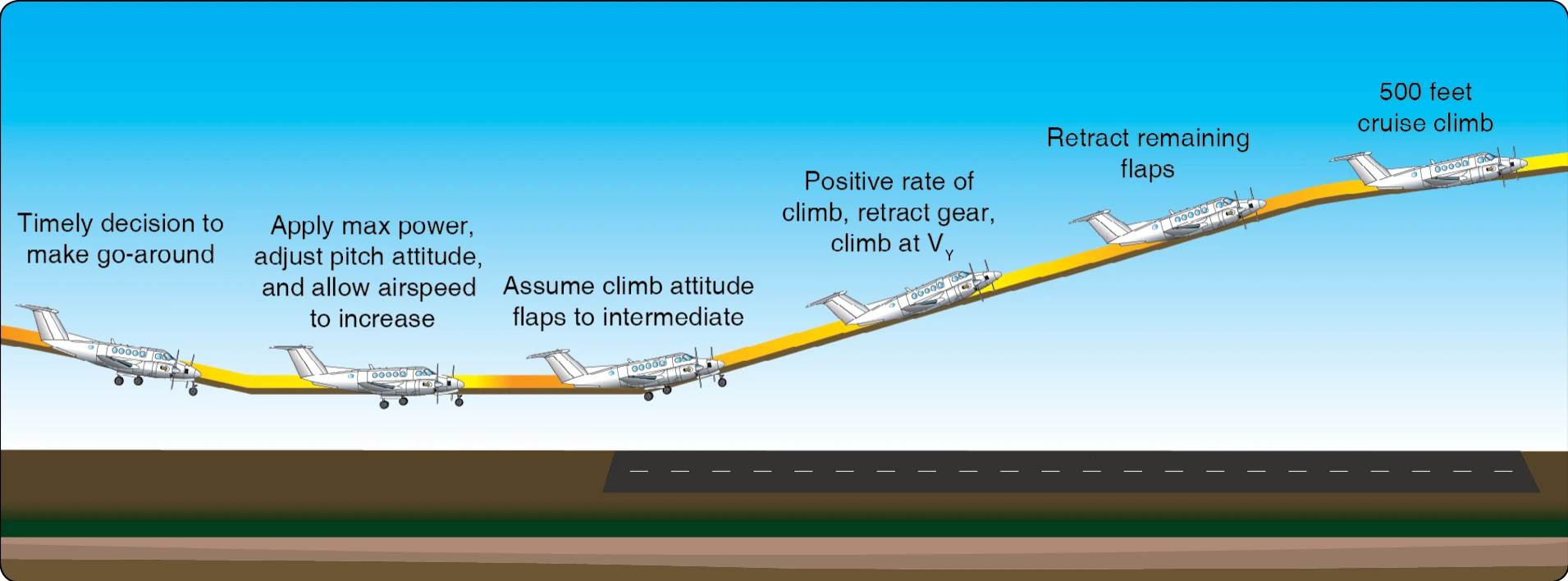
Unless otherwise specified in the AFM/POH, it is generally recommended that the flaps be retracted (at least partially) before retracting the landing gear for two reasons. First, on most airplanes full flaps produce more drag than the landing gear; and second, in case the airplane inadvertently touches down as the go-around is initiated, it is desirable to have the landing gear in the down-and-locked position. After a positive rate of climb is established, the landing gear is retracted.