
Chapter 9
Approaches and Landings
Common Errors
Common errors with forward slips to a landing:
- Incorrect pitch adjustments that result in poor airspeed control.
- Reacting to erroneous airspeed indications.
- Using excess power while trying to lose altitude.
- A slip in the same direction as any crosswind.
- Poor glidepath control.
- Late transition to a sideslip during landing with crosswinds.
- Landing without the longitudinal axis parallel to runway.
- Landing off the centerline.
Crosswind Approach and Landing
Most runways or landing areas are such that landings need to be made while the wind is blowing at an angle to the runway rather than parallel to the landing direction. All pilots should be prepared to manage a crosswind situation when it arises. Many of the same basic principles and factors involved in a normal approach and landing apply to a crosswind approach and landing; therefore, only the additional procedures required for correcting for wind drift are discussed here.
Crosswind landings are a little more difficult to perform than crosswind takeoffs, mainly due to different inputs involved in maintaining accurate control of the airplane while its speed is decreasing rather than increasing as on takeoff.
There are two usual methods of accomplishing a crosswind approach and landing—the crab method and the wing-low (sideslip) method. Although the crab method may be easier for the pilot to maintain during final approach, it requires judgment and precise timing when removing the crab immediately prior to touchdown. The wing-low method is recommended in most cases, although a combination of both methods may be used. While current testing standards allow for either method, pilots should learn to do both.
Crosswind Final Approach
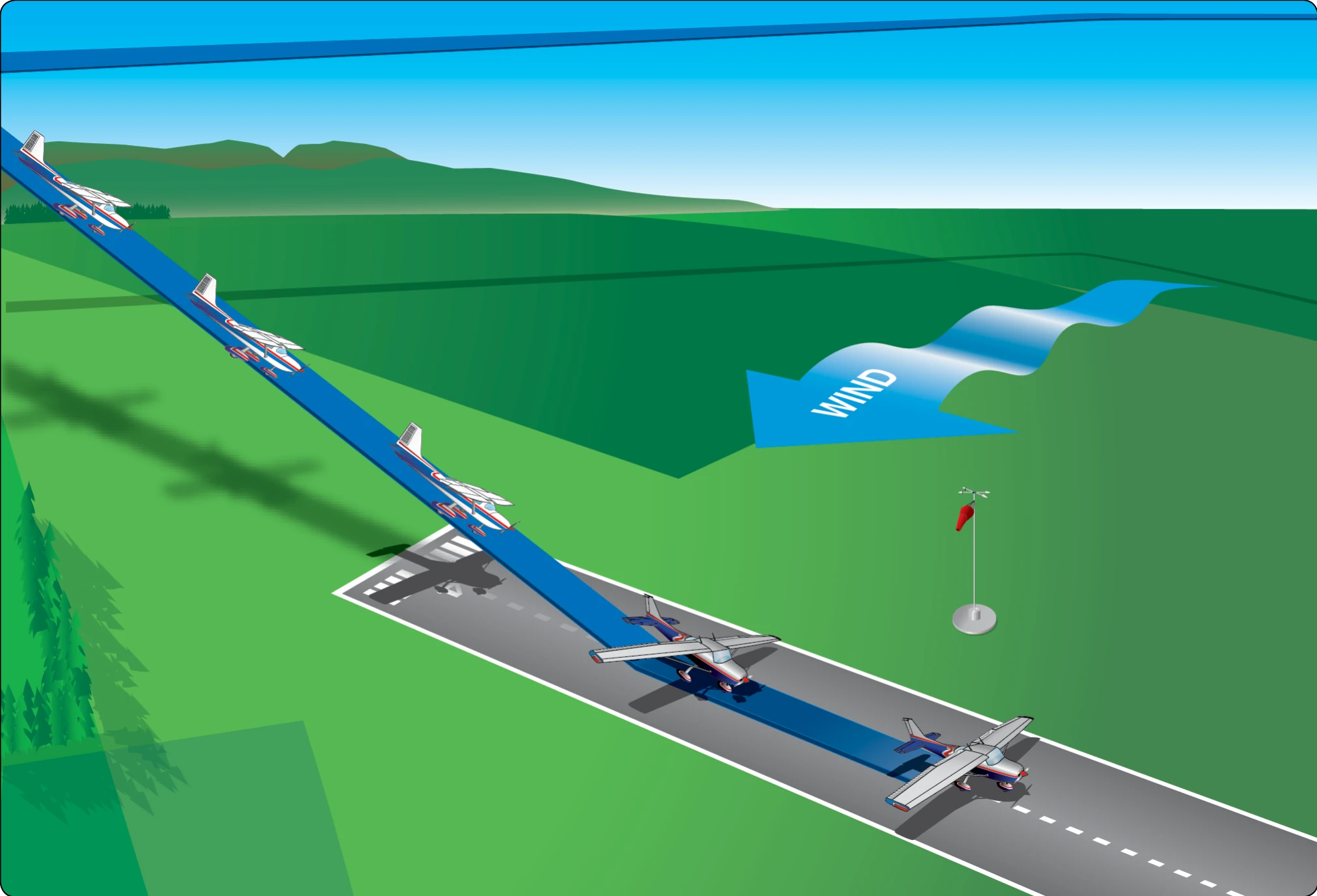
When using the crab method, the pilot makes a coordinated turn to establish a heading (crab) toward the wind. The selected heading should align the airplane’s wings-level ground track with the centerline of the runway. The pilot makes small heading corrections, if needed, to maintain alignment with the runway. [Figure 9-15] The appropriate crab angle is maintained until just prior to touchdown, when the pilot uses rudder control to align the longitudinal axis of the airplane with the runway to avoid sideward contact of the wheels with the runway. A change in alignment made too early or too late results in a side load. If a long final approach is being flown, one option is to use the crab method initially and smoothly transition to the wing-low method before the round out is started.
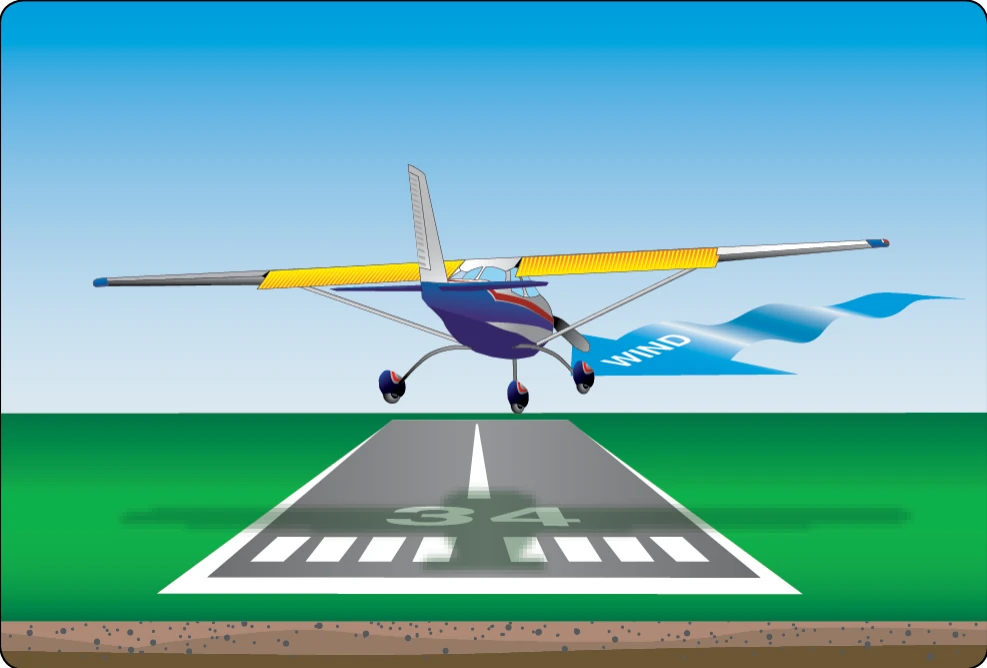
While the wing-low (sideslip) method also compensates for a crosswind from any angle, it keeps the airplane’s ground track and longitudinal axis aligned with the runway centerline throughout the final approach, round out, touchdown, and after-landing roll. This prevents the airplane from touching down in a sideward motion and imposing damaging side loads on the landing gear. When first experienced, it may seem odd to land while holding a bank angle. Although some pilots state that it appears the upwind wingtip will strike the ground, this is not the case. This method sets up the crosswind correction well before touchdown, does not require a heading change at the moment before touchdown, and allows the pilot to exercise smooth and continuous control. Pilots using this technique use precise airplane control as changes in control pressure occur near the ground, on short final, and while over the runway.
To use the wing-low method, the pilot first uses rudder to align and maintain the airplane’s heading with the runway direction. Since the airplane is now exposed to an uncorrected crosswind, the airplane will begin to drift. Note the rate and direction of drift, and oppose it using ailerons resulting in just enough bank to cancel the drift. [Figure 9-16] Varying the amount of bank allows the pilot to drift either to the left or to the right, and the pilot adjusts control pressures as needed to intercept and maintain the runway centerline. If the crosswind changes, the sideslip is adjusted to keep the airplane in line with the center of the runway. [Figure 9-17]
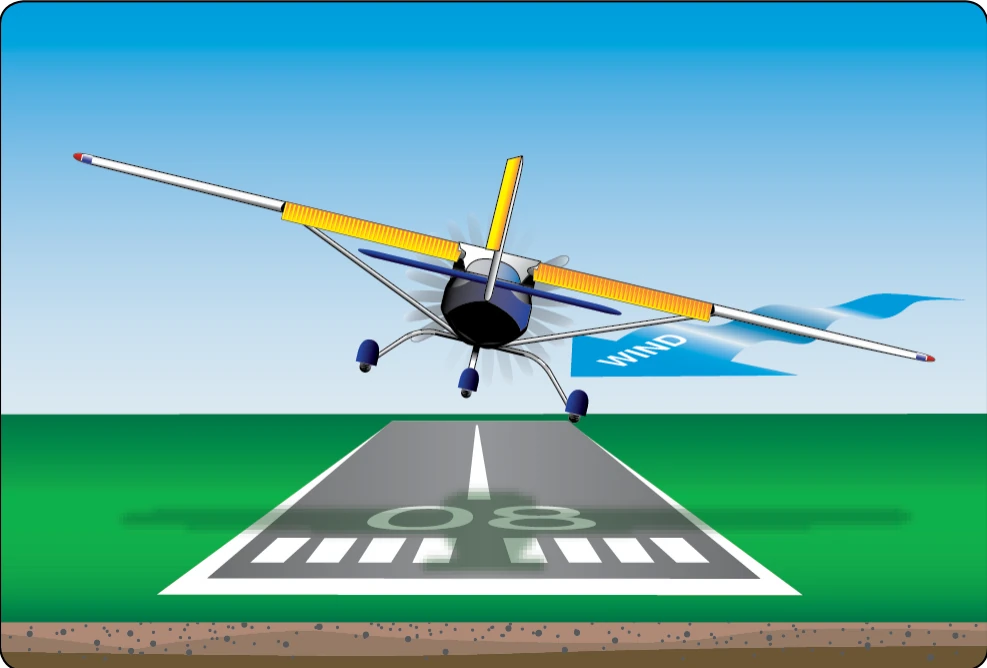
To correct for strong crosswind, the slip into the wind is increased by lowering the upwind wing as needed. As a consequence, this results in a greater tendency of the airplane to turn. Since turning is not desired, considerable opposite rudder is applied to keep the airplane’s longitudinal axis aligned with the runway. In some airplanes, there may not be sufficient rudder travel available to compensate for the strong turning tendency caused by the steep bank. If the required bank is such that full opposite rudder does not prevent a turn, the wind is too strong to safely land the airplane on that particular runway with those wind conditions. Since the airplane’s capability is exceeded, it is imperative that the landing be made on a more favorable runway either at that airport or at an alternate airport.
Flaps are used during most approaches since they tend to have a stabilizing effect on the airplane. The degree to which flaps are extended vary with the airplane’s handling characteristics, as well as the wind velocity.
Crosswind Round Out (Flare)
Generally, the round out is made like a normal landing approach, but the application of a crosswind correction is continued as necessary to prevent drifting.
Since the airspeed decreases as the round out progresses, the flight controls gradually become less effective. As a result, the crosswind correction being held becomes inadequate. When using the wing-low method, it is necessary to gradually increase the deflection of the rudder and ailerons to maintain the proper amount of drift correction.
Keep the upwind wing down throughout the round out. If the wings are leveled, the airplane begins drifting and the touchdown occurs while drifting. Remember, the primary objective is to land the airplane without subjecting it to any side loads that result from touching down while drifting.