
Chapter 9
Approaches and Landings
Crosswind Touchdown
If the crab method of drift correction is used throughout the final approach and round out, the crab needs to be removed the instant before touchdown by applying rudder to align the airplane’s longitudinal axis with its direction of movement.
If the wing-low method is used, the crosswind correction is maintained throughout the round out, and the initial touchdown occurs on the upwind main wheel. During gusty or high wind conditions, prompt adjustments are made in the crosswind correction to assure that the airplane does not drift as the airplane touches down. As the forward momentum decreases after initial contact, the weight of the airplane causes the downwind main wheel to gradually settle onto the runway.
In those airplanes having nose-wheel steering interconnected with the rudder, the nose-wheel is not aligned with the runway as the main wheels touch down because opposite rudder is being held for the crosswind correction. To prevent swerving in the direction the nose-wheel is offset, the corrective rudder pressure needs to be relaxed as the nose-wheel touches down.
Crosswind After-Landing Roll
Particularly during the after-landing roll, special attention should be given to maintaining directional control by the use of rudder or nose-wheel steering, while keeping the upwind wing from rising by the use of aileron. When an airplane is airborne, it moves with the air mass in which it is flying regardless of the airplane’s heading and speed. When an airplane is on the ground, it is unable to move with the air mass (crosswind) because of the resistance created by ground friction on the wheels.
Characteristically, an airplane has a greater profile or side area behind the main landing gear than forward of the gear. With the main wheels acting as a pivot point and the greater surface area exposed to the crosswind behind that pivot point, the airplane tends to turn or weathervane into the wind.
The relative wind acting on an airplane during the after-landing roll is the result of two factors. One is the natural wind, which acts in the direction the air mass is traveling. It has a headwind component acting along the airplane’s ground track and a crosswind component acting 90° to its track. The other factor is the wind induced by the forward movement of the airplane, which acts parallel and opposite to the direction of movement. The relative wind is the resultant of these two factors and acts from a direction somewhere between the two components. The faster the airplane’s groundspeed, the more the relative wind aligns towards the nose of the aircraft. As the airplane’s forward speed decreases during the after-landing roll, the forward component of the relative wind decreases, causing the relative wind to act in a direction more aligned with the crosswind component. The greater the crosswind component, the more difficult it is to prevent weathervaning, especially with a conventional-gear airplane.
Maintaining control on the ground is a critical part of the after-landing roll because of the weathervaning effect of the wind on the airplane. Additionally, tire side load from runway contact while drifting may generate a "roll-over" in a tricycle-geared airplane. This occurs when one main wheel lifts up off the ground and the airplane tips forward along the axis between the nose-wheel and the main wheel still on the ground. A roll-over could cause one wingtip or the prop to contact the ground. The basic factors involved are cornering angle and side load.
Cornering angle is the angular difference between the heading of a tire and its path. Whenever a load-bearing tire’s path and heading diverge, a side load is created. It is accompanied by tire distortion. Although side load differs in varying tires and air pressures, it is completely independent of speed, and through a considerable range, is directly proportional to the cornering angle and the weight supported by the tire. As little as 10° of cornering angle creates a side load equal to half the supported weight; after 20°, the side load does not increase with increasing cornering angle. For each high-wing, tricycle-geared airplane, there is a cornering angle at which roll-over is inevitable. At lesser angles, the roll-over may be avoided by use of ailerons, rudder, or steerable nose-wheel, but not brakes.
While the airplane is decelerating during the after-landing roll, more and more aileron is applied to keep the upwind wing from rising. Since the airplane is slowing down, there is less airflow around the ailerons and they become less effective. At the same time, the relative wind becomes more of a crosswind and exerts a greater lifting force on the upwind wing. When the airplane is coming to a stop, the aileron control should be held fully toward the wind.
Maximum Safe Crosswind Velocities
Takeoffs and landings in certain crosswind conditions are inadvisable or even dangerous. [Figure 9-18] If the crosswind is great enough to warrant an extreme drift correction, a hazardous landing condition may result. Therefore, the takeoff and landing capabilities with respect to the reported surface wind conditions and the available landing directions should be considered.
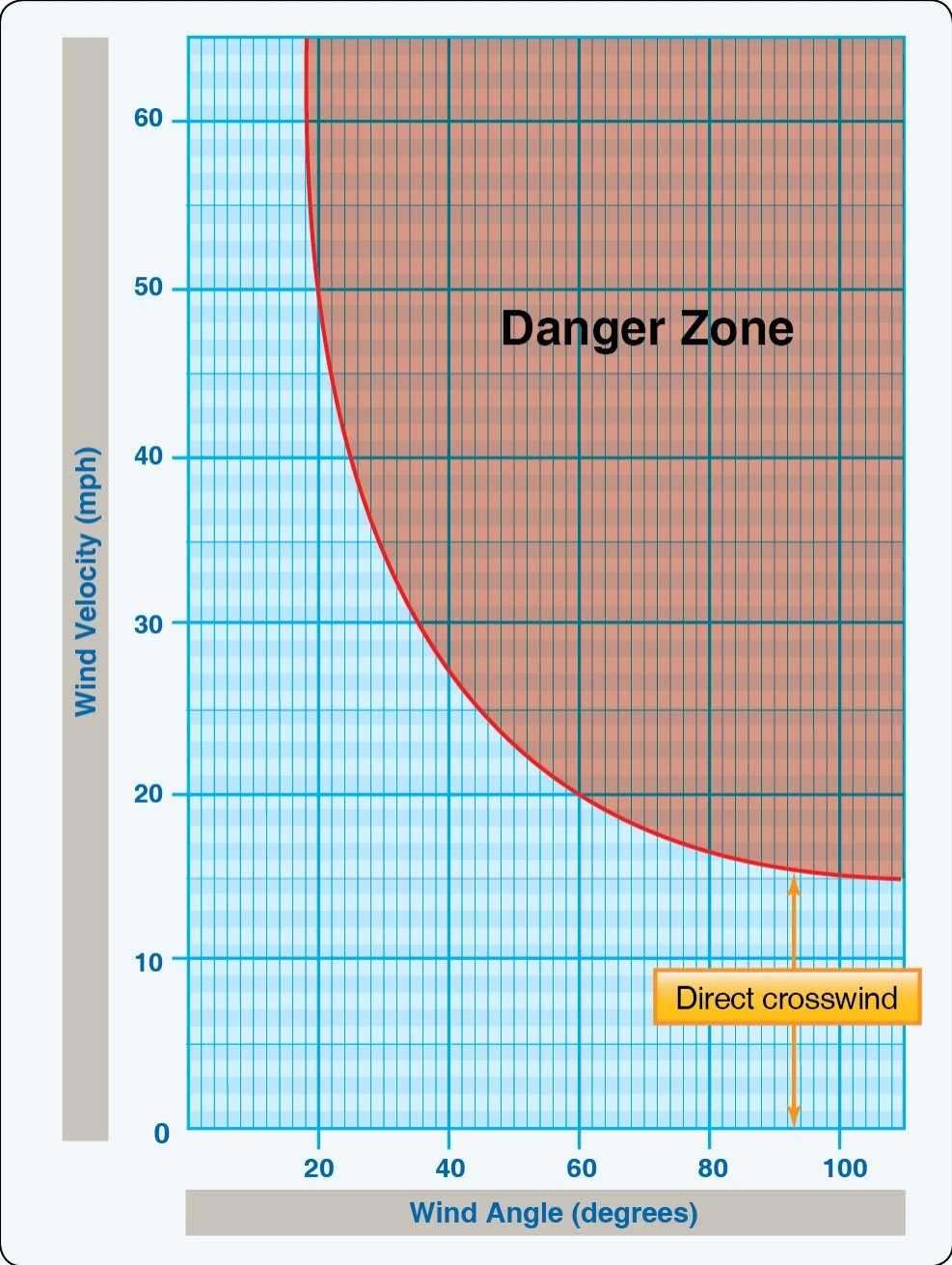
Before an airplane is type certificated by the Federal Aviation Administration (FAA), it is flight tested to ensure it meets certain requirements. Among these is the demonstration of being satisfactorily controllable with no exceptional degree of skill or alertness on the part of the pilot in 90° crosswinds up to a velocity equal to 0.2 VSO. This means a wind speed of two-tenths of the airplane’s stalling speed with power off and in landing configuration. The demonstrated crosswind velocity is included on a placard in airplanes certificated after May 3, 1962.
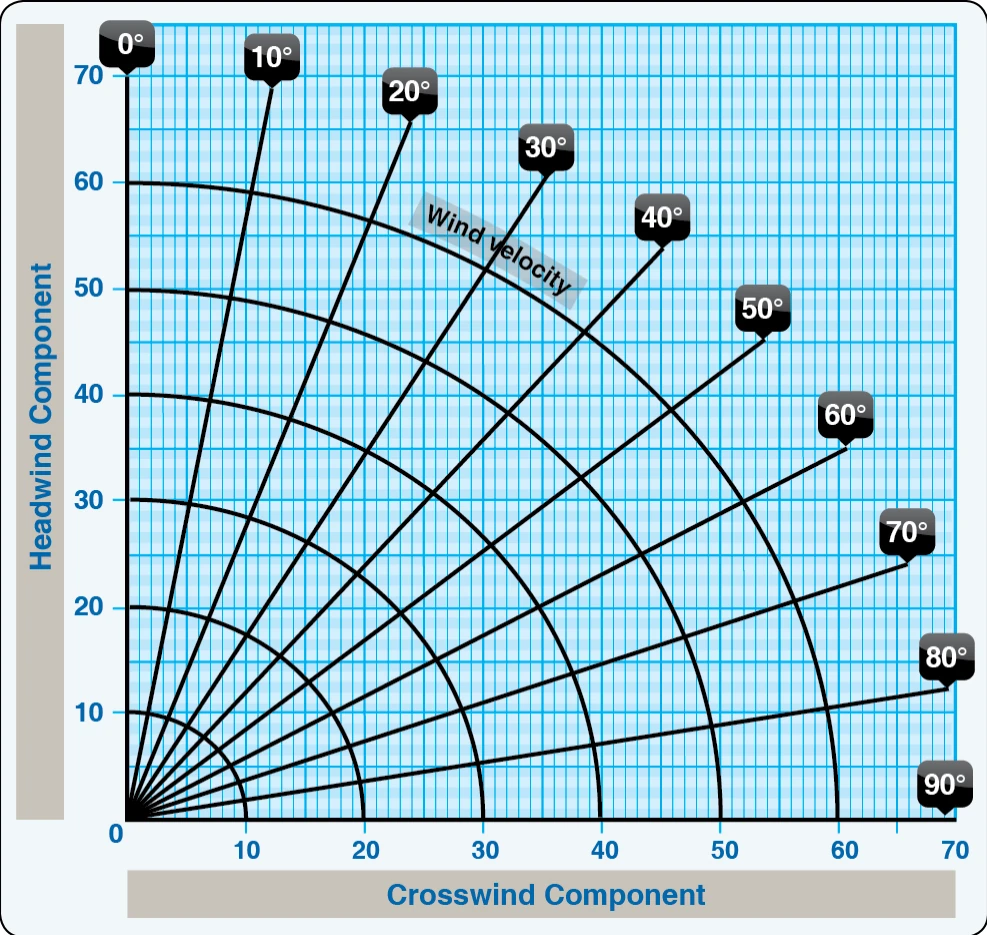
The headwind component and the crosswind component for a given situation is determined by reference to a crosswind component chart. [Figure 9-19] It is imperative that pilots determine the maximum crosswind component of each airplane they fly and avoid operations in wind conditions that exceed the capability of the airplane.
Common Errors
Common errors in the performance of crosswind approaches and landings are:
- Attempted landing in crosswinds that exceed the airplane’s maximum demonstrated crosswind component.
- Undershooting or overshooting the turn from base leg to final approach.
- Inadequate compensation for wind drift on final approach.
- Unstable approach.
- Excessive sink rate or too low an airspeed from increased drag and reduced vertical lift during sideslip.
- Failure to touch down with the longitudinal axis aligned with the runway.
- Touching down while drifting.
- Excessive airspeed on touchdown.
- Failure to apply appropriate flight control inputs during rollout.
- Failure to maintain direction control on rollout.
- Excessive braking.
- Loss of aircraft control.