
Chapter 9
Approaches and Landings
Turbulent Air Approach and Landing
For landing in turbulent conditions, the pilot should use a power-on approach at an airspeed slightly above the normal approach speed. This provides for more positive control of the airplane when strong horizontal wind gusts, or up and down drafts, are experienced. Like other power-on approaches, a coordinated combination of both pitch and power adjustments is usually required. The proper approach attitude and airspeed require a minimum round out and should result in little or no floating during the landing.
To maintain control during an approach in turbulent air with gusty crosswind, the pilot should use partial wing flaps. With less than full flaps, the airplane is in a higher pitch attitude. Thus, it requires less of a pitch change to establish the landing attitude and touchdown at a higher airspeed to ensure more positive control.
Pilots often use the normal approach speed plus one-half of the wind gust factors in turbulent conditions. If the normal speed is 70 knots, and the wind gusts are 15 knots, an increase of airspeed to 77 knots is appropriate. In any case, the airspeed and the flap setting should conform to airplane manufacturer's recommendations in the AFM/POH.
Use an adequate amount of power to maintain the proper airspeed and descent path throughout the approach, and retard the throttle to idling position only after the main wheels contact the landing surface. Care should be exercised in closing the throttle before the pilot is ready for touchdown. In turbulent conditions, the sudden or premature closing of the throttle may cause a sudden increase in the descent rate, resulting in a hard landing.
When landing from power approaches in turbulence, the touchdown is made with the airplane in approximately level flight attitude. The pitch attitude at touchdown would be only enough to prevent the nose-wheel from contacting the surface before the main wheels have touched the surface. After touchdown, the pilot should avoid the tendency to apply forward pressure on the yoke, as this may result in wheelbarrowing and possible loss of control. The pilot should allow the airplane to decelerate normally, assisted by careful use of wheel brakes and avoid heavy braking until the wings are devoid of lift and the airplane’s full weight is resting on the landing gear.
Short-Field Approach and Landing
Short-field approaches and landings require the use of procedures for approaches and landings at fields with a relatively short landing area or where an approach is made over obstacles that limit the available landing area. [Figure 9-20 and Figure 9-21] This low-speed type of power-on approach is closely related to the performance of flight near minimum controllable airspeeds.
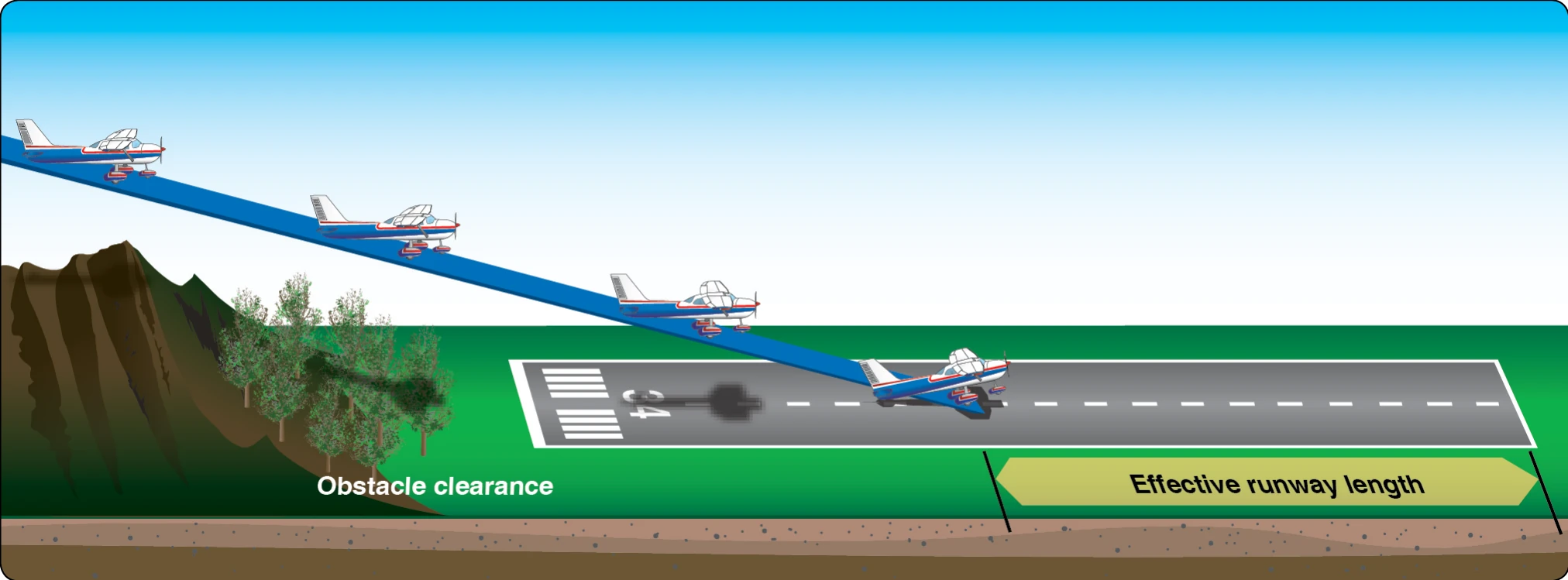
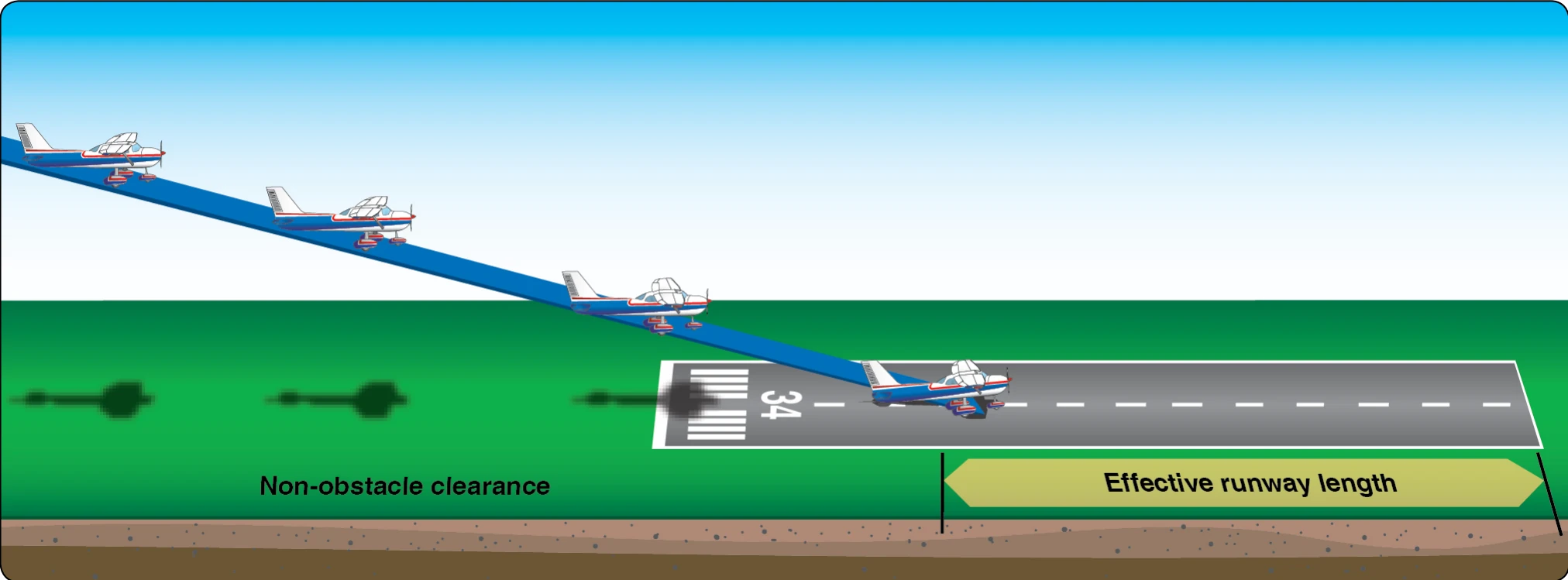
To land within a short field or a confined area, the pilot needs to have precise, positive control of the rate of descent and airspeed, and fly an approach that clears any obstacles, results in little or no floating during the round out, and permits the airplane to be stopped in the shortest possible distance. When safety and conditions permit, a wider-than-normal pattern with a longer final approach may be used. This allows the pilot ample opportunity to adjust and stabilize the descent angle after the airplane is configured and trimmed. A stabilized approach is essential.
The procedures for landing on a short field or for landing approaches over obstacles as recommended in the AFM/POH should be used. [Figure 9-22 and Figure 9-23] These procedures generally involve a final approach started from an altitude of at least 500 feet higher than the touchdown area and the use of full flaps at an appropriate point during the final approach. For many general aviation airplanes this means flying a stabilized final approach with the flap setting that precedes full flaps. When the field is made, the pilot should extend full flaps and lower the nose in order to maintain airspeed and keep the aiming point stationary in the windscreen. When over the obstacle, the pilot may reduce power slightly. Ideally, if full flaps are extended at the correct point, the pilot will be in a position to slowly reduce power. When no manufacturer’s recommended approach speed is available, a speed of not more than 1.3 VSO is used. In gusty air, no more than one-half the gust factor is added. An excessive amount of airspeed could result in a touchdown too far from the runway threshold or an after-landing roll that exceeds the available landing area. When obstacles are present, a slightly steeper approach angle places the touchdown closer to the obstacle, which gives the pilot more room to stop.
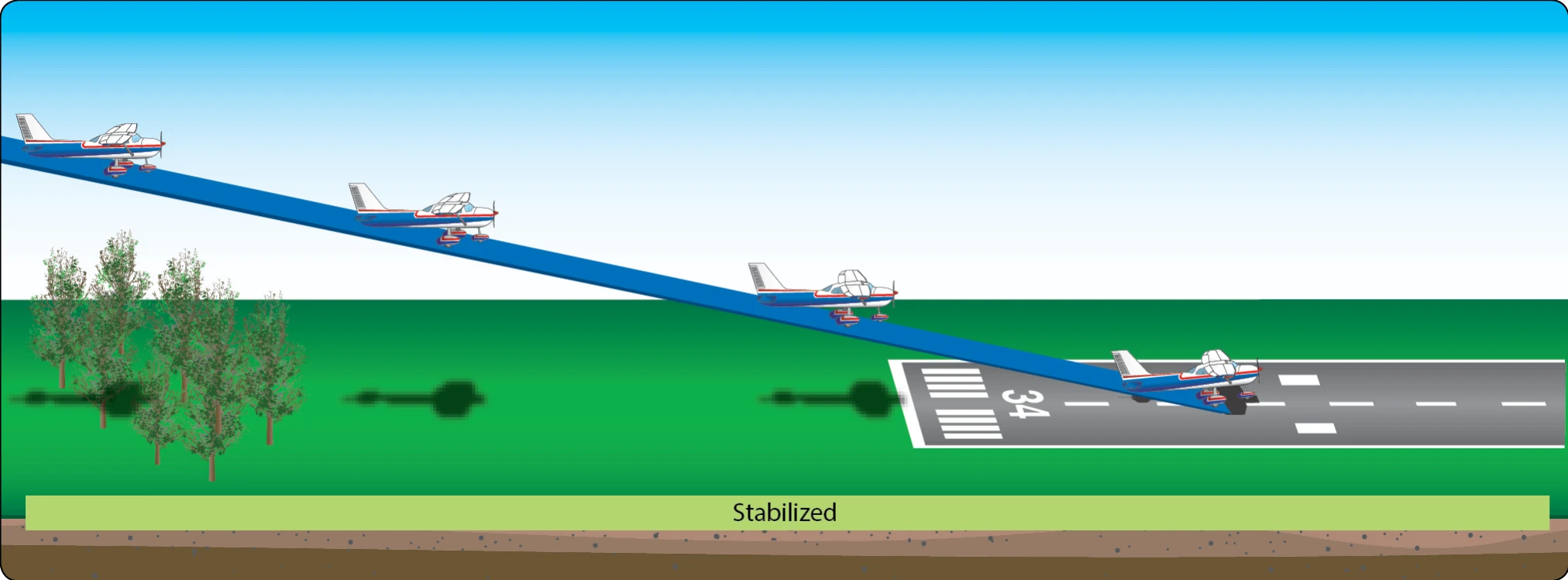
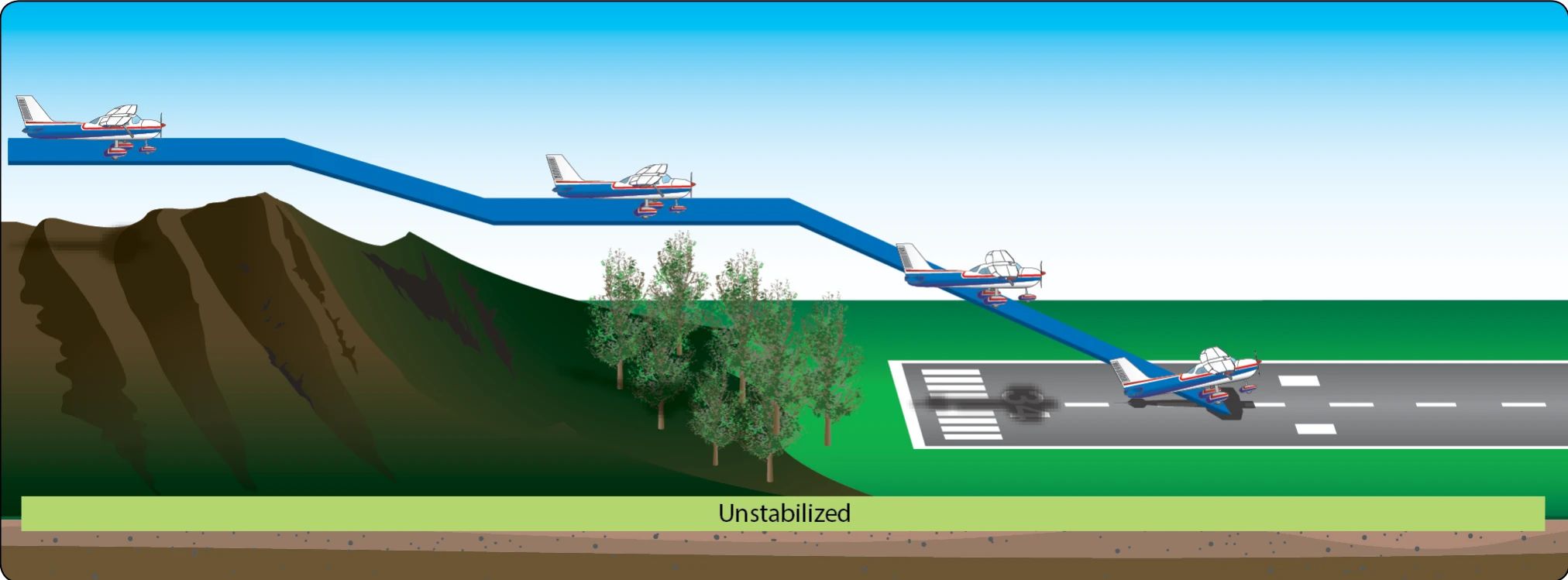
After the landing gear has been extended, if applicable, or when beginning a suitable final approach, the pilot simultaneously adjusts the power and the pitch attitude to establish and maintain the proper descent angle and airspeed. During a stabilized approach, small changes in the airplane’s pitch attitude and power setting are needed when making corrections to the angle of descent and airspeed.
The short-field approach and landing is an accuracy approach to an aiming point. The procedures previously outlined in the section on the stabilized approach concept are used. If it appears that the obstacle clearance is excessive and touchdown occurs well beyond the desired aiming point, leaving insufficient room to stop, power is reduced while lowering the pitch attitude to steepen the descent path and increase the rate of descent. If it appears that the descent angle does not ensure safe clearance of obstacles, power is increased while simultaneously raising the pitch attitude to shallow the descent path and decrease the rate of descent. Care should be taken to avoid excessively low airspeeds. When operating at high AOAs and low airspeeds, an increase in pitch attitude increases the rate of descent. When there is doubt regarding the outcome of the approach, the pilot should execute a go-around, evaluate the situation, and decide whether to make another approach or divert to a more suitable landing area.
Because the final approach over obstacles is made at a relatively steep approach angle and close to the airplane’s stalling speed, the initiation of the round out or flare needs to be judged accurately to avoid flying into the ground or stalling prematurely and sinking rapidly. A lack of floating during the flare with sufficient control to touch down properly is verification that the approach speed was correct.
Touchdown should occur at the minimum controllable airspeed with the airplane in approximately the pitch attitude that results in a power-off stall when the throttle is closed. Care should be exercised to avoid closing the throttle too rapidly, as closing the throttle may result in an immediate increase in the rate of descent and a hard landing. Note that a small amount of power provides more airflow over the elevator giving it more authority at low airspeeds to enable the pilot to flare. There is a risk that low airspeed and a windmilling propeller blocking airflow over the elevator may make it difficult to flare.
Upon touchdown, the airplane is held in this positive pitch attitude as long as the elevators remain effective and if recommended by the manufacturer. This provides aerodynamic braking to assist in deceleration. However, immediately upon touchdown of the nose-wheel,
maximum braking is applied to minimize the after-landing roll. For most airplanes, aerodynamic drag is the single biggest factor in slowing the aircraft in the first quarter of its speed decay. Brakes become increasingly effective as airspeed and lift decrease. The pilot increases braking effectiveness by holding the wheel or stick full back while smoothly applying brakes. Back pressure is needed because the airplane tends to lean forward with heavy braking. Best braking results are always achieved with the wheels in an “incipient skid condition.” That means a little more brake pressure would lock up the wheels entirely. In an incipient skid, the wheels are turning, but with great reluctance. If the wheels lock, braking effectiveness drops dramatically in a skid and the tires could be damaged. The airplane is normally stopped within the shortest possible distance consistent with safety and controllability. If the proper approach speed has been maintained, resulting in minimum float during the round out and the touchdown made at minimum control speed, excessive braking should not be needed.