
Chapter 9
Approaches and Landings
Common Errors
Common errors in the performance of short-field approaches and landings are:
- A final approach that necessitates an overly steep approach and high sink rate.
- Unstable approach.
- Undue delay in initiating glide path corrections.
- Too low an airspeed on final resulting in inability to flare properly and landing hard.
- Too high an airspeed resulting in floating on round out.
- Prematurely reducing power to idle on round out resulting in hard landing.
- Touchdown with excessive airspeed.
- Excessive and/or unnecessary braking after touchdown.
- Failure to maintain directional control.
- Failure to recognize and abort a poor approach that cannot be completed safely.
Soft-Field Approach and Landing
Landing on fields that are rough or have soft surfaces, such as snow, sand, mud, or tall grass, requires unique procedures. When landing on such surfaces, the objective is to touch down as smoothly as possible and at the slowest possible landing speed. A pilot needs to control the airplane in a manner that the wings support the weight of the airplane as long as practical to minimize stresses imposed on the landing gear by a rough surface or to prevent sinking into a soft surface.
The approach for the soft-field landing is similar to the normal approach used for operating into long, firm landing areas. The major difference between the two is that a degree of power is used throughout the level-off and touchdown for the soft-field landing. This allows the airspeed to slowly dissipate while the airplane is flown 1 to 2 feet off the surface in ground effect. When the wheels first touch the ground, the wings continue to support much of the weight of the airplane. [Figure 9-24] This technique minimizes the nose-over forces that suddenly affect the airplane at the moment of touchdown.
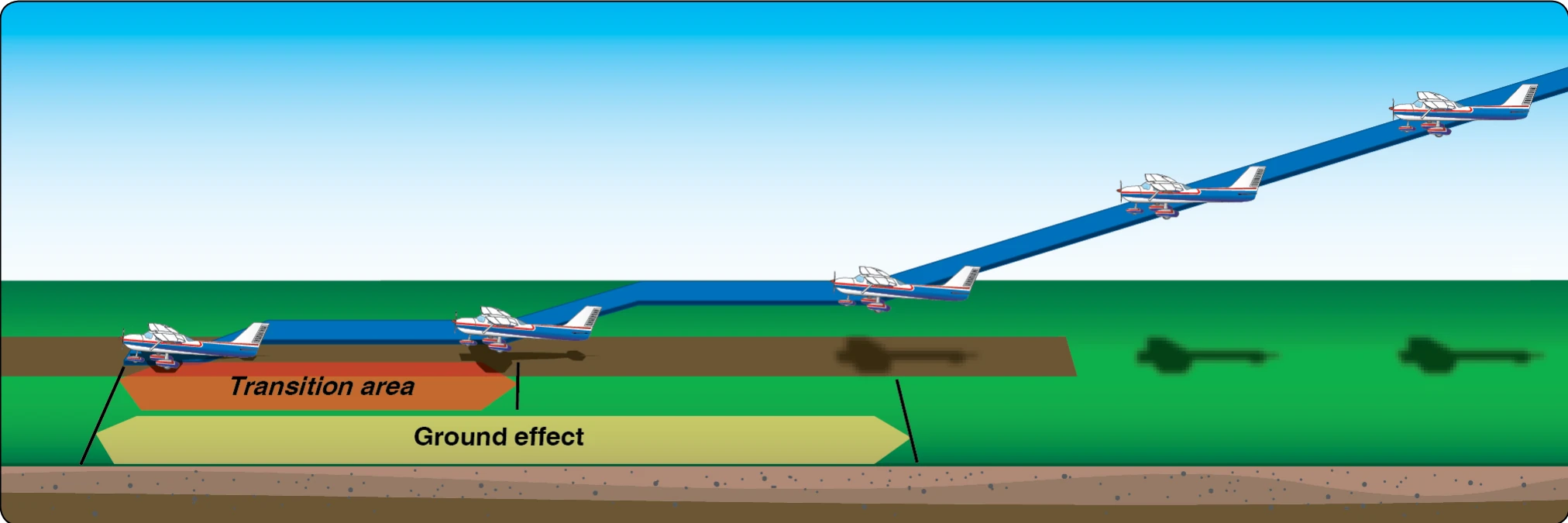
The use of flaps during soft-field landings aids in touching down at minimum speed and is recommended whenever practical. In low-wing airplanes, the flaps may suffer damage from mud, stones, or slush thrown up by the wheels. If flaps are used, it is generally inadvisable to retract them during the after-landing roll because the need for flap retraction is less important than the need for total concentration on maintaining full control of the airplane.
The final-approach airspeed used for short-field landings is equally appropriate to soft-field landings. The use of higher approach speeds may result in excessive float in ground effect, and floating makes a smooth, controlled touchdown even more difficult. There is no reason for a steep angle of descent unless obstacles are present in the approach path.
Touchdown on a soft or rough field is made at the lowest possible airspeed with the airplane in a nose-high pitch attitude. In nose-wheel type airplanes, after the main wheels touch the surface, the pilot should hold sufficient back-elevator pressure to keep the nose-wheel off the surface. Using back-elevator pressure and engine power, the pilot can control the rate at which the weight of the airplane is transferred from the wings to the wheels.
Field conditions may warrant that the pilot maintain a flight condition in which the main wheels are just touching the surface but the weight of the airplane is still being supported by the wings until a suitable taxi surface is reached. At any time during this transition phase, before the weight of the airplane is being supported by the wheels, and before the nose-wheel is on the surface, the ability is retained to apply full power and perform a safe takeoff (obstacle clearance and field length permitting) should the pilot elect to abandon the landing. Once committed to a landing, the pilot should gently lower the nose-wheel to the surface. A slight addition of power usually aids in easing the nose-wheel down.
The use of brakes on a soft field is not needed and should be avoided as this may tend to impose a heavy load on the nose-gear due to premature or hard contact with the landing surface, causing the nose-wheel to dig in. The soft or rough surface itself provides sufficient reduction in the airplane’s forward speed. Often upon landing on a very soft field, an increase in power may be needed to keep the airplane moving and from becoming stuck in the soft surface.
Common Errors
Common errors in the performance of soft-field approaches and landings are:
- Excessive descent rate on final approach.
- Excessive airspeed on final approach.
- Unstable approach.
- Round out too high above the runway surface.
- Poor power management during round out and touchdown.
- Hard touchdown.
- Inadequate control of the airplane weight transfer from wings to wheels after touchdown.
- Allowing the nose-wheel to “fall” to the runway after touchdown rather than controlling its descent.
Power-Off Accuracy Approaches
Power-off accuracy approaches and landings involve gliding to a touchdown at a given point (or within a specified distance beyond that point), while using a specific pattern and with the engine idling. The objective is to instill in the pilot the judgment and procedures necessary for accurately flying the airplane, without power, to a safe landing.
The ability to estimate the distance an airplane glides to a landing is the real basis of all power-off accuracy approaches and landings. The distance to be covered largely determines the amount of maneuvering needed to complete an approach from a given altitude. While developing the pilot's ability to estimate gliding distance, power-off accuracy approaches call upon the pilot to use a variety of techniques to set and maintain an appropriate glide angle and airspeed to the aiming point.
With experience and practice, altitudes up to approximately 1,000 feet can be estimated with fair accuracy; while above this level the accuracy in judgment of height above the ground decreases, since all features tend to merge. The best aid in perfecting the ability to judge height above this altitude is through the indications of the altimeter and associating them with the general appearance of the earth.
The judgment of altitude in feet, hundreds of feet, or thousands of feet is not as important as the ability to estimate gliding angle and its resultant distance. Regardless of altitude, a pilot who knows the normal glide angle of the airplane can estimate, with reasonable accuracy, the approximate spot along a given ground path at which the airplane will land. A pilot who has the ability to accurately estimate altitude, can also judge how much maneuvering is possible and safe during the glide, which is important to the choice of landing areas in an actual emergency.