
Chapter 1
Risk Management and Single-Pilot Resource Management
- Will the trip include flying over water or unpopulated areas?
- Will the flight conditions allow a safe emergency landing at night?
- Are the aircraft lights found to be operational during preflight and is a flashlight available that is appropriate for intended use before and during flight?
E = External Pressures
External pressures are influences external to the flight that create a sense of pressure to complete a flight—often at the expense of safety. Factors that can be external pressures include the following:
- Someone waiting at the airport for the flight’s arrival.
- A passenger the pilot does not want to disappoint.
- The desire to demonstrate pilot qualifications.
- The desire to impress someone. (Probably the two most dangerous words in aviation are “Watch this!”)
- The desire to satisfy a specific personal goal (“get-home-itis,” “get-there-itis,” and “let’s-go-itis").
- The pilot’s general goal-completion orientation.
- Emotional pressure associated with acknowledging that skill and experience levels may be lower than a pilot would like them to be. Pride can be a powerful external factor!
Management of external pressure is the single most important key to risk management because it is the one risk factor category that can cause a pilot to ignore all the other risk factors. External pressures put time-related pressure on the pilot and figure into a majority of accidents.
The use of personal standard operating procedures (SOPs) is one way to manage external pressures. The goal is to supply a release for the external pressures of a flight. These procedures include but are not limited to:
- Allow time on a trip for an extra fuel stop or to make an unexpected landing because of weather.
- Have alternate plans for a late arrival or make backup airline reservations for must-be-there trips.
- For important trips, plan to leave early enough so that there would still be time to drive to the destination.
- Advise those who are waiting at the destination that the arrival may be delayed. Know how to notify them when delays are encountered.
- Manage passengers’ expectations. Make sure passengers know that they might not arrive on a firm schedule, but if they need to arrive by a certain time, they may make alternative plans.
- Eliminate pressure to return home, even on a casual day flight, by carrying a small overnight kit containing prescriptions, contact lens solutions, toiletries, or other necessities on every flight.
The key to managing external pressure is to be ready for and accept delays. Remember that people get delayed when traveling on airlines, driving a car, or taking a bus. The pilot’s goal is to manage risk, not create hazards.
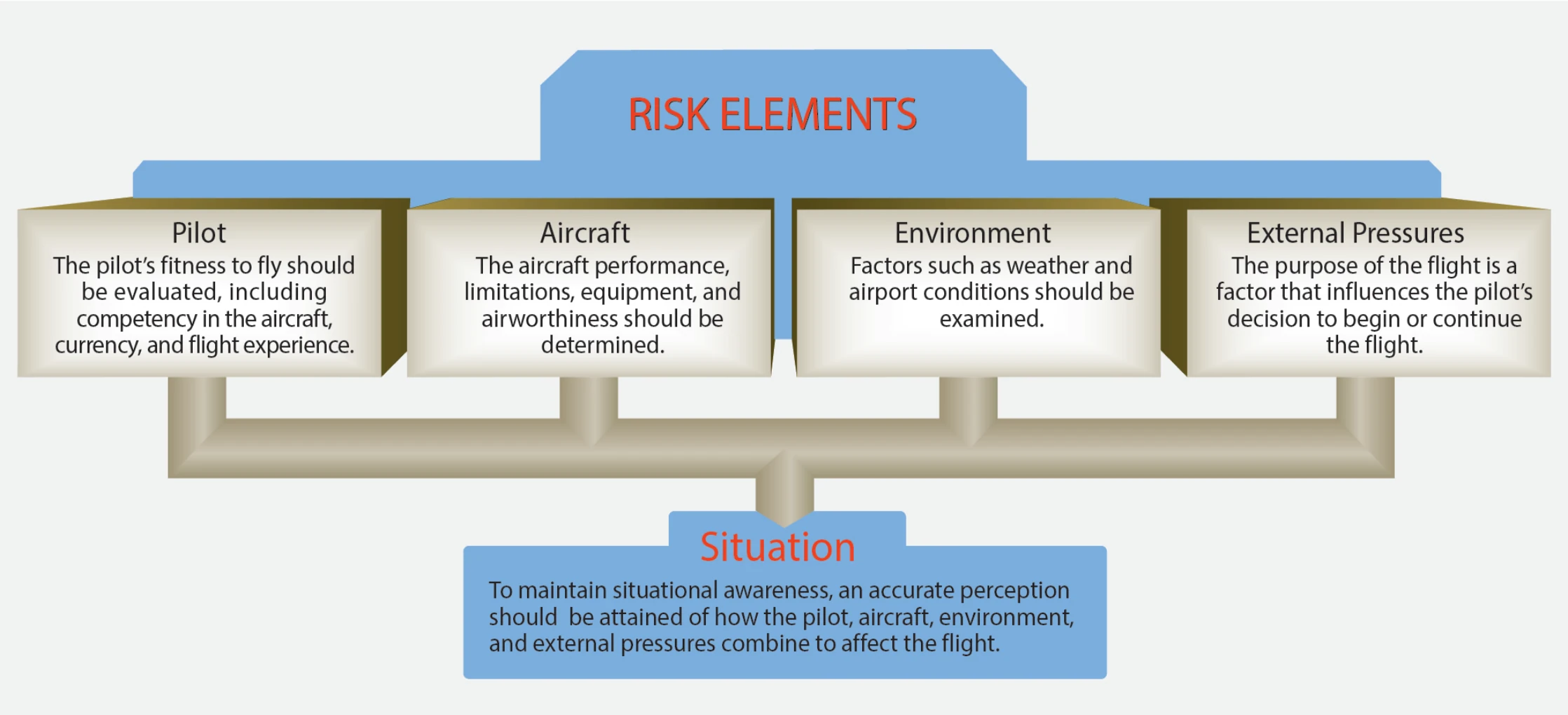
During each flight, decisions should be made regarding events involving interactions between the four risk elements—PIC, aircraft, environment, and external pressures. The decision-making process involves an evaluation of each of these risk elements to achieve an accurate perception of the flight situation. [Figure 1-2]
IMSAFE Checklist
As mentioned earlier, one of the best ways that single pilots can identify risk associated with physical and mental readiness for flying is to use the IMSAFE checklist acronym. [Figure 1-3]
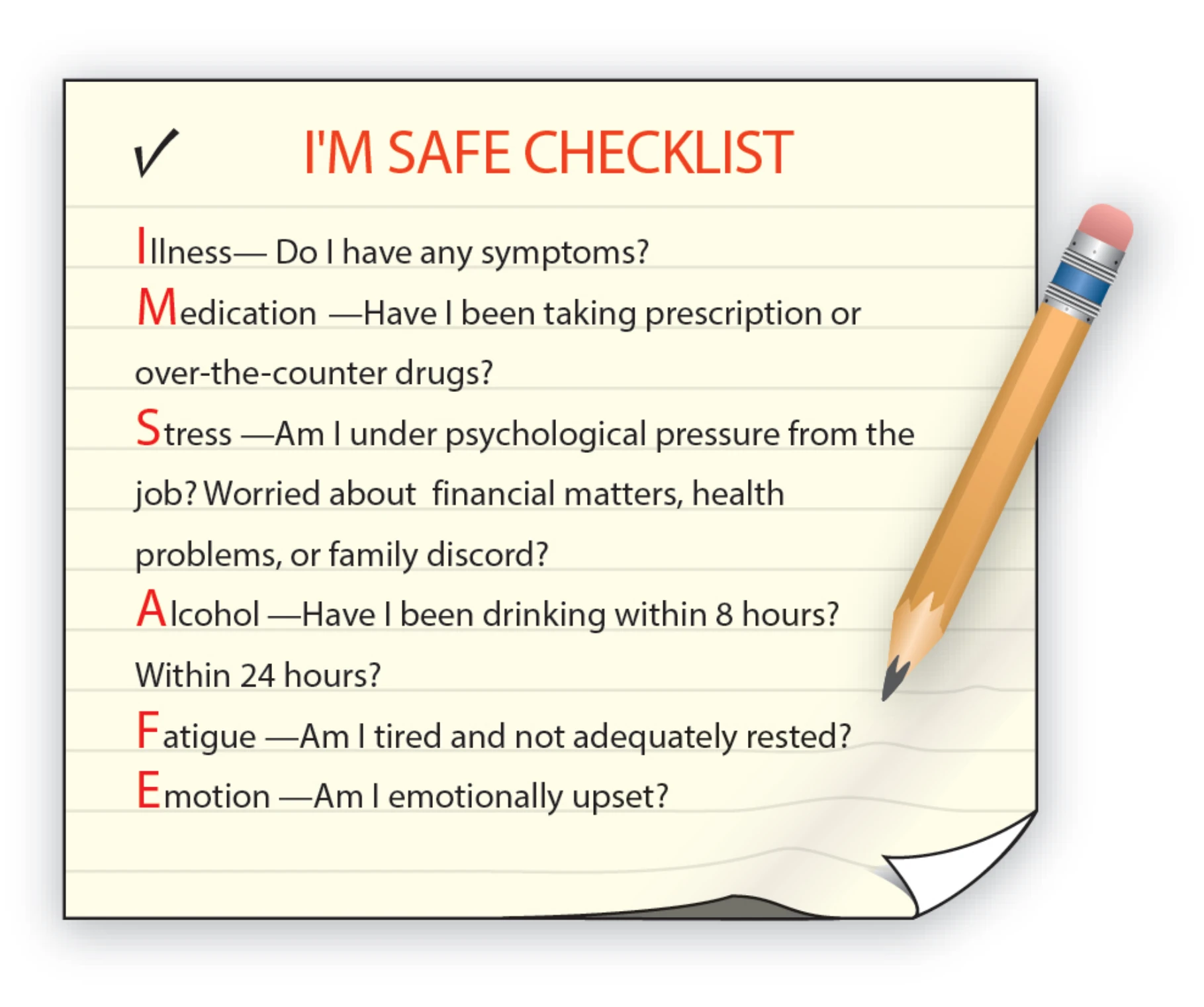
- Illness—Am I sick? Illness is an obvious pilot risk.
- Medication—Am I taking any medicines that might affect my judgment or make me drowsy?
- Stress—Am I under psychological pressure from the job? Do I have money, health, or family problems? Stress causes concentration and performance problems. While the regulations list medical conditions that require grounding, stress is not among them. A thorough evaluation of risk accounts for the effects of stress on performance.
- Alcohol—Have I been drinking within 8 hours? Within 24 hours? A small amount of alcohol can impair flying skills. Alcohol also renders a pilot more susceptible to disorientation and hypoxia.
- Fatigue—Am I tired and not adequately rested? Fatigue continues to be one of the most insidious hazards to flight safety, as it may not be apparent to a pilot until serious errors are made.
- Emotion—Am I emotionally upset? The emotions of anger, depression, and anxiety from such events as a serious argument; death in the family; separation or divorce; loss of employment; and/or financial problems not only decrease alertness, but may also lead to taking risks that border on self-destruction. A pilot who experiences an emotionally upsetting event may choose to refrain from flying until the pilot has satisfactorily recovered.
Assessing Risk
Assessment of risk is an important part of good risk management. For example, the hazard of a nick in the propeller poses a risk only if the airplane is flown. If the damaged prop is exposed to the constant vibration of normal engine operation, there is a high risk is that it could fracture and cause catastrophic damage to the engine and/or airframe and the passengers.
Every flight has hazards and some level of risk associated with it. It is critical that pilots and especially learners can differentiate in advance between a low-risk flight and a high-risk flight, and then establish a review process and develop risk mitigation strategies to address flights throughout that range.
For the single pilot, assessing risk is not as simple as it sounds. For example, the pilot acts as his or her own quality control in making decisions. If a fatigued pilot who has flown 16 hours is asked if he or she is too tired to continue flying, the answer may be no. Most pilots are goal oriented and, when asked to accept a flight, there is a tendency to deny personal limitations while adding weight to issues not germane to the mission. For example, pilots of helicopter emergency services (EMS) have been known to make flight decisions that add significant weight to the patient’s welfare. These pilots add weight to intangible factors (the patient in this case) and fail to appropriately quantify actual hazards such as fatigue or weather when making flight decisions. The single pilot deals with the intangible factors that may draw one into a hazardous position. Therefore, he or she has a greater vulnerability than a full crew.
Examining National Transportation Safety Board (NTSB) reports and other accident research can help a pilot learn to assess risk more effectively. For example, the accident rate during night VFR decreases by nearly 50 percent once a pilot obtains 100 hours and continues to decrease until the 1,000- hour level. The data suggest that for the first 500 hours, pilots flying VFR at night might want to establish higher personal limitations than are required by the regulations and, if applicable, apply instrument flying skills in this environment.
Several risk assessment models are available to assist in the process of assessing risk. The models, all taking slightly different approaches, seek a common goal of assessing risk in an objective manner.