
Chapter 1
Aircraft Structures
- Tension
- Compression
- Torsion
- Shear
- Bending
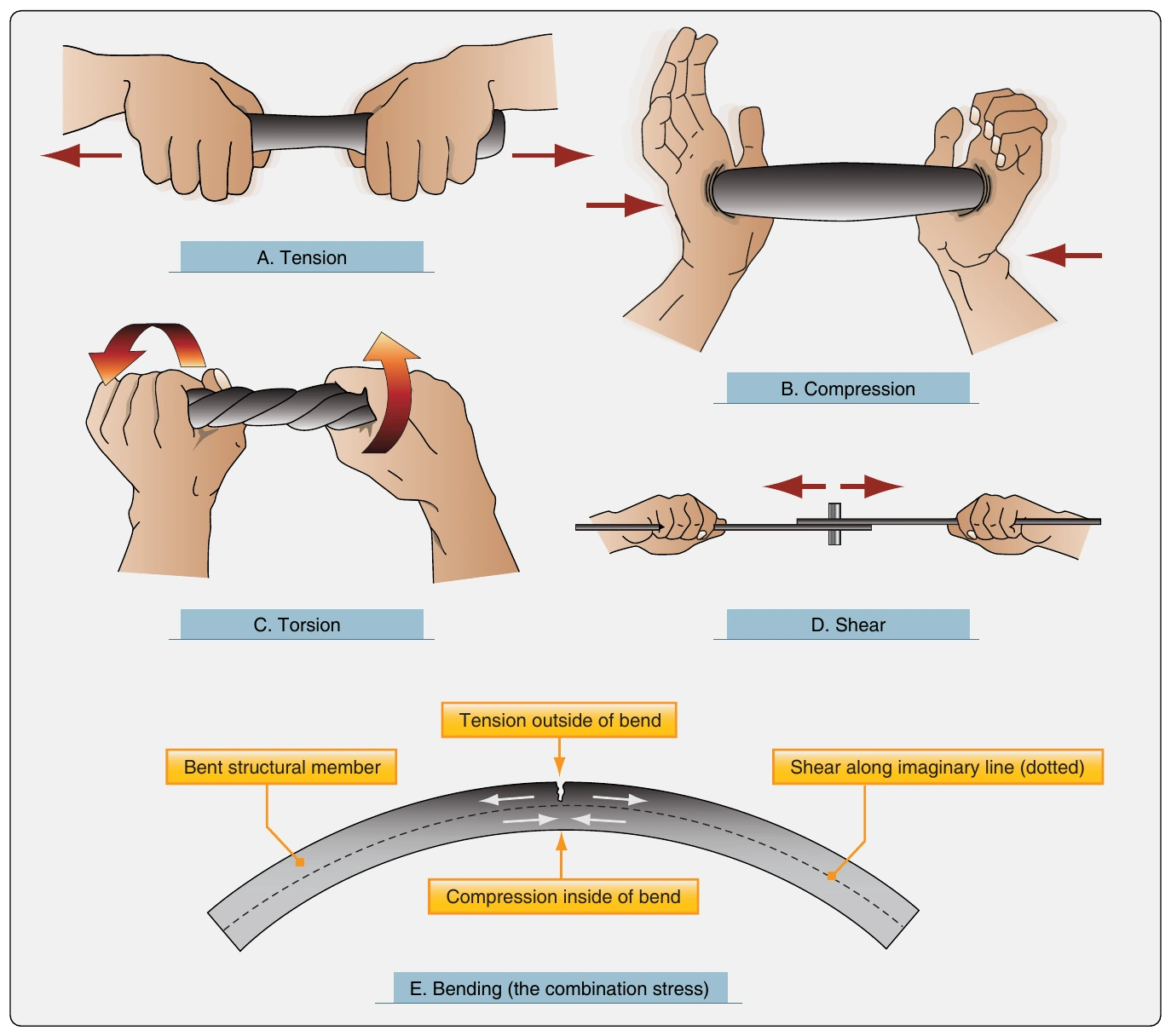
Tension is the stress that resists a force that tends to pull something apart. [Figure 1-14A] The engine pulls the aircraft forward, but air resistance tries to hold it back. The result is tension, which stretches the aircraft. The tensile strength of a material is measured in pounds per square inch (psi) and is calculated by dividing the load (in pounds) required to pull the material apart by its cross-sectional area (in square inches).
Compression is the stress that resists a crushing force. [Figure 1-14B] The compressive strength of a material is also measured in psi. Compression is the stress that tends to shorten or squeeze aircraft parts.
Torsion is the stress that produces twisting. [Figure 1-14C] While moving the aircraft forward, the engine also tends to twist it to one side, but other aircraft components hold it on course. Thus, torsion is created. The torsion strength of a material is its resistance to twisting or torque.
Shear is the stress that resists the force tending to cause one layer of a material to slide over an adjacent layer. [Figure 1-14D] Two riveted plates in tension subject the rivets to a shearing force. Usually, the shearing strength of a material is either equal to or less than its tensile or compressive strength. Aircraft parts, especially screws, bolts, and rivets, are often subject to a shearing force.
Bending stress is a combination of compression and tension. The rod in Figure 1-14E has been shortened (compressed) on the inside of the bend and stretched on the outside of the bend. A single member of the structure may be subjected to a combination of stresses. In most cases, the structural members are designed to carry end loads rather than side loads. They are designed to be subjected to tension or compression rather than bending.
Strength or resistance to the external loads imposed during operation may be the principal requirement in certain structures. However, there are numerous other characteristics in addition to designing to control the five major stresses that engineers must consider. For example, cowling, fairings, and similar parts may not be subject to significant loads requiring a high degree of strength. However, these parts must have streamlined shapes to meet aerodynamic requirements, such as reducing drag or directing airflow.
Fixed-Wing Aircraft
Fuselage
The fuselage is the main structure or body of the fixed-wing aircraft. It provides space for cargo, controls, accessories, passengers, and other equipment. In single-engine aircraft, the fuselage houses the powerplant. In multiengine aircraft, the engines may be either in the fuselage, attached to the fuselage, or suspended from the wing structure. There are two general types of fuselage construction: truss and monocoque.
Truss-Type
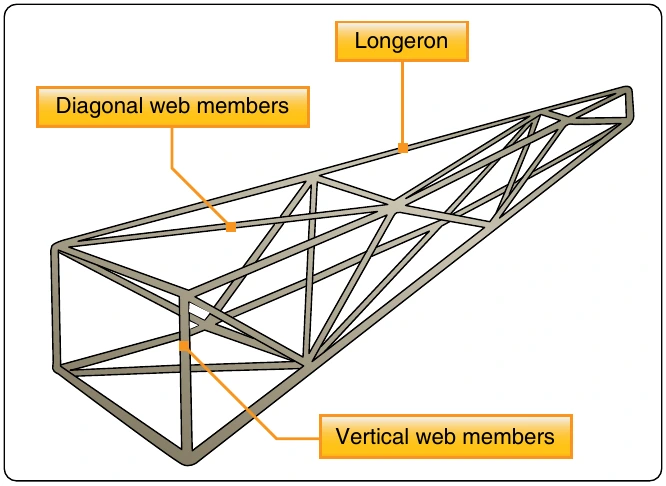
A truss is a rigid framework made up of members, such as beams, struts, and bars to resist deformation by applied loads. The truss-framed fuselage is generally covered with fabric. The truss-type fuselage frame is usually constructed of steel tubing welded together in such a manner that all members of the truss can carry both tension and compression loads. [Figure 1-15] In some aircraft, principally the light, single-engine models, truss fuselage frames may be constructed of aluminum alloy and may be riveted or bolted into one piece, with cross-bracing achieved by using solid rods or tubes.
Monocoque Type
The monocoque (single shell) fuselage relies largely on the strength of the skin or covering to carry the primary loads. The design may be divided into three classes:
- Monocoque
- Semimonocoque
- Reinforced shell
Different portions of the same fuselage may belong to either of the three classes, but most modern aircraft are considered to be of semimonocoque type construction.
The true monocoque construction uses formers, frame assemblies, and bulkheads to give shape to the fuselage. [Figure 1-16] The heaviest of these structural members are located at intervals to carry concentrated loads and at points where fittings are used to attach other units such as wings, powerplants, and stabilizers. Since no other bracing members are present, the skin must carry the primary stresses and keep the fuselage rigid. Thus, the biggest problem involved in monocoque construction is maintaining enough strength while keeping the weight within allowable limits.