
Chapter 1
Aircraft Structures
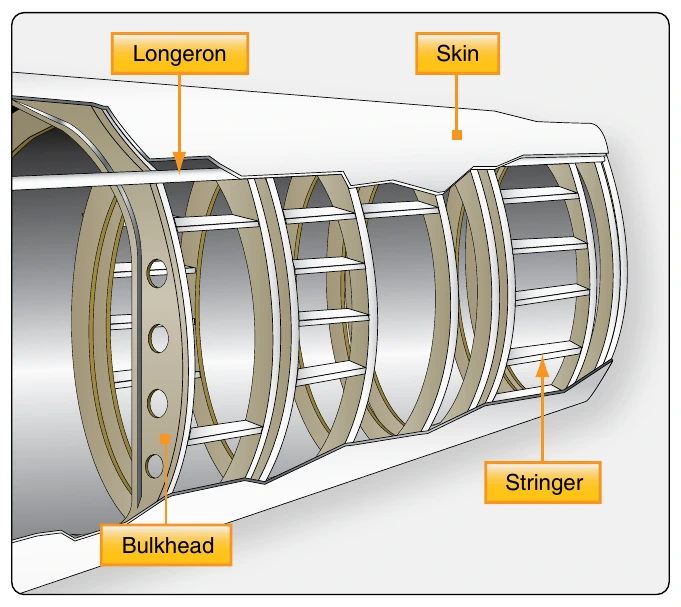
To overcome the strength/weight problem of monocoque construction, a modification called semimonocoque construction was developed. It also consists of frame assemblies, bulkheads, and formers as used in the monocoque design but, additionally, the skin is reinforced by longitudinal members called longerons. Longerons usually extend across several frame members and help the skin support primary bending loads. They are typically made of aluminum alloy either of a single piece or a built-up construction. The longerons are supplemented by other longitudinal members called stringers.
Stringers are typically more numerous and lighter in weight than the longerons. They come in a variety of shapes and are usually made from single piece aluminum alloy extrusions or formed aluminum. Stringers have some rigidity but are chiefly used for giving shape and for attachment of the skin. Stringers and longerons together prevent tension and compression from bending the fuselage. [Figure 1-17]
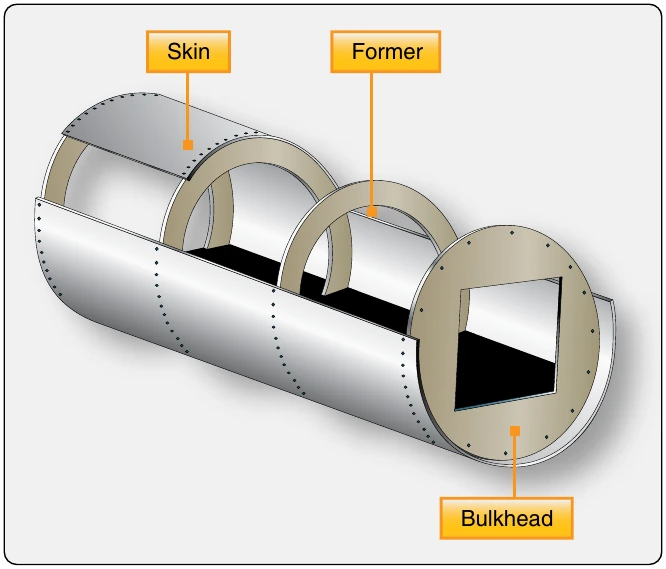
Other bracing between the longerons and stringers can also be used. Often referred to as web members, these additional support pieces may be installed vertically or diagonally. It must be noted that manufacturers use different nomenclature to describe structural members. For example, there is often little difference between some rings, frames, and formers. One manufacturer may call the same type of brace a ring or a frame. Manufacturer instructions and specifications for a specific aircraft are the best guides.
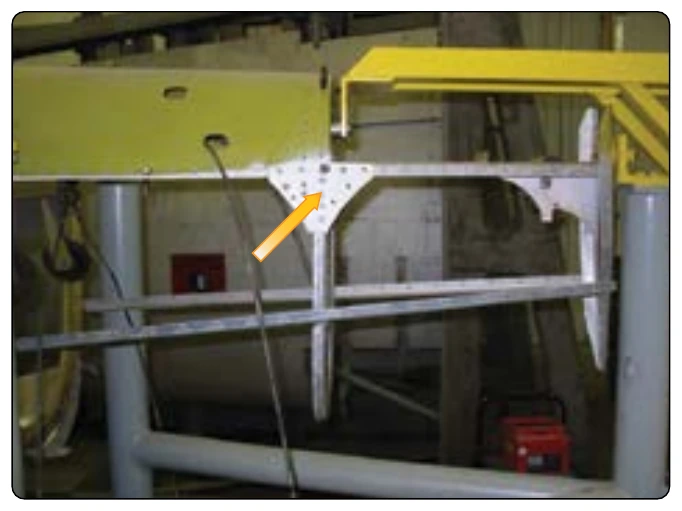
The semimonocoque fuselage is constructed primarily of alloys of aluminum and magnesium, although steel and titanium are sometimes found in areas of high temperatures. Individually, not one of the aforementioned components is strong enough to carry the loads imposed during flight and landing. But, when combined, those components form a strong, rigid framework. This is accomplished with gussets, rivets, nuts and bolts, screws, and even friction stir welding. A gusset is a type of connection bracket that adds strength. [Figure 1-18]
To summarize, in semimonocoque fuselages, the strong, heavy longerons hold the bulkheads and formers, and these, in turn, hold the stringers, braces, web members, etc. All are designed to be attached together and to the skin to achieve the full-strength benefits of semimonocoque design. It is important to recognize that the metal skin or covering carries part of the load. The fuselage skin thickness can vary with the load carried and the stresses sustained at a particular location.
The advantages of the semimonocoque fuselage are many. The bulkheads, frames, stringers, and longerons facilitate the design and construction of a streamlined fuselage that is both rigid and strong. Spreading loads among these structures and the skin means no single piece is failure critical. This means that a semimonocoque fuselage, because of its stressed-skin construction, may withstand considerable damage and still be strong enough to hold together.
Fuselages are generally constructed in two or more sections. On small aircraft, they are generally made in two or three sections, while larger aircraft may be made up of as many as six sections or more before being assembled.
Reinforced Shell Type
The reinforced shell has the skin reinforced by a complete framework of structural members.
Pressurization
Many aircraft are pressurized. This means that air is pumped into the cabin after takeoff and a difference in pressure between the air inside the cabin and the air outside the cabin is established. This differential is regulated and maintained. In this manner, enough oxygen is made available for passengers to breathe normally and move around the cabin without special equipment at high altitudes.
Pressurization causes significant stress on the fuselage structure and adds to the complexity of design. In addition to withstanding the difference in pressure between the air inside and outside the cabin, cycling from unpressurized to pressurized and back again on each flight causes metal fatigue. To deal with these impacts and the other stresses of flight, nearly all pressurized aircraft are semimonocoque in design. Pressurized fuselage structures undergo extensive periodic inspections to ensure that any damage is discovered and repaired. Repeated weakness or failure in an area of structure may require that section of the fuselage be modified or redesigned.
Wings
Wing Configurations
Wings are airfoils that, when moved rapidly through the air, create lift. They are built in many shapes and sizes. Wing design can vary to provide certain desirable flight characteristics. Control at various operating speeds, the amount of lift generated, balance, and stability all change as the shape of the wing is altered. Both the leading edge and the trailing edge of the wing may be straight or curved, or one edge may be straight and the other curved. One or both edges may be tapered so that the wing is narrower at the tip than at the root where it joins the fuselage. The wing tip may be square, rounded, or even pointed. Figure 1-19 shows a number of typical wing leading and trailing edge shapes.
The wings of an aircraft can be attached to the fuselage at the top, mid-fuselage, or at the bottom. They may extend perpendicular to the horizontal plane of the fuselage or can angle up or down slightly. This angle is known as the wing dihedral. The dihedral angle affects the lateral stability of the aircraft. Figure 1-20 shows some common wing attach points and dihedral angle.