
Chapter 11
Communication & Navigation
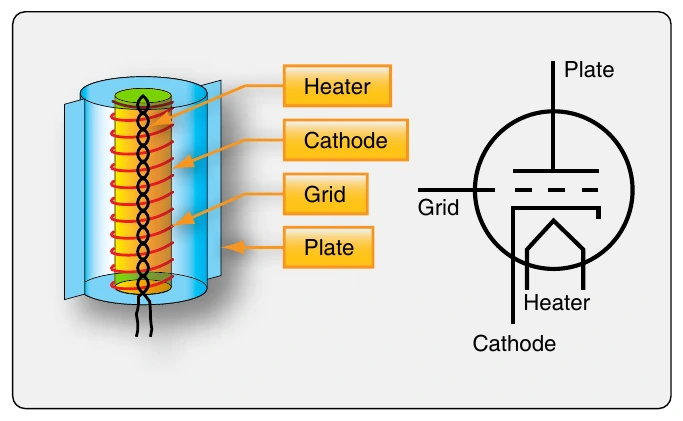
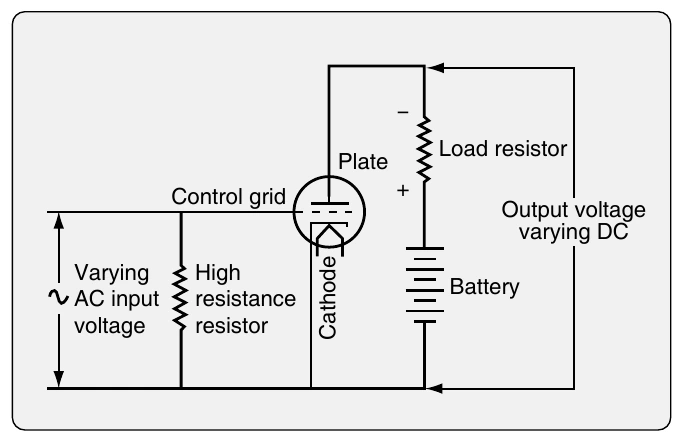
Figure 11-9 illustrates a triode in a simple circuit. AC voltage input is applied to the grid. A high-resistance resistor is used so that only minimum voltage passes through to the grid. As this small AC input voltage varies, the amount of DC output in the cathode-plate circuit also varies. When the input signal is positive, the grid is positive. This aids in drawing electrons from the cathode to the plate. However, when the AC input signal cycles to negative, the grid becomes negatively charged and flow from the cathode to the plate is cut off with the help of the negatively charged grid that repels the electrons on the cathode.
Tetrodes
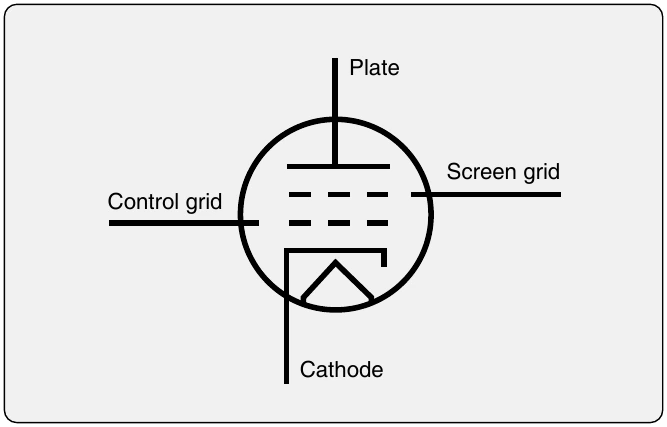
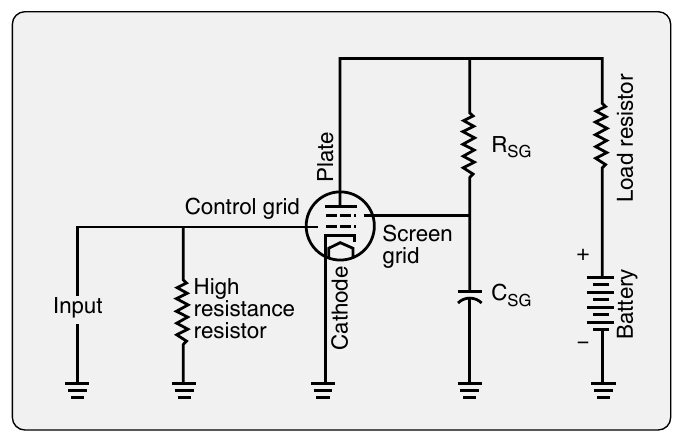
A tetrode vacuum tube electron control valve has four elements. In addition to the cathode, plate, and grid found in a triode, a tetrode also contains a screen grid. The cathode and plate of a vacuum tube electron control valve can act as a capacitor. At high frequencies, the capacitance is so low that feedback occurs. The output in the plate circuit feeds back into the control grid circuit. This causes an oscillation generating AC voltage that is unwanted. By placing a screen grid between the anode and the control grid windings, this feedback and the inter-electrode capacitive effect of the anode and cathode are neutralized. [Figure 11-10]
Figure 11-11 illustrates a tetrode in a circuit. The screen grid is powered by positive DC voltage. The inter-electrode capacitance is now between the screen grid and the plate. A capacitor is located between the screen grid and ground. AC feedback generated in the screen grid goes to ground and does not oscillate. This allows use of the tetrode at higher frequencies than a triode.
Pentodes
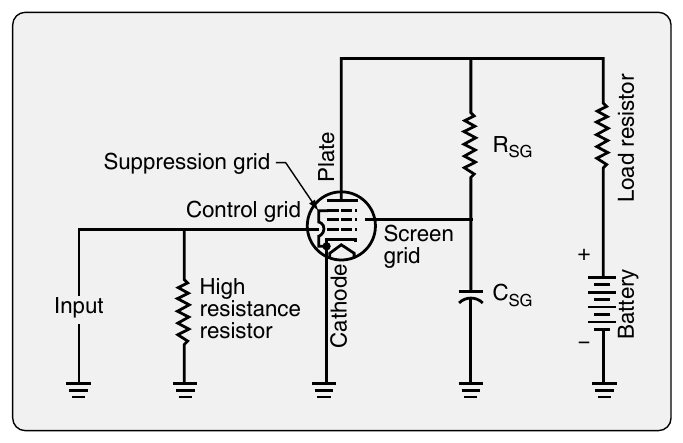
The plate in a vacuum tube can have a secondary emission that must be controlled. When electrons flow from the cathode through the control grid and screen grid to the plate, they can arrive at such high velocity that some bounce off. Therefore, the tendency is for those electrons to be attracted to the positively charged screen grid. The screen grid is not capable of handling large amounts of current without burning up. To solve this problem, a third grid is constructed between the plate and the screen grid. Called a suppression grid, it is charged negatively so that secondary electron flow from the plate is repelled by the negative charge back toward the plate and is not allowed to reach the screen grid. The five-element pentode is especially useful in high-power circuits where secondary emissions from the plate are high. [Figure 11-12]
Solid-State Devices
Solid-state devices began replacing vacuum tube electron control valves in the late 1950s. Their long life, reliability, and resilience in harsh environments make them ideal for use in avionics.
Semiconductors
The key to solid-state electronic devices is the electrical behavior of semiconductors. To understand semiconductors, a review of what makes a material an insulator or a conductor follows. Then, an explanation for how materials of limited conductivity are constructed and some of their many uses is explained. Semiconductor devices are the building blocks of modern electronics and avionics.
An atom of any material has a characteristic number of electrons orbiting the nucleus of the atom. The arrangement of the electrons occurs in somewhat orderly orbits called rings or shells. The closest shell to the nucleus can only contain two electrons. If the atom has more than two electrons, they are found in the next orbital shell away from the nucleus. This second shell can only hold eight electrons. If the atom has more than eight electrons, they orbit in a third shell farther out from the nucleus. This third shell is filled with eight electrons and then a fourth shell starts to fill if the element still has more electrons. However, when the fourth shell contains eight electrons, the number of electrons in the third shell begins to increase again until a maximum of 18 is reached. [Figure 11-13]
The outer most orbital shell of any atom’s electrons is called the valence shell. The number of electrons in the valence shell determines the chemical properties of the material. When the valence shell has the maximum number of electrons, it is complete, and the electrons tend to be bound strongly to the nucleus. Materials with this characteristic are chemically stable. It takes a large amount of force to move the electrons in this situation from one atom valence shell to that of another. Since the movement of electrons is called electric current, substances with complete valence shells are known as good insulators because they resist the flow of electrons (electricity). [Figure 11-14]
In atoms with an incomplete valence shell, that is, those without the maximum number of electrons in their valence shell, the electrons are bound less strongly to the nucleus. The material is chemically disposed to combine with other materials or other identical atoms to fill in the unstable valence configuration and bring the number of electrons in the valence shell to maximum. Two or more substances may share the electrons in their valence shells and form a covalent bond. A covalent bond is the method by which atoms complete their valence shells by sharing valence electrons with other atoms.
Electrons in incomplete valence shells may also move freely from valence shell to valence shell of different atoms or compounds. In this case, these are known as free electrons. As stated, the movement of electrons is known as electric current or current flow. When electrons move freely from atom to atom or compound to compound, the substance is known as a conductor. [Figure 11-15]