
Chapter 12
Hydraulic & Pneumatic Power Systems
Nose Gear Isolation Valve
The nose gear isolation valve opens for any of these conditions:
- Airspeed is less than 60 knots.
- Pump pressures for ACMP C2, ADP C1, ADP C2, and the RAT is less than 1,200 psi for 30 seconds.
- Left and right engine rpm is above idle, left and right EDP pressure is more than 2,400 psi, and the NLG is not up, the NLG doors are not closed, or the landing gear lever is not up for 30 seconds.
The first condition permits the flight crew to operate the NLG steering when airspeed is less than 60 knots (decreased rudder control authority during taxi). The second condition permits operation of the NLG actuation and steering if the hydraulic leak is in the part of the center hydraulic system isolated by the reserve isolation valve. The third condition permits operation of the NLG actuation and steering if there has not been an engine burst and the other hydraulic systems are pressurized. The nose gear isolation valve opens when pressure is necessary at the NLG. If the NLG is not fully retracted or the NLG doors are not closed, the nose gear isolation valve opens to let the NLG complete the retraction. When the landing gear lever is moved to the down position, the nose gear isolation valve opens to let the NLG extend with center system pressure.
Central Hydraulic System Reset
Both valves open again automatically when the center system quantity is more than 0.70 and airspeed is less than 60 knots for 5 seconds. Both valves also reset when the center system quantity is more than 0.70 and both engines and both engine-driven pumps operate normally for 30 seconds. [Figure 12-69]
Aircraft Pneumatic Systems
Some aircraft manufacturers have equipped their aircraft with a high pressure pneumatic system (3,000 psi) in the past. The last aircraft to utilize this type of system was the Fokker F27. Such systems operate a great deal like hydraulic systems, except they employ air instead of a liquid for transmitting power. Pneumatic systems are sometimes used for:
- Brakes.
- Opening and closing doors.
- Driving hydraulic pumps, alternators, starters, water injection pumps, etc.
- Operating emergency devices.
Both pneumatic and hydraulic systems are similar units and use confined fluids. The word confined means trapped or completely enclosed. The word fluid implies such liquids as water, oil, or anything that flows. Since both liquids and gases flow, they are considered as fluids; however, there is a great deal of difference in the characteristics of the two. Liquids are practically incompressible; a quart of water still occupies about a quart of space regardless of how hard it is compressed. But gases are highly compressible; a quart of air can be compressed into a thimbleful of space. In spite of this difference, gases and liquids are both fluids and can be confined and made to transmit power. The type of unit used to provide pressurized air for pneumatic systems is determined by the system’s air pressure requirements.
High-Pressure Systems
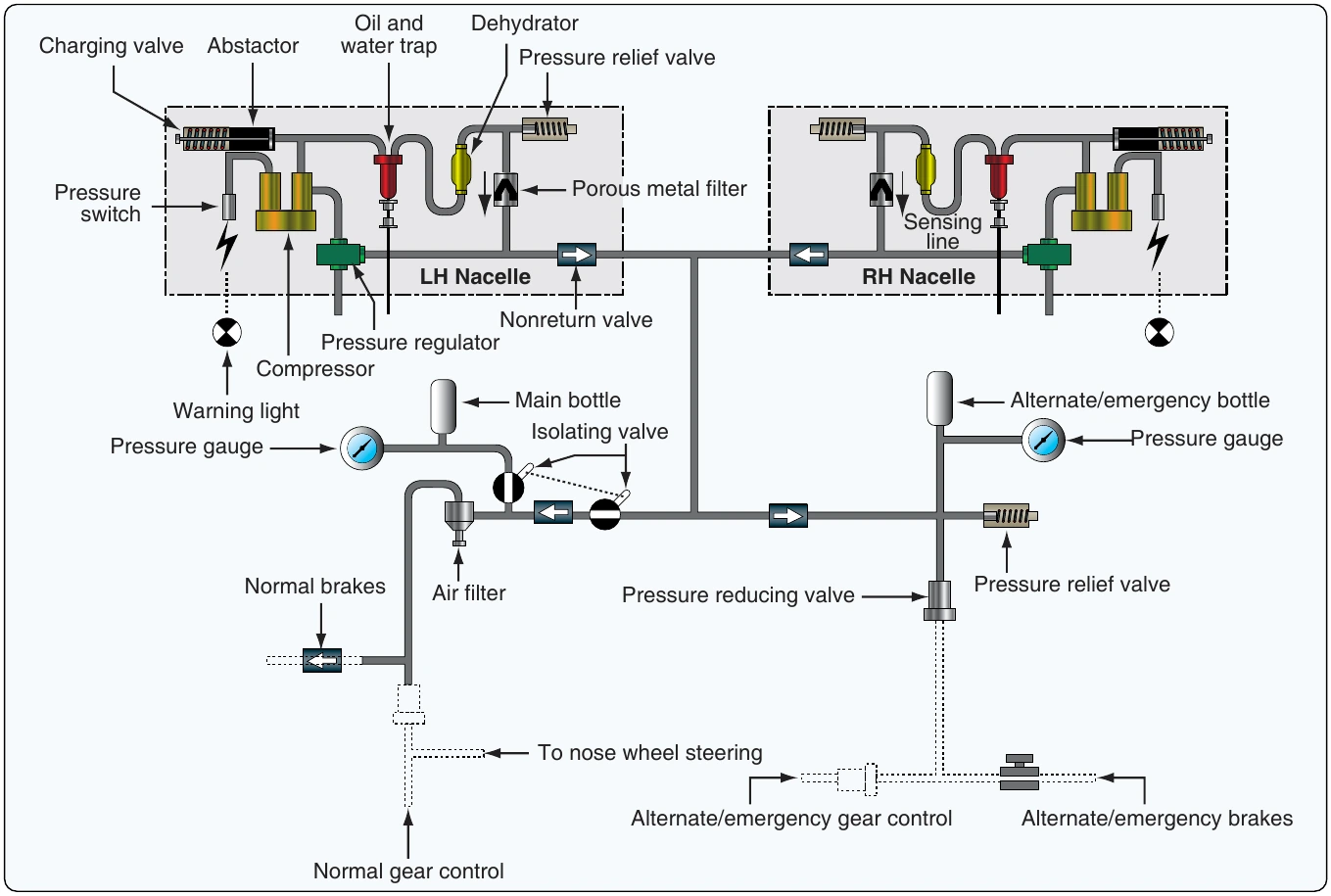
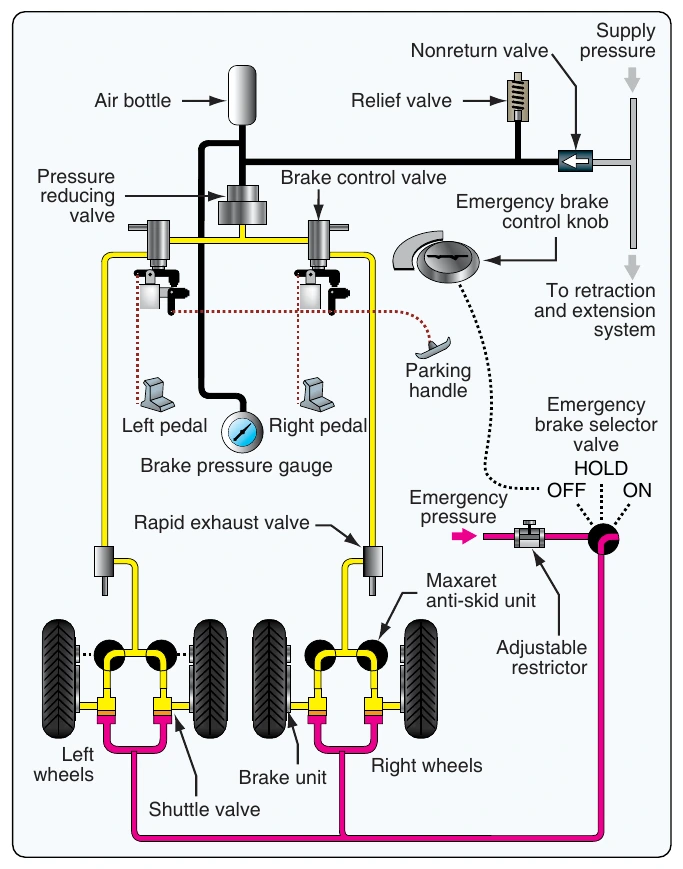
For high-pressure systems, air is usually stored in metal bottles at pressures ranging from 1,000 to 3,000 psi, depending on the particular system. [Figure 12-70] This type of air bottle has two valves, one of which is a charging valve. A ground-operated compressor can be connected to this valve to add air to the bottle. The other valve is a control valve. It acts as a shutoff valve, keeping air trapped inside the bottle until the system is operated. Although the high-pressure storage cylinder is light in weight, it has a definite disadvantage. Since the system cannot be recharged during flight, operation is limited by the small supply of bottled air. Such an arrangement cannot be used for the continuous operation of a system. Instead, the supply of bottled air is reserved for emergency operation of such systems as the landing gear or brakes. The usefulness of this type of system is increased, however, if other air-pressurizing units are added to the aircraft. [Figure 12-71]
Pneumatic System Components
Pneumatic systems are often compared to hydraulic systems, but such comparisons can only hold true in general terms. Pneumatic systems do not utilize reservoirs, hand pumps, accumulators, regulators, or engine-driven or electrically driven power pumps for building normal pressure. But similarities do exist in some components.
Air Compressors
On some aircraft, permanently installed air compressors have been added to recharge air bottles whenever pressure is used for operating a unit. Several types of compressors are used for this purpose. Some have two stages of compression, while others have three, depending on the maximum desired operating pressure.
Relief Valves
Relief valves are used in pneumatic systems to prevent damage. They act as pressure limiting units and prevent excessive pressures from bursting lines and blowing out seals.