Chapter 14
Aircraft Fuel Systems
Fuel Storage Refilling or Recharging System
Each fuel storage refilling or recharging system must be designed to prevent improper refilling or recharging; prevent contamination of the fuel stored during likely operating conditions; and prevent the occurrence of any hazard to the airplane or to persons during refilling or recharging.
Types of Aviation Fuel
Each aircraft engine is designed to burn a certain fuel. Use only the fuel specified by the manufacturer. Mixing fuels is not permitted. There are two basic types of fuel discussed in this section: reciprocating-engine fuel (also known as gasoline or AVGAS) and turbine-engine fuel (also known as jet fuel or kerosene).
Reciprocating Engine Fuel—AVGAS
Reciprocating engines burn gasoline, also known as AVGAS. It is specially formulated for use in aircraft engines. Combustion releases energy in the fuel, which is converted into the mechanical motion of the engine. AVGAS of any variety is primarily a hydrocarbon compound refined from crude oil by fractional distillation. Aviation gasoline is different from the fuel refined for use in turbine-powered aircraft. AVGAS is very volatile and extremely flammable, with a low flash point. Turbine fuel is a kerosene-type fuel with a much higher flash point, so it is less flammable.
Aircraft engines must perform throughout a wide range of demanding conditions. They must be lightweight and produce significant power in a wide range of atmospheric and engine operating temperatures. The gasoline used must support uninterrupted combustion throughout this range and must truly burn rather than explode or detonate. This ensures maximum power derivation and minimal engine wear. Over the years, AVGAS has been available in different formulas. These mostly correlate to how much energy can be produced without the fuel detonating. Larger, high-compression engines require fuel with a greater amount of potential power production without detonation than smaller low-compression engines.
Volatility
One of the most important characteristics of an aircraft fuel is its volatility. Volatility is a term used to describe how readily a substance changes from liquid into a vapor. For reciprocating engines, highly volatile fuel is desired. Liquid gasoline delivered to the engine induction system carburetor must vaporize in the carburetor to burn in the engine. Fuel with low volatility vaporizes slowly. This can cause hard engine starting, slow warm-up, and poor acceleration. It can also cause uneven fuel distribution to the cylinders and excessive dilution of the oil in the crankcase in engines equipped with oil dilution systems. However, fuel can also be too volatile, causing detonation and vapor lock.
AVGAS is a blend of numerous hydrocarbon compounds, each with different boiling points and volatility. A straight chain of volatile compounds creates a fuel that vaporizes easily for starting, but also delivers power through the acceleration and power ranges of the engine.
Vapor Lock
Vapor lock is a condition in which AVGAS vaporizes in the fuel line or other components between the fuel tank and the carburetor. This typically occurs on warm days on aircraft with engine-driven fuel pumps that suck fuel from the tank(s). Vapor lock can be caused by excessively hot fuel, low pressure, or excessive turbulence of the fuel traveling through the fuel system. In each case, liquid fuel vaporizes prematurely and blocks the flow of liquid fuel to the carburetor.
Aircraft gasoline is refined to have a vapor pressure be between 5.5 pounds per square inch (psi) and 7.0 psi at 100 °F. At this pressure, an aircraft fuel system is designed to deliver liquid fuel to the carburetor when drawn out of the tank by an engine-driven fuel pump. But temperatures in the fuel system can exceed 100 °F under the engine cowl on a hot day. Fuel may vaporize before it reaches the carburetor, especially if it is drawn up a line under a low pressure, or if it swirls while navigating a sharp bend in the tubing. To make matters worse, when an aircraft climbs rapidly, the pressure on the fuel in the tank decreases while the fuel is still warm. This causes an increase in fuel vaporization that can also lead to vapor lock.
Various steps can be taken to prevent vapor lock. The use of boost pumps located in the fuel tank that force pressurized liquid fuel to the engine is most common.
Carburetor Icing
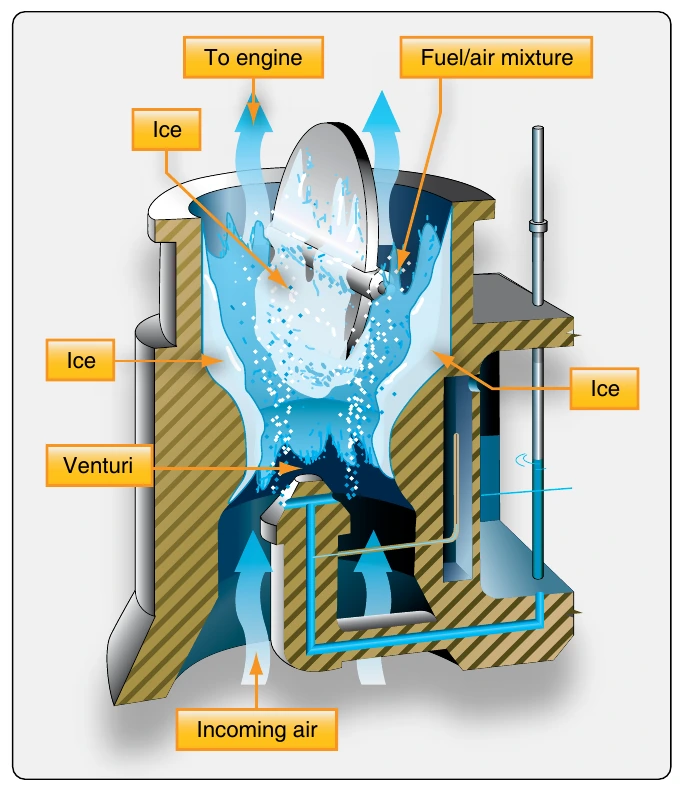
As fuel vaporizes, it draws energy from its surroundings to change state from a liquid to a vapor. This can be a problem if water is present. When fuel vaporizes in the carburetor, water in the fuel-air mixture can freeze and deposit inside the carburetor and fuel induction system. The fuel discharge nozzle, throttle valve, venturi, or simply the walls of the induction system all can develop ice. As the ice builds, it restricts the fuel-air flow and causes loss of engine power. In severe cases, the engine stops running. [Figure 14-5]
Carburetor icing is most common at ambient temperatures of 30–40 °F but can occur at much higher temperatures, especially in humid conditions. Most aircraft are equipped with carburetor heating to help eliminate this threat caused by the high volatility of the fuel and the presence of moisture. [Figure 14-6]