
Chapter 14
Aircraft Fuel Systems
Aromatic Fuels
The aviation gasoline market is a relatively small part of the overall gasoline market. AVGAS producers are few. In years past, when this was less the case, considerable quantities of aromatic hydrocarbons were sometimes added to increase the rich mixture performance of AVGAS. It was used mainly in high horsepower reciprocating engines, such as military and transport category aircraft. Special hoses and seals were required for use of aromatic fuels. These additives are no longer available.
Detonation
Detonation is the rapid, uncontrolled explosion of fuel due to high pressure and temperature in the combustion chamber. The fuel-air charge ignites and explodes before the ignition system spark lights it. Occasionally, detonation occurs when the fuel is ignited via the spark plug but explodes before it is finished burning.
The engine is not designed to withstand the forces caused by detonation. It is made to turn smoothly by having the fuel-air mixture burn in the combustion chamber and propagate directionally across the top of the piston. When it does so, a smooth transfer of the force developed by the burning fuel pushes the piston down. Detonation of fuel instead sends a shock wave of force against the top of the piston, which in turn is transferred through the piston to the piston pin, to the connecting rod, and to the crankshaft. Valve operation is also affected by this shock wave. In short, the explosion of fuel detonating in the combustion chamber transfers the energy contained in the fuel harshly throughout the entire engine, causing damage.
Aviation fuels are refined and blended to avoid detonation. Each has an ignition point and burn speed at specific fuel-air mixture ratios that manufacturers rely on to design engines that can operate without detonation. An engine experiencing detonation in the field should be investigated. A pinging or knocking sound is a sign of detonation. This is often more difficult to detect in an aircraft than in an automobile due to propeller tip noise. Detonation causes an increase in cylinder head temperature.
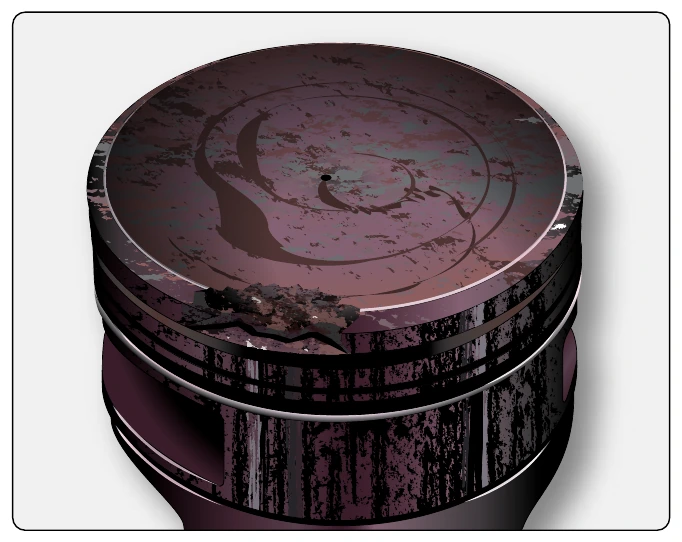
If ignored or allowed to continue, detonation can eventually lead to engine failure. Causes of detonation include incorrect fuel, already high engine temperature at high power settings, such as takeoff, preignition of the fuel, extended operations with an extremely lean mixture, and operation at high revolutions per minute (rpm) with low airspeed.
Surface Ignition & Preignition
A sharp deposit or incandescent hot spot in the combustion chamber can cause fuel to ignite before the spark plug lights it. Detonation can cause such an area to form as can a cracked spark plug insulator or a sharp valve edge. The result could be ignition of the fuel before the piston is at the proper place during its movement toward top dead center of the compression stroke. The extended burn period of the fuel can increase temperatures and pressure in the combustion chamber to the point at which the fuel detonates. The repeated incorrect flame propagation and detonation can cause serious engine damage and eventual engine failure. [Figure 14-7]
Maintenance personnel should ensure that the correct fuel is being used, and that the engine is being operated correctly. Spark plugs and valves should be checked for wear. Signs of deposits and detonation must also be investigated and addressed.
Octane & Performance Number Rating
Octane ratings and performance numbers are given to fuels to describe their resistance to detonation. Fuels with high critical pressure and high octane or performance numbers have the greatest resistance. A referencing system is used to rate the fuel. A mixture of two hydrocarbons, iso-octane (C8H18) and heptane (C7H16), is used. Various ratios of the two hydrocarbons in a mixture result in proportional antidetonation properties. The more iso-octane there is in the mixture, the higher its resistance is to detonation.
When a fuel has the same critical pressure as a reference mixture of these two hydrocarbons, it is said to have an octane rating that is the same as the percentage of the iso-octane in this reference mixture. An 80-octane fuel has the same resistance to detonation as an 80 percent iso-octane, 20 percent heptane mixture; a 90-octane fuel has the same resistance to detonation as a 90 percent iso-octane, 10 percent heptane mixture; and a 100-octane fuel has the same resistance to detonation as 100 percent pure iso-octane. So, by comparing a fuel’s tendency to detonate to reference mixtures of iso-octane and heptane, octane ratings from 80 to 100 can be established. The highest-octane fuel possible with this system of measurement is 100-octane fuel.
To increase antidetonation characteristics of fuel, substances can be added. Tetraethyl lead (TEL) is the most common additive that increases the critical pressure and temperature of a fuel. However, additional additives, such as ethylene dibromide and tricresyl phosphate, must be also be added so that the TEL does not leave solid deposits in the combustion chamber.
The amount of TEL added to a fuel can be increased to raise the antidetonation characteristics from 80 to the 100-octane level and higher. References to octane characteristics above 100 percent iso-octane are made by referencing the antidetonation properties of the fuel to a mixture of pure iso-octane and specific quantities of TEL. The specific mixtures of iso-octane and TEL are assigned arbitrary octane numbers above 100. In addition to increasing the antidetonation characteristics of a fuel, TEL also lubricates the engine valves.
Performance numbers are also used to characterize the antidetonation characteristics of fuel. A performance number consists of two numbers (e.g., 80/87, 100/130, 115/145) in which higher numbers indicate a higher resistance to detonation. The first number indicates the octane rating of the fuel in a lean fuel-air mixture, and the second number indicates the octane rating of the fuel in a rich mixture.
Due to the small size of the worldwide aviation gasoline market, a single 100 octane low-lead fuel (100LL) is desired as the only AVGAS for all aircraft with reciprocating engines. This presents problems in engines originally designed to run on 80/87 fuel; the low lead 100-octane fuel still contains more lead than the 80-octane fuel. Spark plug fouling has been common and lower times between overhaul have occurred. Other engines designed for 91/96 fuel or 100/130 fuel operate satisfactorily on 100LL, which contains 2 milliliters of TEL per gallon (enough to lubricate the valves and control detonation). For environmental purposes, AVGAS with no TEL is sought for the aviation fleet of the future.